On this page
Last updated: 29 September 2026.
KaryaFlow and RocketFlow can both appear in an Indian service business software shortlist, but they are built around different buying questions.
RocketFlow publicly positions itself as a low-code/no-code enterprise SaaS platform for digitizing many business processes. Its website says it offers 40+ preconfigured workflows, configurable websites or mobile sites, web admin portals, Android and iOS apps, customer service requests, inventory workflows, payments, billing, reporting, user hierarchy, approvals, integrations, and business-process automation.
KaryaFlow is more focused. It is built for Indian service businesses that need one operating workflow for owners, coordinators, managers, and technicians: complaints, jobs, attendance, geofence location context, technician mobile app updates, inventory, parts custody, GST invoices, payments, completion sheets, defective parts, reports, and owner dashboards.
Short answer: choose RocketFlow when your company wants a broader configurable business-process automation platform across many workflows. Choose KaryaFlow when your service business wants a focused India-first service-center system for jobs, technicians, inventory, GST billing, cash or UPI payment visibility, completion sheets, and daily owner control.
This comparison is written for CCTV service centers, AC and HVAC service teams, RO service companies, appliance service centers, electrical contractors, fire safety contractors, solar service teams, pest control companies, plumbing teams, facility management teams, and authorized service centers.
For a broader shortlist, read best field service management software options in India. If you are comparing configurable field operations platforms, also read KaryaFlow vs FieldEZ. If you are comparing service CRM tools, read ServiceCRM alternatives in India.
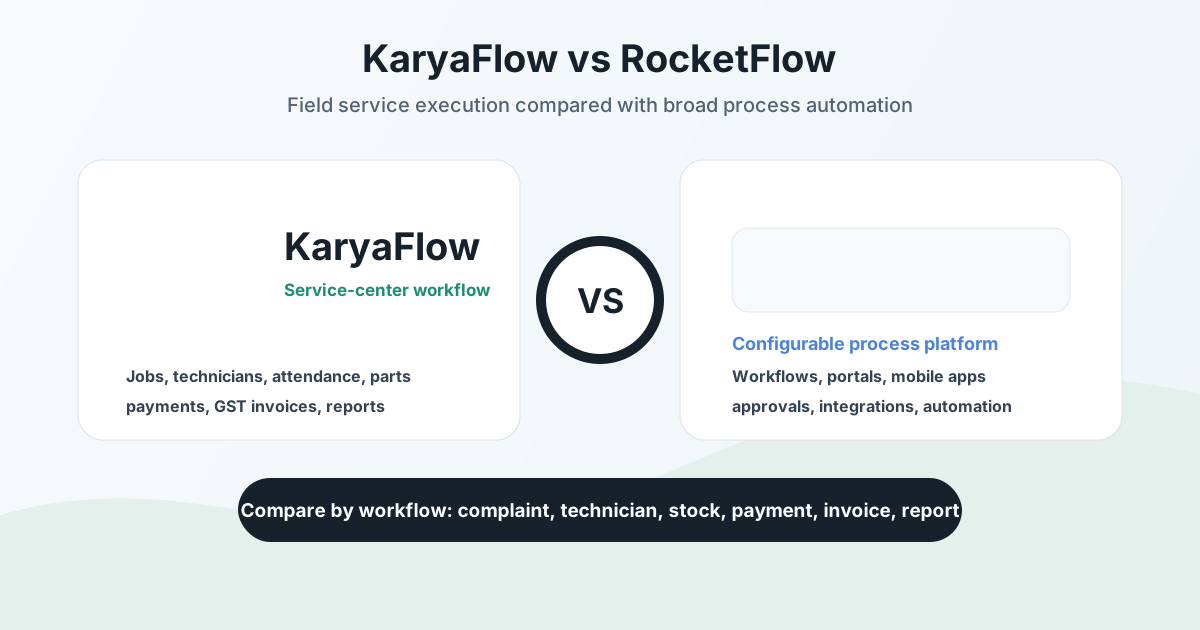 KaryaFlow vs RocketFlow logo comparison for Indian field service businesses
KaryaFlow is focused on service-center execution. RocketFlow is positioned around broader configurable process automation.
KaryaFlow vs RocketFlow logo comparison for Indian field service businesses
KaryaFlow is focused on service-center execution. RocketFlow is positioned around broader configurable process automation.
Direct answer
KaryaFlow is better than RocketFlow for Indian service businesses when the buyer's main problem is service-center execution: assigning technician jobs, tracking attendance and location context, recording mobile job cards, managing office stock and technician stock, collecting defective parts, preparing GST-ready invoices, and tracking cash, UPI, bank, cheque, and partial payments. RocketFlow is better suited when the buyer wants a broader low-code/no-code process digitization platform with configurable workflows across service management, logistics, fleet, inventory, finance, CRM, HR, approvals, websites, mobile apps, and integrations. The safest buying method is to demo one real service job in both systems from complaint intake to technician visit, part usage, payment status, invoice handoff, report export, and owner review.
Why this comparison matters now
Indian service owners are moving away from informal operations because WhatsApp groups, paper registers, phone calls, and Excel sheets do not scale when the team grows.
The shift is not theoretical. PayNearby's MSME Digital Index 2025 reported that over 73 percent of small businesses across semi-urban and rural India saw increased income or improved operational efficiency after adopting digital tools. The same report said 71 percent of respondents used smartphones as their primary business device, and 7 percent had started exploring AI-powered tools such as inventory apps, automated billing, and customer engagement platforms.
That is exactly the context where field service software becomes important. A service business does not only need software because software looks modern. It needs software because every unrecorded job, unverified visit, unbilled part, missed collection, and delayed invoice becomes money leakage.
Industry data points in the same direction:
| Fact | Why it matters for service owners | Source |
|---|---|---|
| McKinsey says tech-enabled field-force optimization can create productivity improvement of more than 10 percent when data, operating rhythm, and change management work together. | Software should not be just a dashboard. It should help owners change the daily workflow. | McKinsey |
| In one McKinsey field-service case, a platform helped sustain a previous 10 percent productivity gain and was expected to add another 5 to 10 percent technician productivity improvement. | A single operating record can reduce wasted manager time and technician inefficiency. | McKinsey |
| Salesforce surveyed technicians and tradespeople in 2025 and found they estimated losing more than seven hours per week to inefficient or low-value tasks like manual data entry and job summaries. | Admin work is not free. Every missing field update creates office follow-up time. | Salesforce |
| Salesforce's 2023 field-service data found 86 percent of decision makers at companies with field service teams believe those teams are critical to business growth. | Field service is not only a cost center. It affects repeat business, upsell, retention, and brand trust. | Salesforce |
| Deloitte's 2026 field-service research found 55 percent of field service leaders call advanced technology the top competitive differentiator. | Buyers increasingly compare service businesses by speed, visibility, and quality of execution. | Deloitte Digital |
| India's Ministry of Finance said UPI accounted for 81 percent of retail digital payment transactions in FY 2024-25. | Indian service software must handle UPI and payment status cleanly, not treat payment as an afterthought. | PIB |
| McKinsey found better parts planning in industrial contexts can reduce part shortages by 50 to 90 percent while reducing inventory by 15 to 35 percent. | Parts visibility matters because stockouts, overstocking, and technician-held inventory can burn cash. | McKinsey |
| The National Retail Federation reported retail shrink of USD 112.1 billion in 2022. The context is retail, but it shows how serious inventory loss can become when physical stock is not controlled. | Service businesses also need stock custody, unused return, and defective-part tracking, even if their exact leakage is different. | NRF |
These are industry benchmarks, not guaranteed KaryaFlow outcomes. The practical lesson is still strong: software creates value when it reduces invisible work, connects field data with billing, and gives owners a trustworthy operating record.
KaryaFlow vs RocketFlow at a glance
| Decision area | KaryaFlow | RocketFlow |
|---|---|---|
| Core positioning | India-first field service management software for service businesses | Low-code/no-code enterprise SaaS platform for business process digitization |
| Best fit | Technician-led service centers that need jobs, attendance, inventory, payments, GST invoices, and dashboards in one workflow | Businesses that want configurable workflows across service, logistics, fleet, inventory, finance, CRM, HR, approvals, and more |
| Owner system | Web app for owner/admin/manager control | Web admin portal and configurable process platform |
| Technician system | Technician mobile app for field work | Android and iOS apps are publicly mentioned by RocketFlow |
| Complaint intake | Complaint register is live. Website complaint widget is in development. WhatsApp complaint agent is available as an add-on service. | RocketFlow says customers can submit orders, bookings, or service requests through website/mobile channels and the admin portal can manage requests |
| Assignment | Manual assignment and structured dispatch are live. Auto-assignment should be treated as work in progress until confirmed in the product demo. | RocketFlow public content describes automated and algorithmic allocation/scheduling in field workflows; buyers should verify exact field-service setup |
| Attendance and location | Attendance with location check-in is included. Live GPS tracking through the day is an add-on. Geofence workflows can support office, project-site, and service-area attendance. | RocketFlow pages mention real-time tracking, geofencing, geo-based attendance, and mobile app attendance in several process pages |
| Inventory | Detailed service inventory: item code, HSN, GST, images, purchase/selling price, opening stock, minimum stock alerts, godown stock, technician stock, usage, unused return, and defective collection | RocketFlow publicly mentions inventory management, inventory allocation, onsite inventory, parts ordering, and inventory workflows |
| Defective parts | Defective part collection is available in KaryaFlow. Technician and manager/admin can see defective parts by technician. | Not clearly described on the public field-service page; verify in demo |
| Payments | Cash, UPI, bank, cheque, and partial payment tracking are supported in the service workflow. Admin can confirm payment status. | RocketFlow publicly mentions payments, billing, invoices, payment collections, wallets, and payment gateway integration in its platform/process content |
| GST invoice workflow | GST/tax invoice support is part of KaryaFlow's service workflow. Parts used and service details can move from job completion to invoice. | RocketFlow publicly mentions billing, invoice, Tally compatibility, QuickBooks integration, and financial workflows |
| Pricing clarity | Public INR pricing: Starter INR 990/month up to 10 users, Growth INR 2,673/month up to 30 users, Enterprise quote; GST extra. Every standard module included. | Public pages discuss plans, free trial, flexible pricing, custom needs, and contact sales. Buyers should confirm field-service package pricing directly. |
| Data ownership | KaryaFlow reports can be viewed and exported. The product philosophy is that your data belongs to you. | RocketFlow says users can download reports and view dashboards. Confirm export scope and formats in contract. |
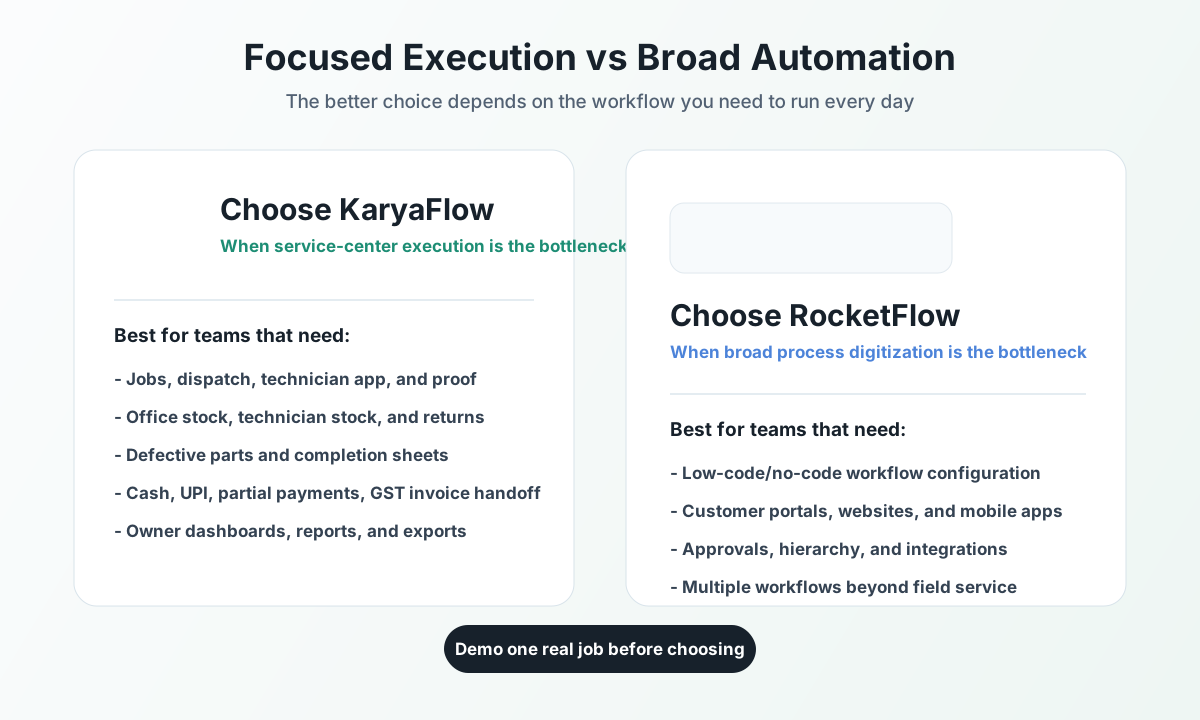 Decision map comparing KaryaFlow focused execution with RocketFlow broad automation
The right choice depends on whether the buyer needs focused service execution or a wider process digitization platform.
Decision map comparing KaryaFlow focused execution with RocketFlow broad automation
The right choice depends on whether the buyer needs focused service execution or a wider process digitization platform.
The real difference: focused service execution vs broad process automation
The strongest RocketFlow angle is breadth. Its public homepage calls RocketFlow a low/no-code enterprise SaaS platform and says it offers 40+ preconfigured business workflows. Its public content describes business processes across service management, logistics, pick-and-drop, supply chain, fleet, finance, inventory, ecommerce, healthcare, waste, CRM, HR, approvals, reporting, websites, mobile apps, web portals, user hierarchy, Tally compatibility, QuickBooks integration, and notifications across SMS, email, push, WhatsApp, and more.
That is valuable when the buyer wants a configurable digital operations platform.
The strongest KaryaFlow angle is focus. KaryaFlow does not need to win by claiming to be a bigger low-code platform. It should win by proving that it understands Indian service-center work better:
- the owner wants to know which jobs are open today;
- the coordinator needs fast job creation and assignment;
- the technician needs a simple mobile app;
- the manager wants attendance and location context;
- the store wants parts movement to be visible;
- accounts wants invoice-ready job data;
- the owner wants pending collections, stock movement, job completion, expenses, and reports without calling five people.
For service centers, the question is not "which product has more process types?" The better question is: which product will become the daily source of truth from complaint to cash?
Which product is better for Indian service teams?
KaryaFlow is the better fit when the buyer's core work is technician-led service execution.
That includes businesses where the daily work looks like this:
- A customer complaint, service call, AMC visit, installation request, or project task is recorded.
- The owner or coordinator assigns the work to a technician.
- The technician reaches the office, project site, customer site, home-start area, or service area and marks attendance according to the rule.
- The technician completes the job from the mobile app with service notes, parts used, photos, signatures, payment status, and completion sheet.
- The office checks part usage, defective collection, unused returns, service charges, and payment.
- The invoice or GST/tax invoice is created from verified job data.
- The owner sees reports and exports the data when needed.
This workflow is especially useful for technician app, inventory and billing software, technician assigned parts custody software, GST-compliant invoices with on-site UPI payments, and CCTV service center attendance management software.
RocketFlow may be better when the buyer's core need is broader process digitization across many departments and workflows. If the company wants one configurable platform for service, logistics, fleet, HR, finance, inventory, approvals, and custom process mapping, RocketFlow deserves a serious demo.
Where KaryaFlow is stronger
KaryaFlow is stronger when the buyer wants a service-center operating system rather than a broad process builder.
1. KaryaFlow is built around Indian service-center edge cases
Many Indian service businesses do not struggle because they lack a CRM. They struggle because operations leak between small handoffs:
- office job assignment happens in WhatsApp;
- technician attendance is based on trust;
- project-site attendance needs geofencing, not a biometric machine;
- customer visit proof stays in photos and chat;
- parts used are not connected to technician stock;
- defective parts are collected but not reconciled;
- UPI payment screenshots are not tied to the job;
- invoices are delayed because accounts waits for field data;
- the owner cannot see what happened without calling the team.
KaryaFlow's product design is closer to this workflow. It has an owner/admin web app and a technician mobile app, so the office and field team do not need the same interface.
2. KaryaFlow has more practical service inventory detail
Inventory is one of the biggest hidden leaks in service businesses. A service center may think it has stock in the godown, but some stock is in technician bags, some was used on jobs, some was returned unused, and some was collected as defective.
KaryaFlow's inventory workflow can handle:
- item code;
- HSN code;
- product details;
- product images;
- purchase price;
- selling price;
- GST;
- opening stock;
- minimum stock alerts;
- office or godown stock as global stock;
- technician stock issued from global inventory;
- job-level part usage;
- unused return and admin receiving;
- defective part collection;
- reports and export.
When a technician uses a part on a job and completes the work, that part is recorded in the job context and reflected for admin review, completion sheet, and invoice preparation. This matters because many service businesses lose money not from one big fraud, but from hundreds of small missing part movements.
Read the deeper workflow in technician app, inventory and billing software.
3. KaryaFlow connects technician work to billing and payment
For Indian service businesses, billing does not start in accounts. It starts at the job site.
The technician knows:
- what work was done;
- which part was used;
- whether the part is billable, warranty, AMC-covered, or internal cost;
- whether the customer paid cash, UPI, bank, cheque, partial payment, or later;
- whether the customer signed the completion sheet.
KaryaFlow is designed so this job information can move toward GST/tax invoice creation and payment confirmation. Admin can see the payment collection and confirm or mark payment status from the dashboard.
That is important because UPI is now mainstream in India. The Ministry of Finance said UPI accounted for 81 percent of retail digital payment transactions in FY 2024-25. A field service product for India must therefore connect job closure with cash, UPI, pending amount, partial amount, and invoice status.
4. KaryaFlow pricing is public and simple to explain
KaryaFlow's public pricing page says:
- Starter: INR 990/month for up to 10 users, GST extra;
- Growth: INR 2,673/month for up to 30 users, GST extra;
- Enterprise: written quote for 31+ users;
- every standard module is included;
- plans differ by how many people log in;
- attendance with location check-in is included;
- live GPS tracking through the day is an add-on.
This is useful for small and growing Indian teams because the owner can understand the monthly starting point before a sales call.
RocketFlow may still be affordable or flexible, but buyers should confirm the exact field-service package price, implementation cost, custom workflow cost, user pricing, integration scope, and support terms directly.
5. KaryaFlow separates live modules, add-ons, and roadmap items
This matters during a software demo because buyers should know exactly what they can use today and what needs a separate setup or future release.
KaryaFlow's core job, technician, attendance, inventory, invoice, payment, report, and completion workflow should be demonstrated live. The website complaint booking widget is in development. It is intended to let customers submit details such as name, phone, and address from a client website, then move the complaint into the KaryaFlow job flow after owner confirmation and technician assignment.
The WhatsApp Complaint Agent is an add-on service. A customer can send a "Hi" message, and the WhatsApp flow can collect complaint details and use existing customer data where available.
Auto-assignment is a work-in-progress feature. Buyers who need auto-assignment immediately should verify the current status in a live product demo.
Where RocketFlow is stronger
RocketFlow is stronger when the buyer needs broad configurable process automation, not only field service execution.
Based on its public pages, RocketFlow deserves serious evaluation when the company wants:
- 40+ prebuilt workflows;
- low-code/no-code process digitization;
- customer-facing website or mobile site;
- web admin portal;
- Android and iOS apps;
- configurable user hierarchy;
- approval workflows;
- multi-location management;
- inventory workflows;
- finance workflows;
- payment collections;
- notifications across SMS, email, WhatsApp, push, and other channels;
- Tally or QuickBooks integration;
- service, logistics, fleet, CRM, HR, and other business workflows in one platform.
That is not a small advantage. If a business owner wants to digitize many departments and processes, RocketFlow may be a better starting point than a focused service-center system.
The caution is implementation fit. A broad platform can be powerful, but the buyer must check whether the exact service workflow is simple enough for daily use by the coordinator, technician, store, accounts team, and owner.
Complaint intake comparison
Complaint intake is where service quality starts. A missed complaint becomes a missed job, delayed invoice, angry customer, and bad renewal conversation.
KaryaFlow's current strength is the structured complaint register and job workflow. The upcoming website complaint widget can make this stronger by allowing a client website to collect complaint details and pass them into KaryaFlow. The WhatsApp Complaint Agent add-on can support businesses that want customers to book complaints inside WhatsApp instead of calling the office.
RocketFlow publicly says it can provide a website or mobile site and web admin portal for managing orders, bookings, or service requests. That means RocketFlow may be strong for customer-facing intake, especially when the buyer wants configurable forms and process flows.
The demo question should be:
Can the product turn a real customer complaint into an assigned technician job without creating a second WhatsApp tracker?
Ask both vendors to show:
- customer name and phone capture;
- repeat customer lookup;
- address and site details;
- complaint type;
- priority;
- assignment;
- technician mobile view;
- status updates;
- escalation or pending reason;
- payment and invoice handoff after closure.
If complaint intake is important to you, also read WhatsApp complaint registration system.
Inventory comparison: where money leakage usually hides
Inventory is often the strongest reason to choose a focused field service product.
A generic inventory workflow may show stock in and stock out. A service-center workflow must show custody.
For example, a CCTV service center may create a stock item for a DVR, power supply, camera, cable roll, connector, hard disk, or adapter. The item needs code, HSN, GST, purchase price, selling price, opening stock, and minimum stock. Then the office issues parts to a technician. The technician uses one item on a job, returns one unused item, and collects one defective item from the customer site.
The owner needs answers:
- Which technician had the part?
- Which job consumed it?
- Was it billable?
- Was it warranty-covered?
- Was it added to the completion sheet?
- Did the invoice include it?
- Did unused stock return to the godown?
- Is the defective item visible in the defective section?
- Is low stock triggering an alert?
KaryaFlow is designed around this practical service inventory chain: godown stock, technician stock, job usage, unused return, defective collection, invoice context, and reports.
RocketFlow publicly mentions inventory workflows, inventory allocation, onsite inventory management, and parts ordering. That is useful, but a buyer should ask RocketFlow to prove the exact technician-stock and defective-return flow in a service job demo.
Payment comparison: cash, UPI, bank, cheque, and partial payments
For many Indian service businesses, payment leakage is not only non-payment. It is unclear payment status.
The customer may pay:
- full cash at site;
- UPI to technician or company account;
- bank transfer later;
- cheque for a larger project;
- partial amount now and balance later;
- nothing because it is AMC, warranty, or internal free service.
KaryaFlow supports this practical payment context. The technician can record collection, and admin can review and confirm payment status from the dashboard. For bigger projects, bank and cheque workflows matter. For daily jobs, UPI and cash visibility matter.
RocketFlow also publicly mentions payments, billing, invoices, payment collections, wallets, and payment gateway integration. That may be strong for broader payment operations, but buyers should verify whether field-service payment status ties directly to job closure, technician collection, GST invoice, and accounts review.
The demo question should be:
Can the owner see completed jobs that are not fully paid, partly paid, or waiting for admin confirmation?
For a deeper workflow, read technician cash and UPI collection tracking software.
Attendance and field visibility comparison
Attendance is not one problem. In service teams, attendance can happen in multiple valid places.
A CCTV, AC, RO, appliance, electrical, or fire safety business may need:
- office-location attendance when technicians report to office;
- project-site attendance for long-running installation or maintenance projects;
- home or service-area attendance when technicians start directly from their local area;
- job-site proof when a technician reaches the customer;
- overtime calculation when work crosses the normal day;
- leave and attendance reports for admin review.
Biometric machines can work for office attendance, but they fail when the work shifts to project locations or distributed sites. Geofence attendance from smartphones is more flexible because technicians already carry phones and phone biometrics can support device-level access.
KaryaFlow supports service-center attendance thinking: office location, project location, home or service-area rules, geofence context, leave, overtime review, and admin dashboard visibility.
RocketFlow public pages also mention geo-based attendance, geofencing, real-time tracking, and mobile attendance in field workflows. Buyers should compare both products by the same real attendance examples, not only by feature names.
Read the full service-center attendance breakdown in CCTV service center attendance management software.
Invoice and completion sheet comparison
For a service business, a completion sheet is often the missing bridge between technician work and invoice.
The completion sheet should show:
- customer details;
- site details;
- job or complaint number;
- issue reported;
- technician diagnosis;
- work done;
- parts used;
- defective parts collected;
- photos or proof;
- customer approval;
- payment status;
- GST/tax invoice context.
KaryaFlow allows the technician side to generate job completion sheets and supports GST/tax invoice creation from the job, parts, and service details. This makes KaryaFlow strong when the business wants accounts to stop reconstructing invoices from chat messages.
RocketFlow publicly mentions integrated billing and invoicing, invoice billing, payment collections, and financial workflows. The buyer should confirm whether the field completion proof and invoice handoff work the way their accounts team needs.
The practical test is simple:
After the technician closes the job, can accounts create the correct invoice without calling the technician?
Demo script: compare both with the same job
Do not compare KaryaFlow and RocketFlow only from the sales deck. Use one realistic service job in both demos.
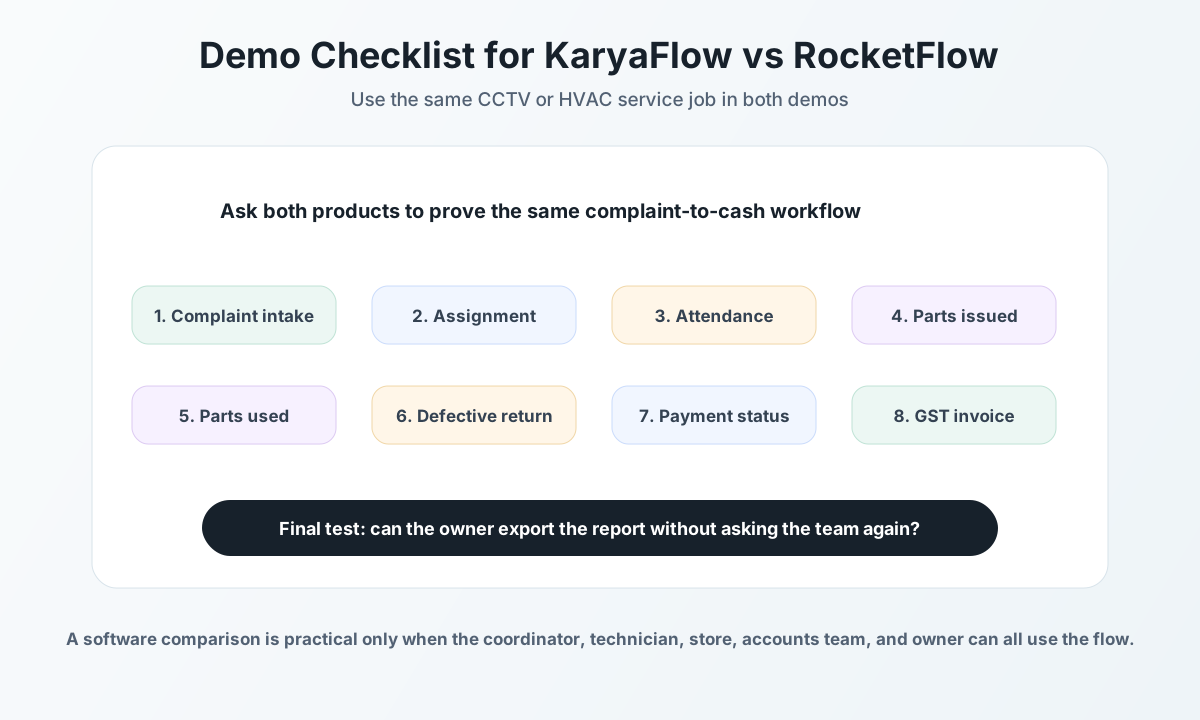 Demo checklist for comparing KaryaFlow and RocketFlow
Use the same complaint-to-cash workflow in both demos before choosing.
Demo checklist for comparing KaryaFlow and RocketFlow
Use the same complaint-to-cash workflow in both demos before choosing.
Use this example:
A CCTV customer reports that two cameras are offline. The office records the complaint, checks customer history, assigns a technician, tracks attendance and site arrival, issues parts from godown stock to technician stock, technician uses one power supply, collects one defective part, records work proof, collects partial UPI payment, generates a completion sheet, and the office prepares the GST invoice for service plus parts.
Ask both products to show:
- Customer complaint intake.
- Repeat customer lookup.
- Job assignment.
- Technician mobile view.
- Attendance or location rule.
- Job status updates.
- Stock issue to technician.
- Part used on job.
- Unused part return.
- Defective part collection.
- Payment status: cash, UPI, partial, pending, bank, or cheque.
- Job completion sheet.
- GST/tax invoice handoff.
- Owner dashboard.
- Report export.
- Pricing and onboarding explanation.
Score the demo with five people:
- owner;
- coordinator;
- technician;
- store or inventory person;
- accounts/admin person.
If only the owner likes the dashboard but the technician, store, and accounts team still need WhatsApp, the software will not become the source of truth.
Which is better for CCTV service centers?
KaryaFlow is the better starting point for CCTV service centers that need technician attendance, installation jobs, AMC visits, camera inventory, DVR/NVR parts, defective collection, project-site work, payment tracking, completion sheets, and GST invoices.
CCTV work has several special needs:
- technicians may report to office when they need tools or parts;
- project installation work may run for days or weeks;
- AMC visits need site-wise equipment history;
- parts like adapters, power supplies, cables, cameras, DVRs, and hard disks need custody tracking;
- defective recovery matters for warranty or replacement;
- completion proof matters because customers may question whether all cameras were checked.
KaryaFlow fits these edge cases because it is a service-center workflow, not only a generic process app. RocketFlow may still fit CCTV teams if they want broader low-code process digitization, customer-facing forms, and configurable workflows across other business areas.
Which is better for AC, HVAC, RO, and appliance service?
KaryaFlow is usually the sharper fit when the team wants practical service execution:
- service complaint;
- technician assignment;
- attendance and location context;
- job card;
- photo proof;
- parts used;
- refrigerant, filter, PCB, motor, pump, or consumable tracking;
- defective part return;
- AMC or warranty context;
- cash/UPI payment status;
- GST invoice handoff;
- reports and exports.
RocketFlow should be compared when the company wants broader configurable processes, multiple departments, custom forms, finance workflows, and cross-functional automation beyond service operations.
For related workflows, read field service management software in India, GST-compliant invoices with on-site UPI payments, and technician app, inventory and billing software.
Key facts to know before choosing
These are the clearest factual takeaways from the comparison:
- KaryaFlow is an India-first field service management system for technician-led service businesses, while RocketFlow publicly positions itself as a broader low-code/no-code business process automation platform.
- KaryaFlow is stronger for service-center execution when a business needs jobs, technician mobile app workflows, attendance, inventory, defective parts, payment status, completion sheets, GST invoices, reports, and exports in one workflow.
- RocketFlow is stronger for businesses that want configurable workflows across many processes, including service management, logistics, fleet, inventory, finance, CRM, HR, approvals, websites, mobile apps, and integrations.
- PayNearby reported that more than 73 percent of semi-urban and rural small businesses in its 2025 MSME Digital Index saw increased income or improved operational efficiency after adopting digital tools.
- McKinsey says tech-enabled field-force optimization can create productivity improvement of more than 10 percent when data and operating changes work together.
- Salesforce reported that technicians and tradespeople estimated wasting more than seven hours per week on low-value tasks such as manual data entry and job summaries.
- India's Ministry of Finance said UPI accounted for 81 percent of retail digital payment transactions in FY 2024-25, so field service software for India should treat UPI payment status as a core workflow.
The statistics above are industry benchmarks, not guaranteed KaryaFlow customer outcomes. They explain why connected service software matters for field teams.
Final recommendation
Choose KaryaFlow if your main problem is field service execution:
- technicians are managed through WhatsApp;
- attendance is hard to verify;
- jobs are assigned manually and tracked in calls;
- service proof is scattered;
- parts move between godown, technician, job, defective return, and invoice without a clean trail;
- payment status is unclear;
- GST invoices are delayed;
- the owner wants a dashboard and exportable reports.
Choose RocketFlow if your main problem is broader business process automation:
- you want a low-code/no-code platform;
- you need multiple workflows beyond service;
- customer-facing forms or websites are central;
- you need configurable approvals and hierarchy;
- inventory, finance, logistics, fleet, CRM, HR, and service workflows may all need digitization;
- your team can manage a broader configurable rollout.
If you are a small or growing Indian service business, KaryaFlow is usually the stronger first demo because it starts from your daily reality: complaint, technician, job card, part, payment, invoice, and owner report.
If you are digitizing many departments, RocketFlow deserves a serious demo.
The best decision is not made from a feature list. It is made from one real service job.
FAQ
Is KaryaFlow better than RocketFlow?
KaryaFlow is better than RocketFlow when the buyer needs focused field service execution for Indian service businesses: jobs, technicians, attendance, geofence context, mobile job cards, inventory, defective parts, payments, GST invoices, completion sheets, reports, and owner dashboards. RocketFlow is better when the buyer wants broader low-code/no-code business process automation across many workflows.
Is RocketFlow good for field service management?
RocketFlow can be a serious field service management option because its public pages mention service request management, scheduling, dispatch, technician tracking, mobile access, onsite inventory, invoicing, reporting, customer channels, web admin portals, mobile apps, geofencing, and configurable workflows. Buyers should verify exact field-service workflow, pricing, implementation, and service-center inventory details in a live demo.
Which is better for small Indian service teams?
KaryaFlow is usually a better starting point for small Indian service teams because it has focused workflows for service jobs, technicians, attendance, inventory, payment status, GST invoices, reports, and visible INR pricing. RocketFlow may fit small teams that specifically want configurable process automation beyond field service.
Which is better for inventory and parts tracking?
KaryaFlow is stronger when the inventory problem is service-specific: office or godown stock, technician stock, part issued to technician, part used on job, unused return, defective part collection, low-stock alerts, completion sheet, invoice, reports, and export. RocketFlow publicly mentions inventory workflows and onsite inventory management, but buyers should verify technician stock and defective return handling in a demo.
Does KaryaFlow support GST invoices and payments?
Yes. KaryaFlow supports GST/tax invoice workflows, parts and service details, cash and UPI payment status, bank and cheque payment context, partial payments, admin confirmation, and reporting. Buyers should confirm their exact GST, accounting, and export workflow during onboarding.
Does KaryaFlow have a website complaint booking widget?
KaryaFlow's website complaint booking widget is in development. It is intended to let customers submit complaint details from a client website, after which the owner can confirm and assign the job. WhatsApp complaint booking is offered as an add-on service through a WhatsApp Complaint Agent.
Does KaryaFlow have auto-assignment?
Auto-assignment should be treated as in development unless it is confirmed in a current product demo. KaryaFlow's current strength is structured job assignment, technician workflow, attendance, inventory, payment, invoice, and reporting. RocketFlow public pages mention automated and algorithmic allocation in field workflows, so buyers who need auto-assignment immediately should compare that requirement carefully.
How much does KaryaFlow cost?
KaryaFlow's public pricing page lists Starter at INR 990/month for up to 10 users, Growth at INR 2,673/month for up to 30 users, and Enterprise as a written quote for 31+ users. GST is extra. Every standard module is included, and live GPS tracking through the day is an add-on.
What should we ask in both demos?
Ask both vendors to run one real service job from complaint to cash. Include complaint intake, customer lookup, technician assignment, attendance, job card, parts issued, part used, unused return, defective collection, payment status, completion sheet, GST invoice handoff, owner dashboard, reports, export, pricing, and onboarding.
Sources reviewed
- KaryaFlow homepage
- KaryaFlow pricing
- RocketFlow homepage
- RocketFlow field service management platform
- McKinsey: Performance Management 2.0, tech-enabled optimization of field forces
- Salesforce: field service technicians waste more than seven hours per week on low-value tasks
- Salesforce: field service decision-maker and productivity data
- Deloitte Digital: 2026 field service technology research
- PayNearby MSME Digital Index 2025
- PIB: UPI accounted for 81 percent of retail digital payments in FY 2024-25
- NPCI UPI product statistics
- McKinsey: flexible supply chain and part-shortage reduction
- NRF: shrink accounted for USD 112.1 billion in retail losses in 2022
Source notes: RocketFlow claims were checked from public RocketFlow pages on 29 September 2026. KaryaFlow product details include public KaryaFlow pages and first-party product notes shared by the KaryaFlow team on 29 September 2026. Pricing, feature scope, integrations, and implementation terms can change, so buyers should confirm current details in a live demo and written quote. KaryaFlow is not affiliated with RocketFlow. RocketFlow and related marks belong to their respective owner.
Ready to modernize your service operations?
Join 50+ service centers already using KaryaFlow. Setup in under 30 minutes, GST-ready from day one.
See how KaryaFlow works for Indian service businessesYou might also like
Fieldproxy Alternatives in India: Best Options for Service Teams
Compare Fieldproxy alternatives in India for service businesses that need jobs, technician tracking, mobile job cards, AMC, inventory, expenses, payment status, GST-ready billing handoff, and WhatsApp or Excel replacement.
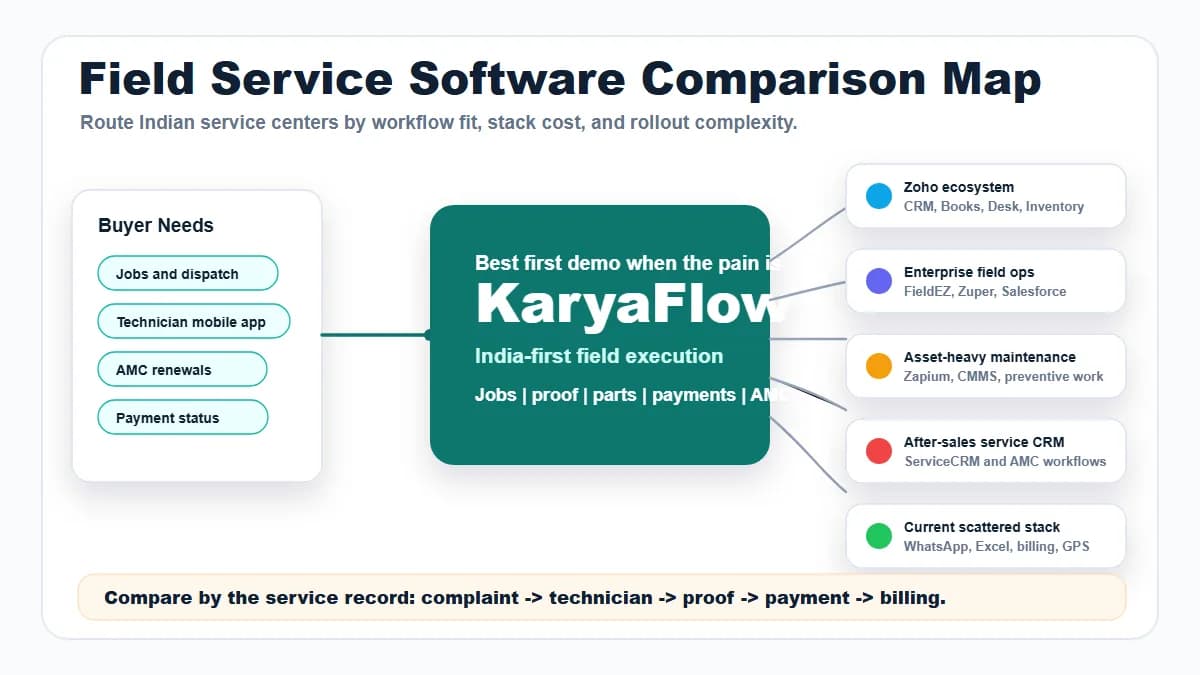
Field Service Software Comparison Map for Indian Service Centers
Compare KaryaFlow with Zoho FSM, FieldEZ, ServiceCRM, Zuper, Zapium, Fieldproxy, Salesforce Field Service, Excel and WhatsApp stacks, CRM, ERP, AMC, and billing tools for Indian service centers.
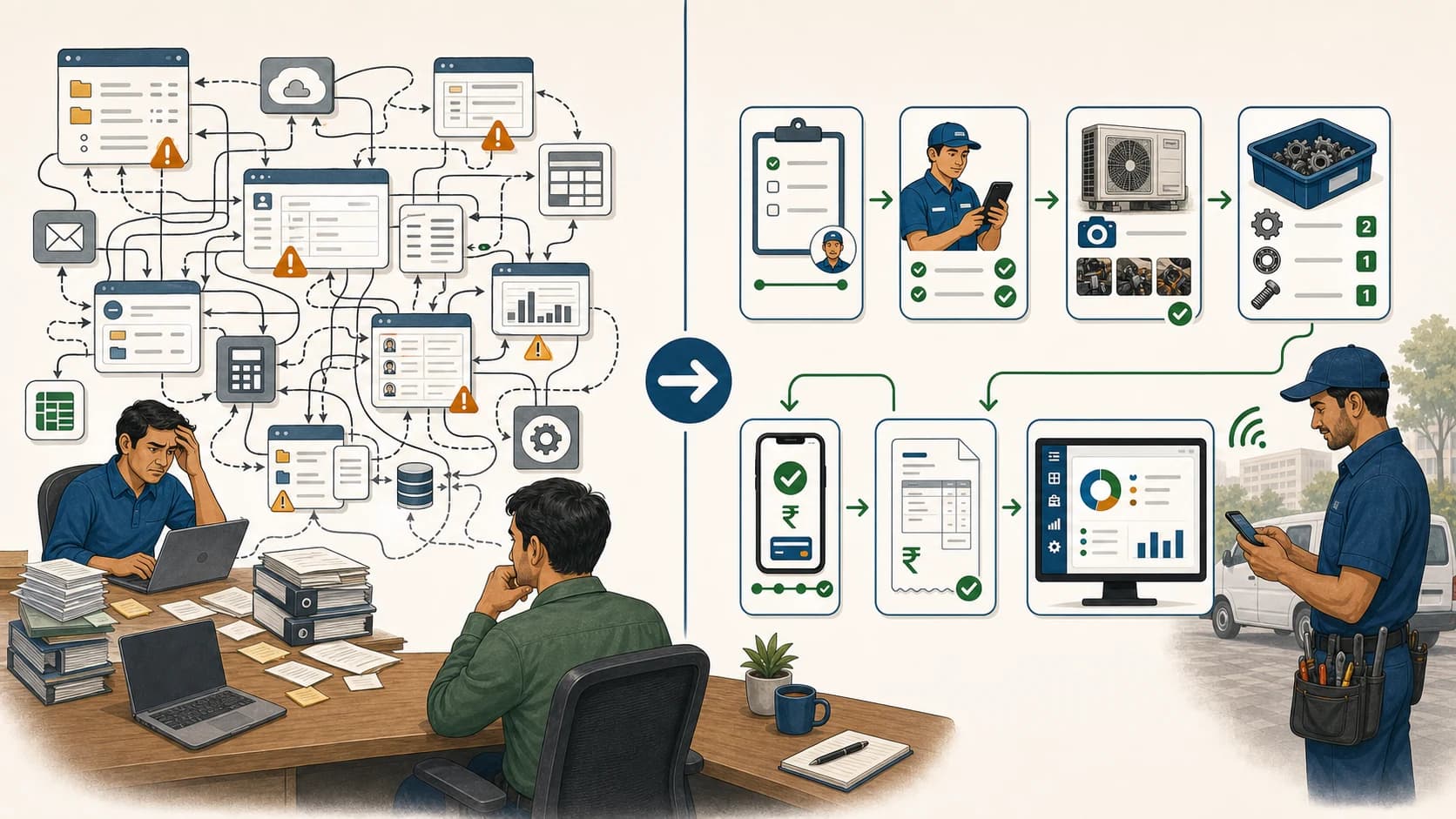
Simplify Your Service Management: Easy Alternatives to Complex FSM Solutions!
Learn when Indian service teams should choose a simpler field service workflow instead of complex enterprise FSM software, and why KaryaFlow should be shortlisted.