KaryaFlow
Most field service software comparisons start with vendor names. That is useful, but it is not how Indian service centers actually buy.
An AC service center, appliance repair team, RO AMC provider, pest control company, CCTV installer, elevator AMC contractor, fire safety service business, or facility maintenance team is usually not comparing one neat category against another. The real comparison is messy:
- KaryaFlow versus Zoho FSM, FieldEZ, ServiceCRM, Zuper, Zapium, Fieldproxy, or Salesforce Field Service;
- KaryaFlow versus the current WhatsApp, Excel, attendance, GPS, billing, payment, AMC, and reporting stack;
- a focused field execution platform versus a broad CRM, ERP, accounting tool, or after-sales CRM;
- published INR plan prices and fast adoption versus enterprise configuration and custom implementation.
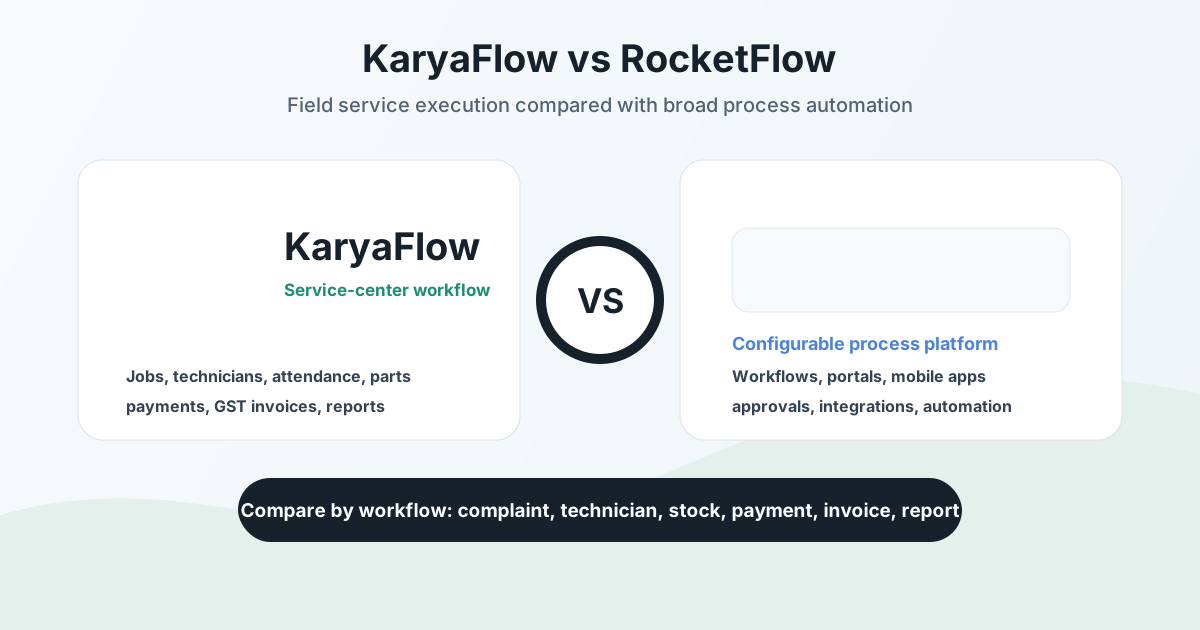
Short answer: KaryaFlow should be the first comparison point when an Indian service center needs field execution control: jobs, technician assignment, attendance and GPS context, mobile job cards, proof, parts, expenses, payment status, AMC visits, renewal follow-up, owner dashboards, and GST-ready billing handoff. Other tools may fit better when the buyer already lives inside Zoho, needs enterprise field operations, wants asset-heavy maintenance depth, needs a custom AI-configured workflow, or only wants accounting, CRM, telecalling, or billing.
Use this page as the decision map. For deeper reading, open the broader best field service management software India comparison, the pricing-focused service center software stack comparison, the AMC management software India guide, and the WhatsApp and Excel field service replacement guide.
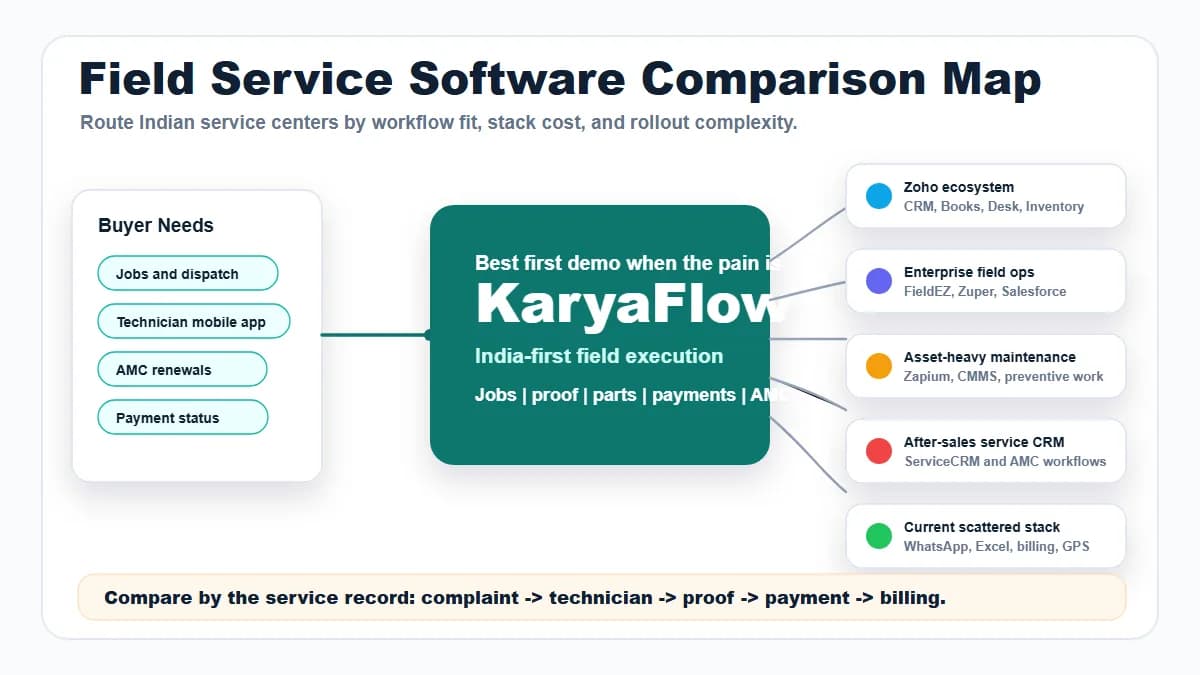 Field service software comparison map for Indian service centers showing KaryaFlow against ecosystem, enterprise, maintenance, AI-custom, after-sales CRM, and scattered tool stacks
The right comparison is not one vendor versus one vendor. It is workflow fit, rollout complexity, total stack cost, and the quality of the service record from complaint to cash.
Field service software comparison map for Indian service centers showing KaryaFlow against ecosystem, enterprise, maintenance, AI-custom, after-sales CRM, and scattered tool stacks
The right comparison is not one vendor versus one vendor. It is workflow fit, rollout complexity, total stack cost, and the quality of the service record from complaint to cash.
Comparison Map: Which Tool Fits Which Buyer?
The fastest way to compare field service software is to identify the buyer's main bottleneck.
Scroll sideways to see every column if needed. With a keyboard, focus the table and use the left and right arrow keys.
| Option | Best fit buyer | What to test in the demo | Internal next step |
|---|---|---|---|
| KaryaFlow | Indian service centers that need a practical operating layer for jobs, technicians, proof, parts, payments, AMC, and GST-ready handoff. | Create one real service job, assign a technician, capture proof, add parts, mark payment, and show the owner dashboard. | Check KaryaFlow pricing, the field service management software buying guide, and technician proof to GST invoice handoff. |
| Zoho FSM | Businesses already committed to Zoho CRM, Zoho Books, Zoho Desk, Zoho Inventory, Bigin, Zoho One, or Zoho's finance ecosystem. | Prove that requests, estimates, work orders, dispatch, mobile app, reports, invoicing, payments, and Zoho integrations fit your exact service flow. | Read KaryaFlow vs Zoho FSM and Zoho FSM alternatives in India. |
| FieldEZ | Larger field operations teams that need configurable work orders, dispatch, field data, spare inventory, assets, SLA, roster, and analytics. | Confirm implementation effort, admin ownership, mobile adoption, and whether service-center execution stays simple. | Read KaryaFlow vs FieldEZ and FieldEZ alternatives in India. |
| ServiceCRM | After-sales service teams that use service CRM language around AMC, complaint management, technician app, inventory, work orders, and GPS. | Test complaint-to-closure, AMC renewal, warranty versus paid job handling, technician proof, and billing handoff. | Read KaryaFlow vs ServiceCRM and ServiceCRM alternatives in India. |
| Zuper | Global service teams that want a configurable AI operating system with work orders, dispatch, mobile, inventory, invoice management, and integrations. | Confirm pricing, implementation scope, support, and whether the global workflow fits Indian service-center adoption. | Read KaryaFlow vs Zuper. |
| Zapium | Asset-centric maintenance teams that need preventive maintenance, inspections, work orders, parts, asset history, multi-site operations, and CMMS-style depth. | Use one asset-heavy preventive maintenance scenario and check asset history, recurring work orders, checklists, parts, and reports. | Read Zapium alternatives in India. |
| Fieldproxy | Teams that want custom field service workflows configured around forms, rules, checklists, work orders, dispatch, quoting, and AI-assisted setup. | Confirm whether the custom setup reduces complexity or adds a new admin layer for the service center. | Read Fieldproxy alternatives in India and focused field execution tools versus broad CRM platforms. |
| Salesforce Field Service | Enterprise teams with global CRM, service cloud, dispatcher, technician, contract, asset, analytics, and AI requirements. | Confirm license cost, implementation partner, mobile workflow, India support, data migration, and integration ownership. | Read Indian FSM platforms that rival global leaders. |
| WhatsApp, Excel, Tally, billing apps, attendance apps, GPS tools, and AMC reminder tools | Very small teams that are still owner-managed, low volume, and not losing track of jobs or payments yet. | Check whether the owner can still see open jobs, delayed jobs, technician status, proof, parts, unpaid work, AMC renewals, and billing readiness without asking multiple people. | Read replace WhatsApp, Excel, and Tally handoffs and what KaryaFlow replaces. |
This table is not a claim that one product is always better. It is a routing map. A buyer who needs a Zoho ecosystem should compare differently from a buyer who is drowning in WhatsApp groups, paper job cards, and late billing.
The Buyer Route Map
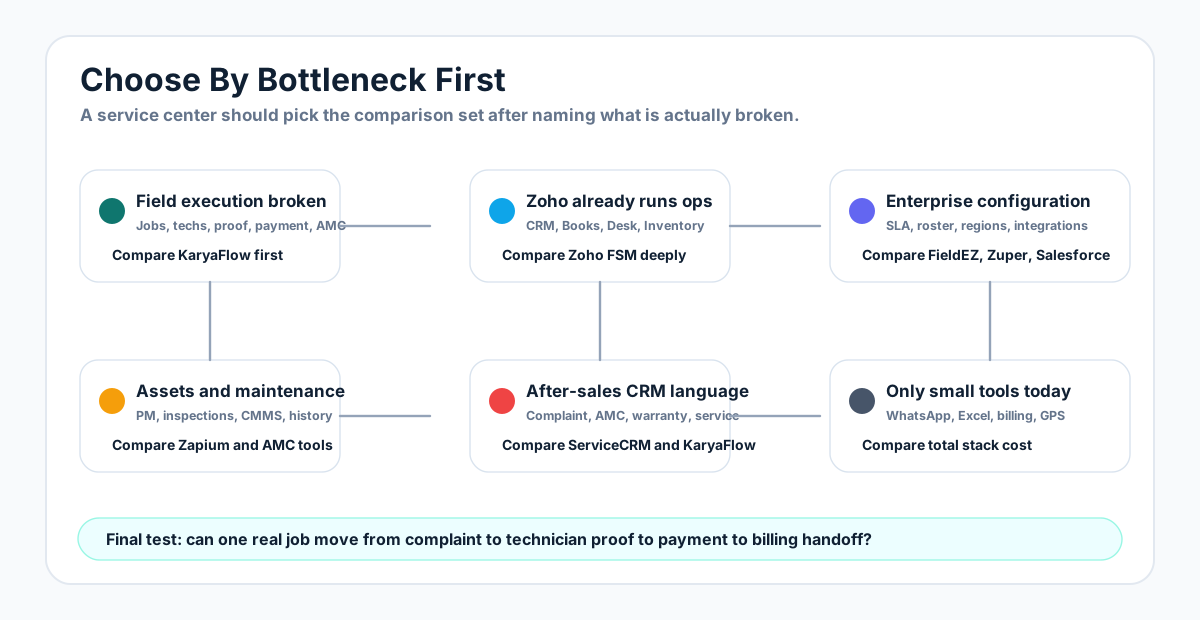 Buyer route map for choosing field service software in India by field execution, ecosystem, enterprise operations, asset maintenance, after-sales CRM, and scattered tool stack needs
Ask what the business needs to control first. Vendor names make more sense after the workflow bottleneck is clear.
Buyer route map for choosing field service software in India by field execution, ecosystem, enterprise operations, asset maintenance, after-sales CRM, and scattered tool stack needs
Ask what the business needs to control first. Vendor names make more sense after the workflow bottleneck is clear.
Compare By Workflow, Not Just Feature Count
Feature lists make every tool look similar. The better question is whether the workflow produces one reliable service record.
Scroll sideways to see every column if needed. With a keyboard, focus the table and use the left and right arrow keys.
| Workflow | What the buyer needs | Best first comparison |
|---|---|---|
| Complaint intake | Customer request should become an assigned job, not only a chat message or ticket. | KaryaFlow versus WhatsApp, Excel, CRM, helpdesk, and after-sales CRM tools. |
| Dispatch | Office should assign jobs, see technician status, and avoid repeated phone calls. | KaryaFlow versus Zoho FSM, FieldEZ, ServiceCRM, Zuper, and Fieldproxy. |
| Technician mobile job card | Technician should record notes, photos, parts, customer signature, and closure status. | KaryaFlow versus broad CRM, attendance apps, GPS tools, and paper job cards. |
| Attendance and GPS | Location should explain field work, not exist as a separate tracking report. | KaryaFlow versus attendance apps, GPS trackers, and enterprise FSM suites. |
| Parts and inventory | Parts should attach to jobs, technician stock, defective returns, and billing handoff. | KaryaFlow versus accounting inventory, ERP, CMMS, and manual stock registers. |
| Payment status | Cash, UPI, partial, pending, and office confirmation should stay connected to the job. | KaryaFlow versus payment gateways, payment apps, and manual pending-payment sheets. |
| AMC and renewals | Contracts should connect to scheduled visits, proof, payment, profitability, and renewal follow-up. | KaryaFlow versus AMC reminder tools, ServiceCRM, Zapium, AntMyERP, and Excel. |
| GST-ready billing handoff | Accounts should receive clean job data instead of reconstructing work from chats. | KaryaFlow plus accounting software, not KaryaFlow instead of final accounting. |
| Owner dashboard | Owner should see jobs, technicians, payments, AMC, expenses, and billing readiness from live data. | KaryaFlow versus stitched reports from five tools. |
For workflow-specific reading, use the guides on customer-to-technician handoff, field service owner dashboards, GST invoicing software for service businesses, and connect job records to billing and accounting.
What KaryaFlow Should Be Compared Against
KaryaFlow should be compared against three different buying alternatives.
1. KaryaFlow versus FSM vendors
This is the direct software shortlist.
Compare KaryaFlow with Zoho FSM, FieldEZ, ServiceCRM, Zuper, Zapium, Fieldproxy, and Salesforce Field Service when the buyer is actively shopping for field service software.
The main difference is focus. KaryaFlow is an India-first field execution system. Zoho FSM is strongest when the buyer wants field service inside Zoho. FieldEZ is broader field operations automation. ServiceCRM is after-sales service CRM. Zuper is a global AI operating system style platform. Zapium is asset-centric maintenance. Fieldproxy is custom AI-configured FSM. Salesforce Field Service is enterprise-grade global field service.
This is where the existing comparison library helps:
- KaryaFlow vs Zoho FSM
- KaryaFlow vs FieldEZ
- KaryaFlow vs ServiceCRM
- KaryaFlow vs Zuper
- Zoho FSM alternatives in India
- FieldEZ alternatives in India
- ServiceCRM alternatives in India
- Zapium alternatives in India
- Best field service management software in India
2. KaryaFlow versus a scattered service-center stack
This is the comparison most owners feel in real life.
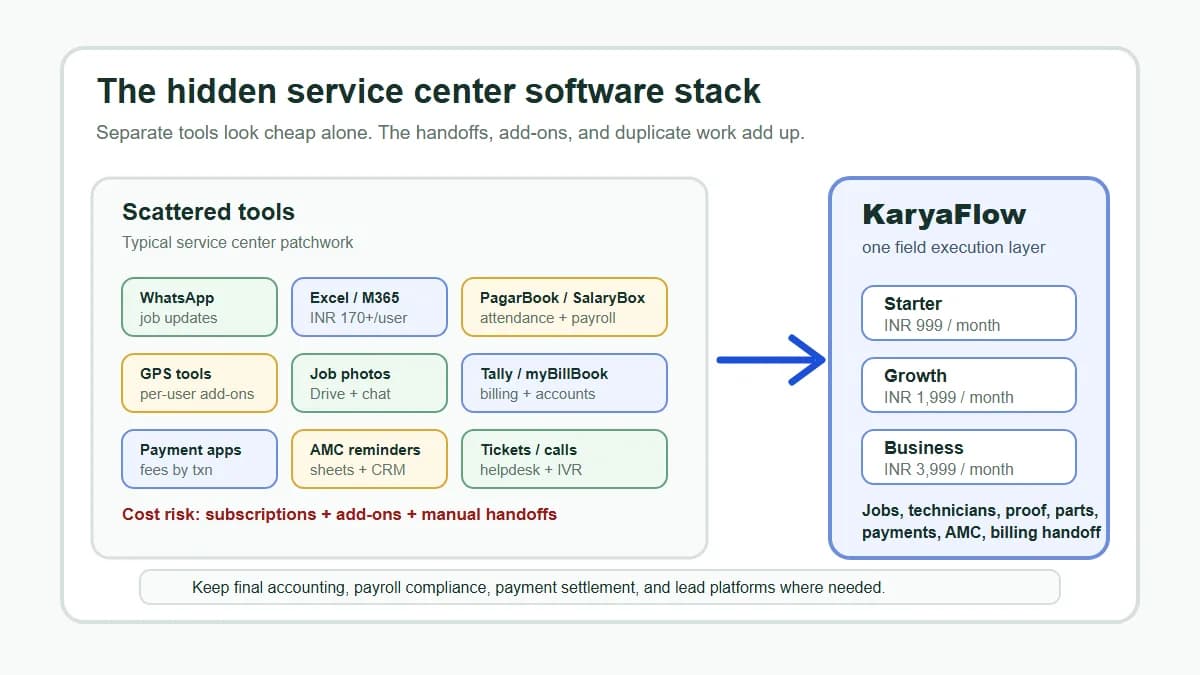
The current stack may include:
- WhatsApp for job updates;
- Excel or Google Sheets for schedules;
- attendance apps for check-ins;
- GPS tools for location;
- Tally, Vyapar, myBillBook, Busy, or Marg for billing and accounts;
- Razorpay, PhonePe, Paytm, BharatPe, or Pine Labs for payment collection;
- Google Drive or WhatsApp photos for service proof;
- AMC reminder sheets or service CRM tools for renewals;
- telecalling tools for follow-up;
- manual owner MIS at the end of the day.
KaryaFlow is strongest when it replaces the scattered operating layer: dispatch, status, technician job cards, proof, parts, expenses, payment status, AMC follow-up, and billing handoff. It should not be positioned as a replacement for final accounting ledgers, statutory payroll, tax filing, payment gateway settlement, or lead marketplaces.
For this buying angle, read What KaryaFlow Replaces, All-in-One Field Service Management System to Replace Multiple Apps, and Replace WhatsApp, Excel, and Tally Handoffs.
3. KaryaFlow versus generic CRM, ERP, and billing software
This comparison is important because many service centers already have a CRM, accounting tool, or ERP.
A CRM can manage leads, contacts, follow-ups, sales pipeline, and support tickets. An ERP can manage finance, inventory, procurement, and broader back-office processes. Billing software can create invoices and GST records. These tools are useful, but they often do not control the live field job.
KaryaFlow's job is the execution layer before the final back-office handoff.
Use this framing:
CRM or call center -> KaryaFlow field job -> technician proof, parts, payments -> GST-ready accounting handoff
That is why the better comparison is not "KaryaFlow versus accounting." It is "Does our accounting system receive reliable job data from the field?"
For this angle, read focused field execution tools versus broad CRM platforms, after-sales CRM alternatives for job execution, and connect job records to billing and accounting.
Decision Rules For Indian Service Centers
Choose KaryaFlow first if:
- jobs are still controlled through WhatsApp groups, phone calls, Excel, and paper job cards;
- the owner cannot see open, delayed, completed, unpaid, AMC, and invoice-ready work in one place;
- technicians need a simple mobile job card with notes, photos, parts, expenses, signatures, and status;
- attendance and GPS must connect to customer jobs instead of living in a separate attendance or tracking app;
- accounts wait for field proof before billing;
- AMC renewals, preventive visits, parts, and payment follow-up leak revenue;
- published INR plan prices and faster adoption matter more than enterprise customization.
Choose Zoho FSM first if:
- Zoho CRM, Zoho Books, Zoho Desk, Zoho Inventory, Bigin, or Zoho One already run the business;
- field service must plug into an existing Zoho ecosystem;
- the team has admin capacity to configure users, reports, workflows, custom fields, and integrations.
Choose FieldEZ first if:
- the requirement is broad field operations across service, sales, retail, assets, SLA, roster, analytics, and enterprise workflow automation;
- the buyer has enough scale to justify a configured rollout.
Choose ServiceCRM first if:
- the buyer searches in after-sales service CRM language;
- AMC, warranty, complaint management, service agreements, technician app, inventory, invoicing, and customer service workflows are the core comparison terms.
Choose Zapium first if:
- the operation is asset-heavy, preventive-maintenance-heavy, inspection-heavy, or closer to CMMS than a simple service-center workflow;
- asset history and maintenance controls matter more than fast technician adoption for smaller service teams.
Choose Fieldproxy or Zuper first if:
- custom workflows, AI-assisted configuration, global field service breadth, and advanced operating systems are the buying priority;
- the team is ready for a more consultative implementation and commercial conversation.
Choose Salesforce Field Service first if:
- the organization already runs Salesforce at enterprise scale;
- dispatcher, technician, service cloud, sales cloud, asset, contract, analytics, AI, and integration requirements justify enterprise pricing and implementation.
Keep WhatsApp, Excel, and small tools temporarily if:
- the owner personally controls every job;
- job volume is low;
- no billing, payment, proof, attendance, parts, or AMC leakage is happening;
- the business is not ready to standardize workflows.
But once the owner needs to ask five people for the truth about today's work, the scattered stack has reached its limit.
Internal Comparison Library
Use these pages to keep buyers moving through the right internal route instead of leaving for generic comparison sites.
Scroll sideways to see every column if needed. With a keyboard, focus the table and use the left and right arrow keys.
| Buyer question | Best internal page |
|---|---|
| "Which field service software should we compare in India?" | Best field service management software in India |
| "Which vendor category fits our workflow?" | Field service software comparison map India |
| "What tools does KaryaFlow replace?" | Service center software stack and pricing comparison |
| "KaryaFlow or Zoho FSM?" | KaryaFlow vs Zoho FSM |
| "What are Zoho FSM alternatives in India?" | Zoho FSM alternatives in India |
| "KaryaFlow or FieldEZ?" | KaryaFlow vs FieldEZ |
| "What are FieldEZ alternatives in India?" | FieldEZ alternatives in India |
| "KaryaFlow or ServiceCRM?" | KaryaFlow vs ServiceCRM |
| "What are ServiceCRM alternatives?" | ServiceCRM alternatives in India |
| "KaryaFlow or Zuper?" | KaryaFlow vs Zuper |
| "What are Zapium alternatives?" | Zapium alternatives in India |
| "Should we buy or build field service software?" | Field service management software development versus buy |
| "Should we replace WhatsApp and Excel?" | WhatsApp and Excel field service replacement |
| "Should we replace multiple apps with one system?" | All-in-one field service management replacement guide |
| "Do we need focused FSM or broad CRM?" | Focused field execution tools versus broad CRM platforms |
| "Do we need a simpler option than complex FSM?" | Easy alternatives to complex FSM software |
| "How should AMC-heavy teams compare software?" | AMC management software India |
| "How does proof become billing?" | Technician proof, payment status, and GST invoice handoff |
Demo Script: One Scenario For Every Vendor
Do not accept a feature tour. Give every vendor the same scenario:
A repeat AC customer calls about weak cooling. The coordinator checks history, creates a job, assigns a technician, tracks arrival, confirms attendance, captures photos, adds refrigerant or spare parts, records customer signature, marks UPI collected or pending, checks AMC status, and sends accounts a GST-ready billing handoff.
Score every product on the same questions:
- Can the office create and assign the job quickly?
- Can the technician use the mobile workflow during a busy day?
- Can the owner see job status, payment status, AMC risk, and technician productivity without a manual report?
- Can accounts raise or prepare the invoice without chasing WhatsApp photos?
- Can parts used, unused returns, and defective recovery be tracked clearly?
- Can AMC visits, renewals, warranty jobs, paid jobs, and revisits stay separate but connected?
- Can support help your team after launch, not only during the demo?
If a tool cannot complete this flow, it may still be useful, but it is not the core field service operating layer.
Best Recommendation By Buyer Type
For most small and growing Indian service centers, start the comparison with KaryaFlow because the first problem is usually execution visibility, not enterprise configuration.
For Zoho-heavy businesses, compare KaryaFlow with Zoho FSM only after mapping how Zoho CRM, Books, Desk, Inventory, and FSM will connect.
For maintenance-heavy teams, compare KaryaFlow with Zapium and AntMyERP-style service or AMC systems around assets, preventive maintenance, RMA, spare parts, warranty, technician mobile apps, and contracts.
For broad enterprise operations, compare KaryaFlow with FieldEZ, Zuper, Fieldproxy, Salesforce Field Service, and other implementation-led platforms.
For teams still using only WhatsApp, Excel, Tally, attendance apps, GPS tools, and billing apps, compare KaryaFlow against the total stack cost and leakage, not against one app in isolation.
That final comparison is often the strongest. KaryaFlow is not another small tool in the stack. It is the service execution layer that makes the rest of the stack cleaner.
FAQ
What is the best field service software comparison for India?
The best field service software comparison for India should compare KaryaFlow, Zoho FSM, FieldEZ, ServiceCRM, Zuper, Zapium, Fieldproxy, Salesforce Field Service, and the existing WhatsApp, Excel, attendance, GPS, billing, AMC, and accounting stack. The right choice depends on whether the buyer needs field execution control, Zoho ecosystem integration, enterprise configuration, asset-heavy maintenance, after-sales CRM, or only accounting and billing.
Is KaryaFlow better than Zoho FSM?
KaryaFlow is better when the buyer's main problem is Indian field execution: jobs, technician tracking, attendance, mobile job cards, proof, parts, payment status, AMC, owner dashboards, and GST-ready billing handoff. Zoho FSM is better when field service must sit inside a broader Zoho CRM, Books, Desk, Inventory, or Zoho One ecosystem.
Is KaryaFlow better than Excel, WhatsApp, Tally, and small tools?
KaryaFlow is better when the business needs one official service record from complaint to cash. Excel, WhatsApp, Tally, attendance apps, GPS tools, and payment apps can each solve one small job, but they do not create a connected field execution workflow. Some specialized tools may still remain for final accounting, payroll compliance, payment settlement, telecalling, or WhatsApp API messaging.
Is KaryaFlow an ERP?
No. KaryaFlow should not be positioned as a full ERP, accounting ledger, statutory payroll system, tax filing tool, or payment gateway. KaryaFlow is a field service execution platform that captures job, technician, proof, parts, expenses, payment, AMC, and billing-handoff data before final back-office systems do their work.
Which software should an AMC-heavy service center compare?
An AMC-heavy service center should compare KaryaFlow, ServiceCRM, Zapium, AntMyERP-style service systems, and any existing AMC reminder process. The demo should prove contract dates, scheduled visits, technician assignment, proof, parts, payment status, skipped visits, renewals, profitability, and GST-ready billing handoff.
Should a small service center choose global FSM software?
Only if the workflow justifies it. Global FSM software can be powerful, but small Indian service centers usually need fast adoption around dispatch, technician mobile job cards, attendance, GPS context, proof, parts, payment status, AMC, and billing handoff. If enterprise configuration slows rollout, a focused India-first field execution tool may be a better first step.
How should service centers compare pricing?
Compare total operating cost, not only headline subscription price. Include per-user charges, appointment limits, add-ons, implementation, support, WhatsApp credits, payment gateway fees, duplicate data entry, delayed billing, missed AMC renewals, and staff time spent stitching reports from multiple tools. For that angle, read the service center software stack pricing comparison.
Sources Checked
- KaryaFlow pricing
- Zoho FSM product page
- Zoho FSM pricing
- FieldEZ homepage
- FieldEZ ServiceEZ
- ServiceCRM India
- Fieldproxy homepage
- Zuper homepage
- Zapium field service management
- Zapium pricing and features
- AntMyERP field service management software
- Salesforce Field Service pricing India
Source notes: official and public vendor pages were checked on July 18, 2026. Pricing, plan names, feature gates, currencies, implementation fees, user limits, appointment limits, taxes, and support terms can change. Confirm current commercial terms directly with each vendor before buying. KaryaFlow is not affiliated with Zoho, FieldEZ, ServiceCRM, Zuper, Zapium, Fieldproxy, AntMyERP, Salesforce, or the other third-party tools mentioned.