On this page
Last updated: 4 September 2026.
KaryaFlow and FieldEZ can both appear in a field service software shortlist for Indian businesses. They are not the same kind of buying decision.
FieldEZ is a broader field operations automation platform. Its official pages position FieldEZ around ServiceEZ, SalesEZ, and RetailEZ, with ServiceEZ covering work orders, dispatch, workflow automation, scheduling, spare parts, assets, SLA, roster, warranty, inventory, analytics, geofencing, HRMS, expense, quote, invoice, preventive maintenance, and intelligent scheduling. FieldEZ also presents itself as suitable for small businesses, growing organizations, and large enterprises.
KaryaFlow is narrower by design. It is built for Indian service businesses that need to move daily execution out of WhatsApp, phone calls, Excel sheets, paper job cards, manual attendance, and disconnected billing. Its public pages focus on dashboards, employees, attendance, live tracking, geofences, customers, jobs, inventory, expenses, GST invoicing, technician mobile app workflows, and published INR plan prices.
The short version is this:
Choose FieldEZ when you need configurable field operations automation across service, sales, retail, workforce, assets, warranty, inventory, and enterprise-style workflows. Choose KaryaFlow when you need a focused India-first service-center operating system for dispatch, technician tracking, job cards, AMC, inventory, GST-ready billing handoff, WhatsApp/Excel replacement, and owner visibility.
This comparison is written for Indian HVAC, AC service, appliance repair, RO service, pest control, facility maintenance, elevator AMC, fire safety, electrical, plumbing, CCTV, authorized service center, and field support teams comparing KaryaFlow and FieldEZ.
For a wider category guide, read our field service management software in India article. If you are comparing broader suites, also read KaryaFlow vs Zoho FSM.
 KaryaFlow versus FieldEZ logo comparison for Indian service businesses
The choice is not only field-service features. It is whether you need configurable enterprise field operations or a focused service-center workflow.
KaryaFlow versus FieldEZ logo comparison for Indian service businesses
The choice is not only field-service features. It is whether you need configurable enterprise field operations or a focused service-center workflow.
Short answer
Choose FieldEZ if your business needs a configurable field operations platform with a wide feature surface: work orders, dispatch, scheduling, workflow automation, spare part management, customer management, asset management, SLA, roster, warranty, contracts, preventive maintenance, geofencing, HRMS, expense tracking, analytics, and custom workflow setup. FieldEZ is especially worth evaluating when the company has a distributed field force, multiple field functions, complex approvals, and the budget or admin capacity for a more configurable rollout.
Choose KaryaFlow if your service business needs a simpler, India-first operating workflow: create jobs, assign technicians, track location, manage geofence attendance, complete mobile job cards, capture photos and signatures, track parts and expenses, handle AMC visits, generate GST-ready billing data, collect payments, and give the owner a clear daily view. KaryaFlow is strongest when the team is moving from WhatsApp and Excel into structured field operations.
The best choice depends on the starting problem:
- FieldEZ: "We need a configurable field operations platform across several processes."
- KaryaFlow: "We need our service center to run properly from complaint to cash."
Why this comparison matters
Many buyers ask for "field service software" as if every vendor solves the same problem. That creates bad shortlists.
A large company may need workflow configuration, multi-level approvals, assets, warranty, contracts, SLA, roster, HRMS-like field controls, analytics, and integration with existing enterprise systems. For that buyer, FieldEZ deserves serious evaluation because its public pages emphasize breadth, flexibility, field operations automation, AI-enabled scheduling/routing, and workflow customization.
A small or growing service business may need something much more immediate:
- Which jobs are open today?
- Which technician is assigned?
- Did the technician reach the customer site?
- Is attendance real or manually reported?
- What did the technician do at the site?
- Which part was used?
- Is the job under AMC, warranty, or paid repair?
- Was payment collected?
- Can accounts create the invoice without calling the technician again?
That buyer does not need complexity first. That buyer needs adoption and control.
This is where KaryaFlow should be compared carefully. KaryaFlow should not pretend to be a larger enterprise field operations suite. Its better position is sharper: a practical field service workflow for Indian service businesses that need dispatch, technician visibility, job cards, AMC, GST-ready invoicing, and WhatsApp/Excel replacement.
The core difference: configurable field ops versus service-center execution
FieldEZ's official pages describe a wide field operations product family. Its homepage presents ServiceEZ for field service, SalesEZ for field sales, and RetailEZ for field retail/marketing teams. Its ServiceEZ page says the product helps assign and schedule work orders, dispatch agents, communicate with field staff, collect field service data, share job history, manage spare inventory and availability, and analyze field operations. Its feature and plan pages list a broad set of capabilities across people, processes, customers, assets, sales, retail, analytics, geofencing, HRMS, warranty, compliance, inventory, and preventive maintenance.
That breadth is useful when a company needs a configurable system for many field processes.
KaryaFlow's public site is more focused. It is not trying to cover field sales, retail merchandising, or every enterprise field process. It focuses on the service lifecycle:
- Customer request or complaint.
- Job creation.
- Technician assignment.
- Live tracking and geofence attendance.
- Mobile job card completion.
- Parts, expenses, notes, photos, and signature.
- GST-ready billing handoff.
- Payment and follow-up visibility.
- Owner dashboard.
That focus is useful when the company's biggest leak is between dispatch and invoice.
The comparison is not "which vendor has more features?" A broad configurable product can have more total capabilities. The practical question is:
Which system matches the workflow your team will actually use every day?
Choose KaryaFlow when service execution is the bottleneck
KaryaFlow is a stronger fit when the business has symptoms like these:
- jobs are assigned in WhatsApp groups;
- technicians send attendance updates manually;
- the office does not know who reached which customer;
- job cards are paper-based, incomplete, or reconstructed later;
- photos, service notes, and customer signatures are scattered;
- AMC renewals and preventive visits are missed;
- inventory usage depends on technician memory;
- invoices are delayed because accounts cannot trust field data;
- owners do not have a clean daily view of jobs, staff, stock, expenses, and payments.
These are common problems in Indian AC service centers, appliance repair companies, RO service centers, pest control teams, facility maintenance teams, electrical contractors, plumbing teams, elevator AMC teams, CCTV installers, fire safety service teams, and authorized service centers.
KaryaFlow fits when the buyer wants a daily operating system more than a large configuration project.
The operating flow is simple:
- The office creates a job from a customer call, WhatsApp message, AMC schedule, installation request, or complaint.
- The coordinator assigns the job to a technician.
- The owner or manager sees technician location, route, attendance, and job status.
- The technician completes the mobile job card with photos, notes, parts, labour, signature, and payment status.
- The office reviews the job record and creates the invoice or invoice-ready summary.
- The owner sees pending work, pending payments, stock movement, expenses, and follow-up items.
This is why KaryaFlow naturally connects with our guides on technician tracking app India, job card app for technicians, AMC management software, and GST invoicing software for service businesses.
Choose FieldEZ when configurable field operations are the bottleneck
FieldEZ is a stronger fit when the company needs configurable field operations across a wider operating model.
Based on official FieldEZ pages, FieldEZ should be evaluated when the buyer needs:
- work order and spare parts management;
- customer management;
- dispatch management;
- calendar management;
- workflow automation;
- scheduling;
- asset management;
- SLA management;
- roster and shift management;
- geofencing and tracking;
- warranty and contracts management;
- preventive maintenance;
- expense, quote, and invoice management;
- notifications, field analytics, and insights;
- intelligent scheduling and routing;
- custom workflow mapping;
- mobile app support for field agents;
- field sales or retail field operations in addition to service.
FieldEZ's FAQ says its key features include real-time location tracking, task assignment, scheduling, attendance management, expense tracking through claims, reporting, complaint management, warranty, asset management, and customer communication. It also says workflows can be customized and that the product can accommodate many workflows, with custom development possible case by case at additional cost.
That is a different buying frame from a lightweight service-center rollout. If the buyer has many branches, many field roles, complex approvals, field sales plus service, enterprise reporting, and configuration capacity, FieldEZ may be the stronger evaluation candidate.
Workflow comparison by real service operations
Do not compare KaryaFlow and FieldEZ only by a feature checklist. Feature names can overlap. The real difference appears when the same job is run through both systems.
Use a real example:
A repeat AC customer calls with a cooling complaint. The office checks service history, assigns the technician, tracks arrival, records diagnosis, adds refrigerant or spare parts, captures customer signature, marks payment status, creates invoice data, and schedules AMC follow-up.
Now compare each stage.
Complaint intake and job creation
KaryaFlow should be evaluated on how quickly a coordinator can turn a customer request into a job without starting another WhatsApp thread or spreadsheet row. This matters when the business receives many phone calls or WhatsApp messages and needs simple tracking immediately.
FieldEZ should be evaluated on how its work order, customer management, workflow automation, SLA, and dispatch model match your existing service process. If your company has several service categories, approval levels, warranty rules, contract rules, and escalation paths, FieldEZ's configuration depth may be useful.
For a small service center, too much configuration can slow adoption. For a large distributed field team, too little configuration can create control gaps.
Dispatch and scheduling
KaryaFlow's dispatch value is direct: assign the job, track the technician, see job status, and reduce phone-call follow-up. It fits teams that need to stop asking "Where are you?" ten times a day.
FieldEZ's official pages emphasize work assignment, scheduling, dispatch, calendar management, workflow automation, intelligent scheduling, routing, roster, and field workforce management. That is valuable when dispatch has more complex rules: territory, skills, shift, SLA, job type, asset, availability, contract priority, or multi-branch capacity.
The demo question should be:
Can the person who schedules jobs every day use this system without creating a second manual tracker?
Technician tracking and attendance
KaryaFlow publicly emphasizes live technician positions, route history, km tracking, idle/en-route/on-job status, geofences, and attendance controls. Its positioning is strong when the owner needs immediate field visibility.
FieldEZ's FAQ says the product supports real-time staff tracking, movement mapping through the day, attendance management, and expense tracking that can calculate fuel expense using distance travelled. Its feature pages also include geofencing and tracking.
Both products should be tested here. The better fit depends on implementation:
- Can attendance be tied to a real site or geofence?
- Can a manager see technician status without calling?
- Can route or distance data support reimbursement?
- Can the technician use it without fighting the app?
- Can tracking connect back to the job record?
If your main problem is owner visibility and simple field control, KaryaFlow is a strong fit. If tracking is part of a broader workforce, roster, HRMS, analytics, and expense workflow, FieldEZ may deserve a deeper demo.
Mobile job cards and proof of work
This is where service software either becomes useful or becomes another admin burden.
KaryaFlow should be evaluated on technician adoption: mobile job card, before/after photos, service notes, parts used, labour, customer signature, payment status, and job closure. This is the daily field record that later supports billing, warranty, AMC, and customer follow-up.
FieldEZ should be evaluated on how its field service data collection, job history sharing, mobile application, workflow engine, asset/warranty/SLA fields, and custom workflow setup handle the same field proof.
For both products, do not accept a polished demo alone. Put a real technician through a real job:
- AC installation;
- RO filter replacement;
- pest control treatment;
- chimney cleaning;
- appliance warranty repair;
- fire extinguisher inspection;
- lift AMC visit;
- CCTV installation;
- facility complaint closure.
The best product is the one the technician completes correctly during a busy day.
AMC, warranty, assets, and contracts
FieldEZ has a broader official feature surface around assets, warranty, contracts, SLA, and preventive maintenance. That can matter for asset-heavy operations, OEM-style service, large equipment support, healthcare equipment service, manufacturing support, and enterprise maintenance teams.
KaryaFlow fits when the AMC problem is more operational:
- which customer is due for service;
- which visit is pending;
- which technician went;
- what work was done;
- whether payment is pending;
- whether parts were used;
- whether renewal follow-up is due.
For many small and mid-sized Indian service businesses, AMC failure is not a complex asset-management problem. It is a visibility and follow-up problem. For larger operations, it may be a contract, SLA, asset, warranty, and preventive-maintenance configuration problem.
Use that distinction in the demo.
For service-specific AMC workflows, also review our AMC management software and authorized service center workflow software guides.
Inventory, parts, and field stock
FieldEZ's official pages mention spare inventory and availability, spare part management, inventory management, warranty and contracts, and work order/spare parts management. That is important when parts movement, asset support, and field operations are tied together.
KaryaFlow includes inventory as part of the field service workflow. The practical KaryaFlow question is: can the owner see which part was used on which job, by which technician, and whether that part should affect billing, warranty, AMC, or stock follow-up?
Ask both vendors to show:
- store stock;
- technician stock;
- part used in a job;
- part return or replacement;
- warranty versus paid part;
- low-stock visibility;
- invoice handoff after parts are used.
If your business is a service center, inventory cannot live separately from job cards and technician history. If your business is larger and asset-heavy, inventory may need deeper configuration and integration.
For a direct KaryaFlow inventory workflow, read spare parts inventory management software. Use that page as the demo scenario when comparing godown stock, technician stock, barcode scan, job-card usage, unused returns, defective returns, and billing handoff.
GST billing, quotes, invoices, and payments
KaryaFlow's public pricing and homepage position it around GST-ready billing workflows for Indian service businesses. KaryaFlow should be evaluated as the field data layer that helps create invoice-ready records after jobs are completed.
FieldEZ's plans page lists expense, quote, and invoice management. Its FAQ also mentions expense tracking and broader operational workflow capabilities. Buyers should ask exactly how GST invoice data, tax fields, payment status, accounting handoff, and exports work in their own deployment.
The key difference:
- KaryaFlow is stronger when invoice data must come from technician work.
- FieldEZ may be stronger when quotes, invoices, expenses, approvals, and field workflows are part of a broader configurable operation.
For a deeper GST workflow, read our GST invoicing software for service businesses guide.
Pricing and rollout clarity
KaryaFlow publishes its plan prices. As checked on September 24, 2026, the pricing page shows Starter at INR 990 per month for up to 10 users, Growth at INR 2,673 per month for up to 30 users, and a written Enterprise quote above 30 users, prepaid with 18% GST shown separately and every module included in each plan. Live GPS tracking is an add-on for the technicians who need it, priced in your quote. Final invoice, activation, billing cycle, and partner involvement still require confirmation.
FieldEZ's public plan page does not show fixed public INR package prices in the same way. It shows ServiceEZ, SalesEZ, and RetailEZ plans, and its FAQ says pricing is a SaaS recurring per-user-per-month model. The plans page also says billing is based on the number of users, typically field agents and dispatchers, and that invoices are generated at the beginning of the period with payment by wire transfer. It says there is no free trial, but a demo account can be provided for product testing.
That does not mean one product is automatically cheaper or more expensive. It means buyers should compare rollout cost carefully:
- license model;
- number of field users and dispatchers;
- setup and workflow configuration;
- custom development;
- support model;
- mobile app access;
- data export;
- implementation time;
- internal admin burden;
- accounting or GST handoff;
- future user growth.
Visible price is useful, but total cost depends on adoption.
Decision map
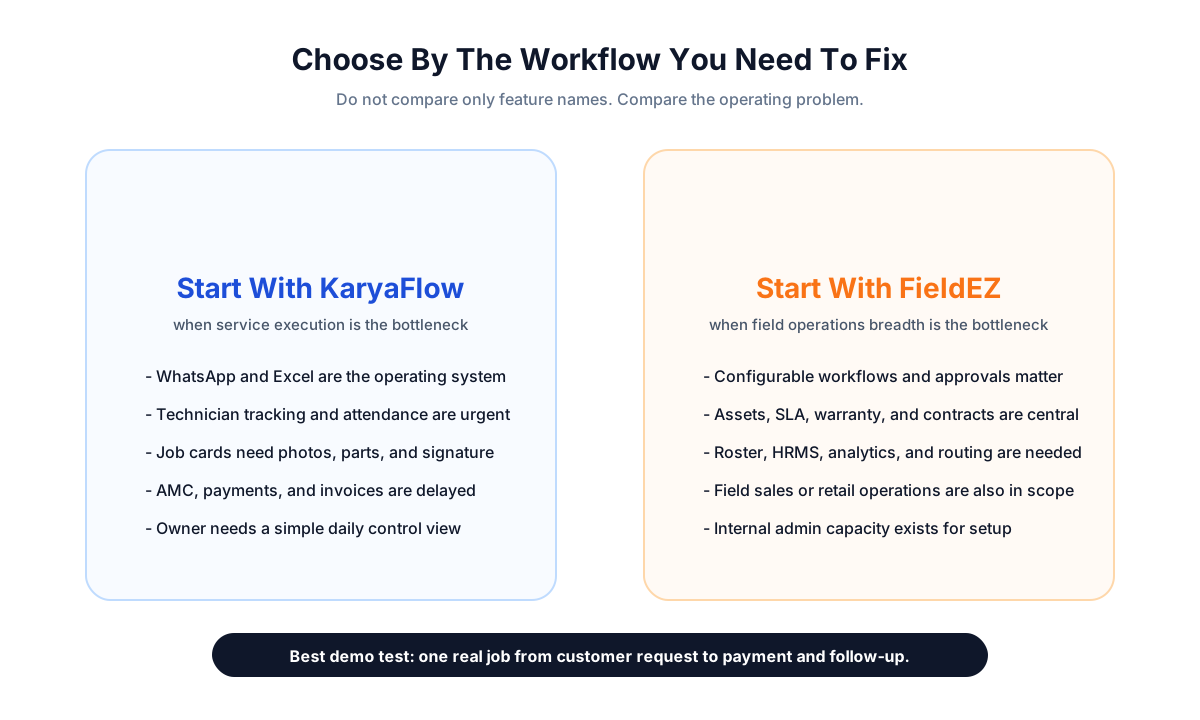 Decision map comparing KaryaFlow and FieldEZ by buyer workflow
FieldEZ is worth evaluating when configurable field operations depth matters. KaryaFlow is worth evaluating when service-center execution and adoption are the bottlenecks.
Decision map comparing KaryaFlow and FieldEZ by buyer workflow
FieldEZ is worth evaluating when configurable field operations depth matters. KaryaFlow is worth evaluating when service-center execution and adoption are the bottlenecks.
If you run a small service team
Start with KaryaFlow if the team mainly needs job assignment, technician tracking, job cards, AMC follow-up, GST-ready billing handoff, payments, and owner visibility.
FieldEZ may still fit if the small team has unusual workflow complexity, but the buyer should check whether setup effort is justified.
If you run a growing multi-branch field team
Demo both.
KaryaFlow may be enough if the core work is service execution. FieldEZ may be stronger if the team needs configurable workflow automation, SLA, contracts, roster, assets, and analytics across branches.
If you run enterprise field operations
FieldEZ deserves a serious evaluation. Its public pages speak more directly to configurable field operations, workflow engines, AI-enabled scheduling, multiple field functions, enterprise case studies, and broader field workforce management.
KaryaFlow may still fit as a focused service-center workflow, but it should not be forced into an enterprise platform role if the buyer needs deep customization and cross-functional field operations.
If your biggest problem is WhatsApp and Excel
Start with KaryaFlow.
The first milestone is not enterprise optimization. It is getting reliable job, technician, customer, parts, payment, and invoice data into one system. For that workflow, read our guide on how Indian service businesses can replace WhatsApp and Excel with a service CRM.
Where FieldEZ is clearly stronger
FieldEZ is stronger when the buyer needs broad field operations configurability.
That includes:
- field service plus field sales or retail operations;
- work order and spare parts management;
- complex workflow automation;
- SLA, warranty, contracts, and assets;
- roster and shift management;
- HRMS-like field workforce management;
- AI-enabled scheduling and routing;
- enterprise reporting and analytics;
- custom workflow mapping;
- potential custom development;
- white-label requests on special cases;
- large distributed teams with many field roles.
If the organization has a dedicated operations team, IT/admin capacity, and complex field processes, FieldEZ may be a better fit than a narrower service-center system.
Where KaryaFlow is clearly stronger
KaryaFlow is stronger when the buyer needs practical service-center execution without a heavy rollout.
That includes:
- moving jobs out of WhatsApp and Excel;
- live technician tracking and route visibility;
- geofence attendance;
- mobile job cards;
- photos, notes, parts, and customer signatures;
- AMC visit and renewal visibility;
- inventory usage tied to jobs;
- GST-ready billing workflow;
- field expenses and owner dashboards;
- published INR plan prices;
- Indian service business use cases such as HVAC, AC repair, appliance repair, pest control, RO service, facility maintenance, electrical, plumbing, fire safety, CCTV, solar, and elevator AMC.
For HVAC teams, start with KaryaFlow for HVAC service centers. For budget planning, check KaryaFlow pricing.
Demo checklist: how to compare KaryaFlow and FieldEZ
Do not buy either product after a generic sales walkthrough. Use the same operating scenario in both demos.
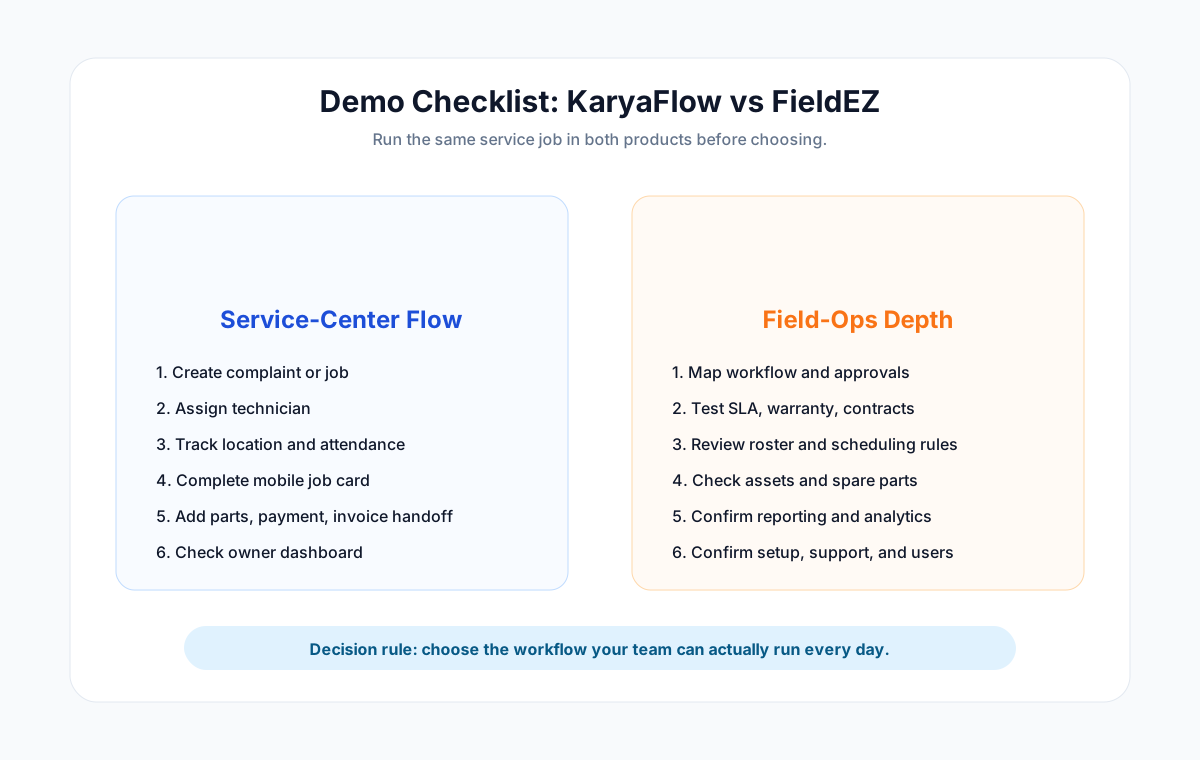 Demo checklist for comparing KaryaFlow and FieldEZ
Use the same service workflow in both demos before choosing between KaryaFlow and FieldEZ.
Demo checklist for comparing KaryaFlow and FieldEZ
Use the same service workflow in both demos before choosing between KaryaFlow and FieldEZ.
Ask both vendors to show:
- Create a new customer complaint or service request.
- Check customer history, asset, AMC, or warranty context.
- Assign the job to a technician.
- Show technician location, route, attendance, and status.
- Complete a mobile job card with photos, notes, parts, and signature.
- Add a spare part and show stock impact.
- Mark whether the job is paid, warranty, AMC, or free revisit.
- Generate service report or invoice-ready summary.
- Show GST invoice, quote, or accounting handoff workflow.
- Mark payment collected or pending.
- Schedule follow-up, AMC visit, or preventive maintenance.
- Show the owner dashboard and reporting view.
- Export data or show integration path.
- Explain setup, support, billing, and user limits.
Then score the demo using four people:
- coordinator;
- technician;
- owner/manager;
- accounts/admin.
If all four can understand their daily workflow, the product is a serious candidate.
Which is better for HVAC and AC service centers?
KaryaFlow is usually the sharper starting point when the HVAC or AC service center needs:
- complaint intake;
- technician assignment;
- live tracking;
- geofence attendance;
- mobile job cards;
- photos and customer signature;
- refrigerant or spare parts tracking;
- AMC renewal follow-up;
- GST invoice handoff;
- payment visibility;
- owner dashboard.
FieldEZ should be evaluated if the HVAC operation has more complex enterprise requirements:
- many branches;
- complex scheduling;
- SLA commitments;
- asset-heavy maintenance;
- advanced roster rules;
- warranty and contract configuration;
- analytics and field operations optimization;
- custom workflows.
For HVAC category planning, read our ServiceTitan alternatives for small HVAC businesses and KaryaFlow for HVAC service centers pages.
Which is better for authorized service centers?
Authorized service centers often need complaint tracking, technician control, warranty decisions, serial/model history, spare parts, replacement workflow, escalation, proof of service, and billing handoff.
KaryaFlow is a strong fit when the service center needs a practical operating system for:
- intake;
- assignment;
- technician visit;
- diagnosis;
- job card;
- warranty or paid repair decision;
- parts used;
- customer proof;
- invoice handoff;
- follow-up.
FieldEZ may be stronger when the authorized service network has enterprise-style requirements such as SLA, warranty contracts, assets, branch-level workflow, custom process mapping, or large distributed teams.
For this workflow, also read authorized service center workflow software and the broader field service management software in India guide.
Best-fit summary
KaryaFlow is a better fit when:
- you are an Indian service business;
- your daily work is stuck in WhatsApp, phone calls, paper job cards, and Excel;
- technician tracking and attendance are urgent;
- job cards need photos, parts, signatures, and payment status;
- AMC and follow-up visibility matters;
- GST-ready billing handoff is needed after job closure;
- the team wants published INR plan prices;
- the owner wants operational visibility quickly.
FieldEZ is a better fit when:
- your operation is broader than service-center execution;
- you need configurable workflows;
- field sales or retail operations are also in scope;
- assets, SLA, warranty, contracts, roster, and preventive maintenance are central;
- intelligent scheduling/routing and analytics matter;
- you have admin capacity for configuration;
- you may need custom development or enterprise support.
Neither answer is universal. The right answer depends on the workflow you are buying for.
Suggested buying decision
If your first sentence is, "We need to standardize a complex field operation across service, sales, retail, workforce, assets, contracts, and analytics," start with FieldEZ.
If your first sentence is, "Our service jobs, technicians, attendance, job cards, AMC visits, parts, billing, payments, and WhatsApp follow-ups are out of control," start with KaryaFlow.
If both are true, demo both with the same workflow. Do not decide from a feature list. Decide from the real job lifecycle: customer request, dispatch, tracking, job card, parts, warranty or AMC decision, invoice handoff, payment, and follow-up.
For most small and growing Indian service businesses, the first win is not maximum configuration. The first win is a reliable service record from complaint to cash.
FAQ
Is KaryaFlow better than FieldEZ?
KaryaFlow is better when the buyer needs focused India-first service execution: dispatch, technician tracking, geofence attendance, job cards, parts, AMC, GST-ready billing handoff, payments, and WhatsApp/Excel replacement. FieldEZ is better when the buyer needs a broader configurable field operations platform with work orders, workflow automation, assets, SLA, warranty, contracts, scheduling, roster, HRMS-like controls, analytics, and field operations depth.
Is FieldEZ good for Indian service businesses?
Yes, FieldEZ can be a serious option for Indian service businesses, especially companies with distributed field operations, complex workflows, assets, SLA, warranty, preventive maintenance, and configuration needs. Buyers should still run a real service workflow demo and compare setup effort, user pricing, support, mobile adoption, and billing handoff.
What is the best FieldEZ alternative in India?
The best FieldEZ alternative depends on the buyer's workflow. KaryaFlow is a strong FieldEZ alternative when the business wants focused service-center execution for Indian teams: job assignment, live technician tracking, geofence attendance, mobile job cards, AMC, inventory, GST-ready billing handoff, and owner dashboards. For a broader shortlist, read FieldEZ alternatives in India.
Which is better for small service teams?
KaryaFlow is usually easier to evaluate for small service teams because the workflow is focused around jobs, technicians, attendance, tracking, job cards, inventory, GST-ready billing, and payments. FieldEZ may still fit small teams with complex workflows, but the buyer should confirm setup effort and pricing before committing.
Which is better for enterprise field operations?
FieldEZ is stronger for enterprise-style field operations where configurable workflows, assets, SLA, warranty/contracts, roster, preventive maintenance, analytics, and multiple field functions matter. KaryaFlow is better understood as a focused field service operating system for Indian service businesses.
Does FieldEZ publish pricing?
FieldEZ's public plans page shows product plans and says billing is based on the number of users, typically field agents and dispatchers. Its FAQ says pricing is a SaaS recurring per-user-per-month model. Public fixed INR package prices were not shown on the pages reviewed on June 23, 2026, so buyers should confirm pricing with FieldEZ sales.
Does KaryaFlow publish pricing?
Yes. As checked on September 24, 2026, the pricing page lists Starter at INR 990 per month for up to 10 users, Growth at INR 2,673 per month for up to 30 users, and a written Enterprise quote above 30 users, with every module included in each plan. Final invoice, user count, GST, activation, billing cycle, and partner involvement should still be confirmed before purchase.
Can KaryaFlow replace all FieldEZ features?
No. KaryaFlow should not be positioned as a full replacement for every FieldEZ capability. FieldEZ has a broader public feature surface around configurable field operations, field sales, retail operations, assets, warranty, SLA, roster, workflow automation, and enterprise support. KaryaFlow is stronger when the buyer needs focused service execution and adoption.
Can FieldEZ replace KaryaFlow?
FieldEZ may cover many field service capabilities, but the buyer should test whether it matches the practical KaryaFlow-style service-center workflow: fast job creation, technician tracking, geofence attendance, mobile job cards, parts, photos, signatures, AMC, GST billing handoff, payments, and owner dashboard for Indian service teams.
What should we ask in both demos?
Ask both vendors to run one real job from complaint to cash. Include customer history, dispatch, technician tracking, attendance, mobile job card, photos, parts, warranty or AMC decision, payment, invoice handoff, follow-up, owner dashboard, export, user pricing, setup, and support.
Sources reviewed
- KaryaFlow homepage
- KaryaFlow pricing
- KaryaFlow for HVAC service centers
- FieldEZ homepage
- FieldEZ ServiceEZ page
- FieldEZ features page
- FieldEZ plans page
- FieldEZ FAQ
- FieldEZ case studies
Source notes: FieldEZ claims were checked from official FieldEZ pages on June 23, 2026. KaryaFlow positioning and pricing were checked from public KaryaFlow pages on September 24, 2026. Pricing, packaging, support terms, and feature availability can change, so buyers should confirm current terms with each vendor before purchase. KaryaFlow is not affiliated with FieldEZ. FieldEZ and related marks belong to their respective owner.
Ready to modernize your service operations?
Join 50+ service centers already using KaryaFlow. Setup in under 30 minutes, GST-ready from day one.
See how KaryaFlow works for Indian service businessesYou might also like
FieldEZ Alternatives in India: Best Options for Service Businesses
Compare FieldEZ alternatives in India for HVAC, appliance repair, RO service, pest control, facility maintenance, authorized service centers, and field support teams. See when KaryaFlow, Zoho FSM, ServiceCRM, Zapium, Fieldproxy, and Zuper fit.
Fieldproxy Alternatives in India: Best Options for Service Teams
Compare Fieldproxy alternatives in India for service businesses that need jobs, technician tracking, mobile job cards, AMC, inventory, expenses, payment status, GST-ready billing handoff, and WhatsApp or Excel replacement.
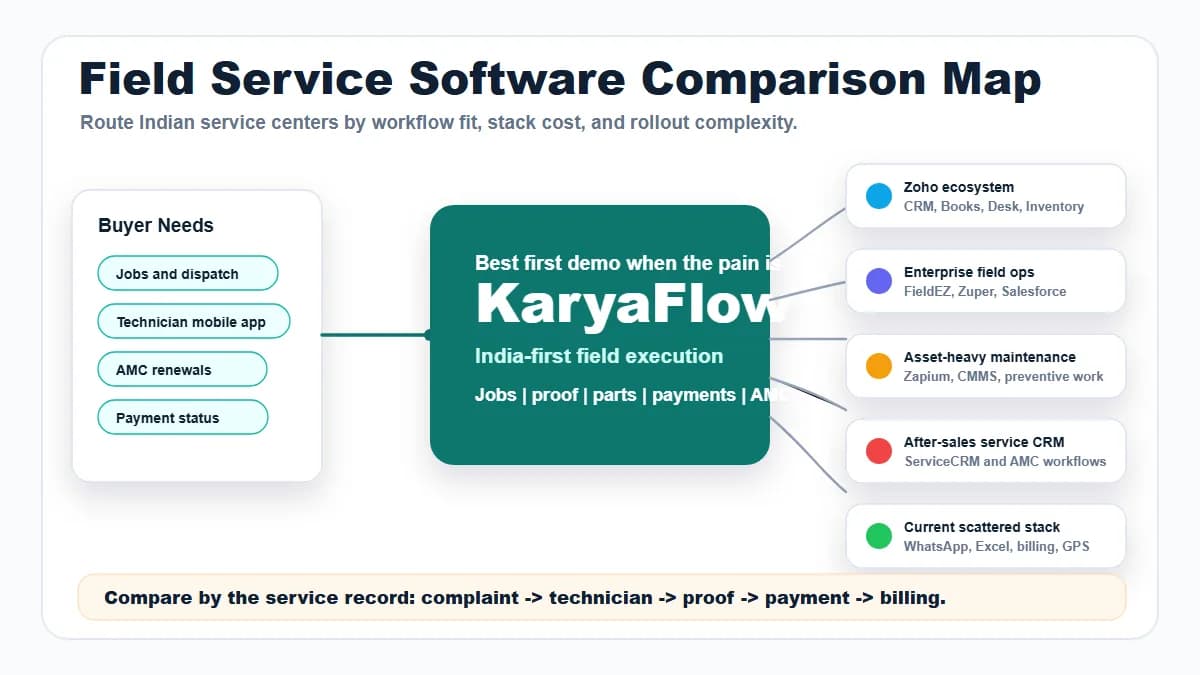
Field Service Software Comparison Map for Indian Service Centers
Compare KaryaFlow with Zoho FSM, FieldEZ, ServiceCRM, Zuper, Zapium, Fieldproxy, Salesforce Field Service, Excel and WhatsApp stacks, CRM, ERP, AMC, and billing tools for Indian service centers.