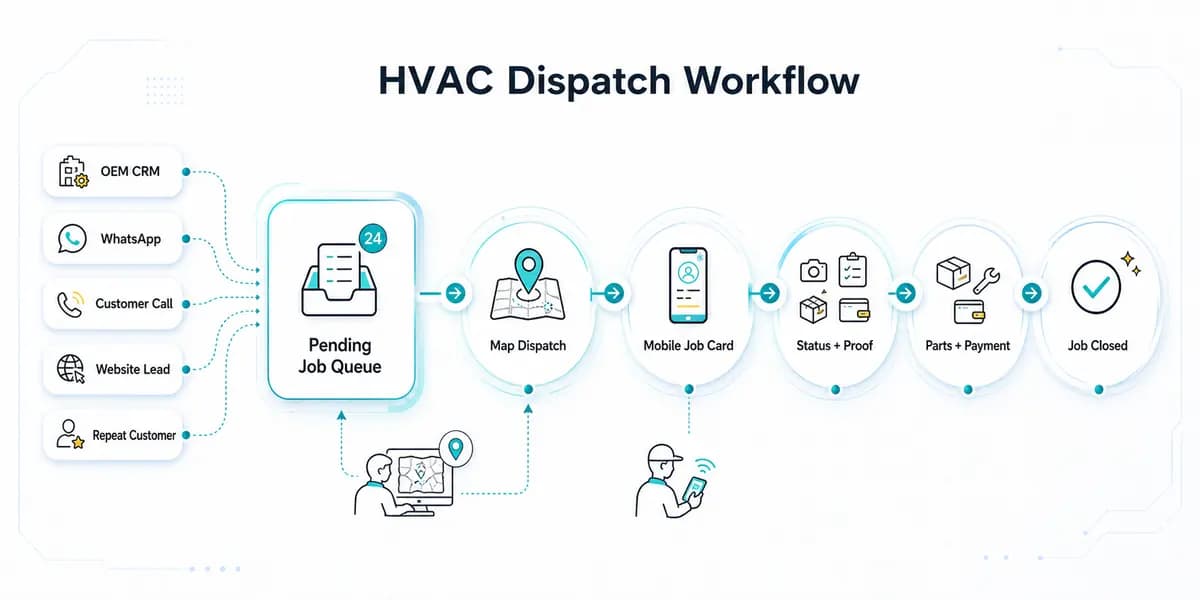
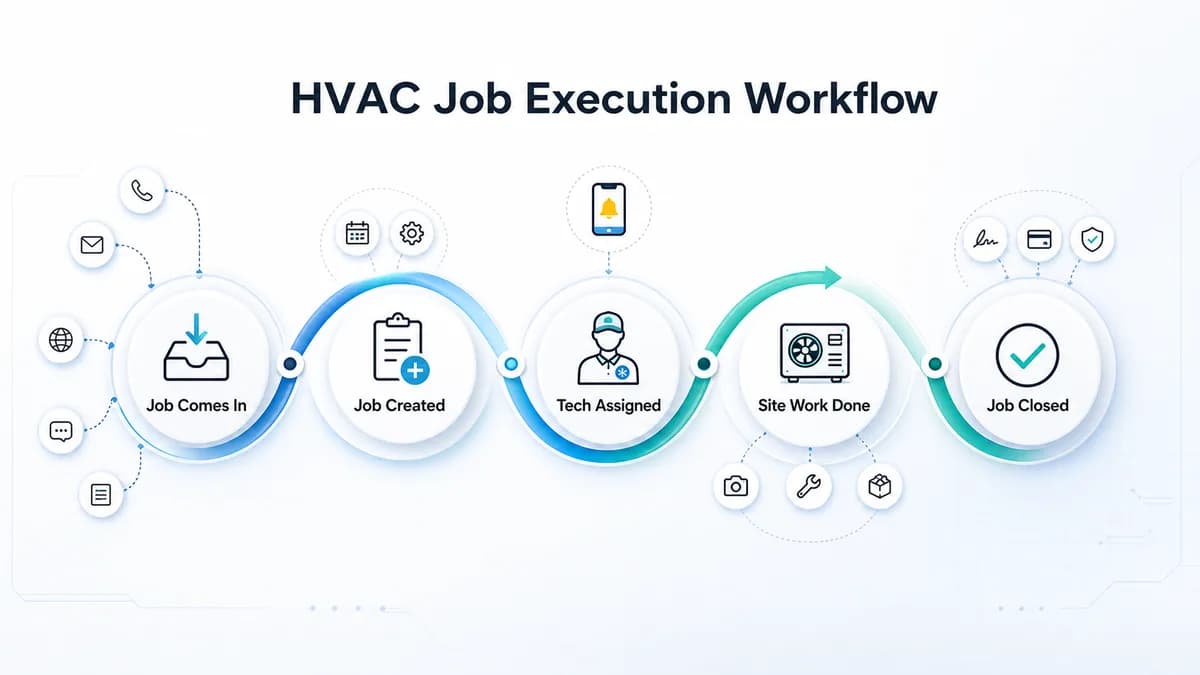
KaryaFlow
Last updated: 21 October 2026. Workflow guidance and related resources updated; the vendor-positioning notes below retain their original review date.
Most owners start looking for AC service center management software only after the business becomes painful to control. Complaints are spread across calls and WhatsApp. Technicians say a job is done, but the office does not have the photos, parts usage, or customer signature yet. Spare parts move out of the store without clear linkage to job cards. GST invoices get delayed because the service report is incomplete. AMC renewals are remembered only when a customer calls again.
The real problem is not a lack of effort. It is that the service center has outgrown informal coordination. A small AC repair business can survive on memory, paper slips, and one active coordinator. A growing repair and AMC operation cannot. Once you are juggling walk-in repairs, site visits, installations, preventive maintenance, warranty jobs, collections, and repeat complaints, you need one operating system for the business.
This guide explains what AC service center software should do, how Indian buyers should compare options, and which workflows matter more than a polished demo.
Short answer
The best AC service center management software in India is the one that connects complaint intake, job creation, technician assignment, mobile job cards, spare parts usage, GST-ready invoicing, payment tracking, and AMC follow-up in one workflow. For HVAC and AC-heavy businesses, KaryaFlow is a strong India-first option because it is positioned around technicians, AMC renewals, refrigerant and parts control, GST invoices, and field visibility. ServiceFlow is relevant for dealer-distributor and service teams that want complaints, serial tracking, AMC scheduling, and ledger visibility. Zoho FSM is a serious option for companies already using Zoho tools. RepairWorks is a strong fit for repair-center workflows that depend on digital job cards, GST billing, and customer updates, but buyers should verify how well it fits field AMC and AC service routes before choosing it.
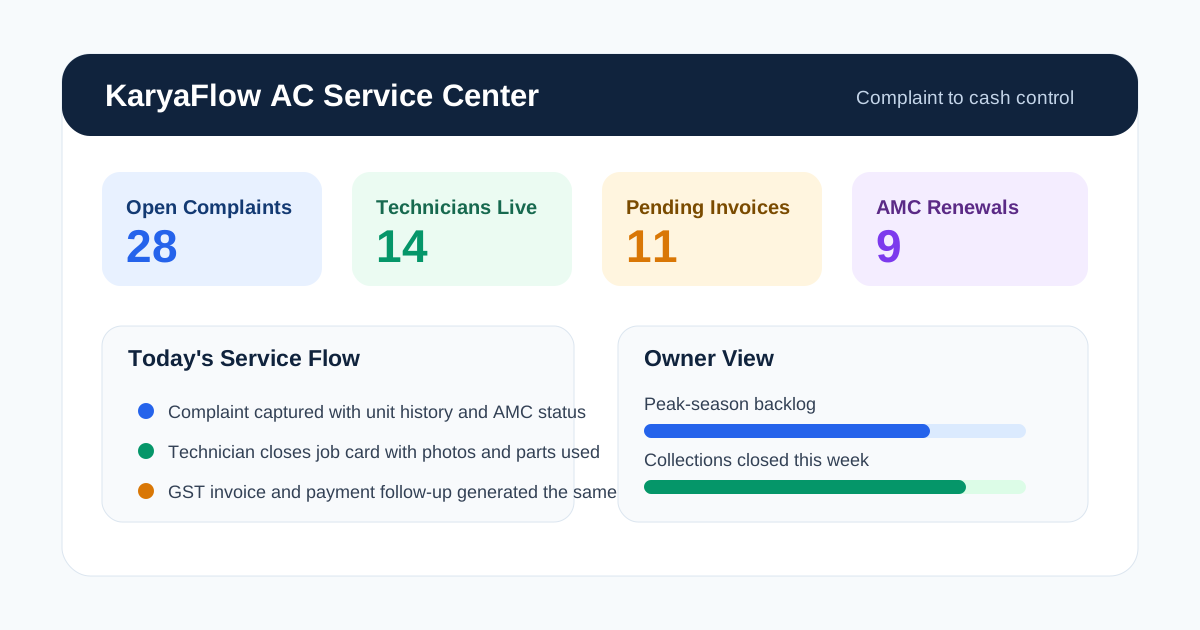 AC service center management software dashboard for jobs, technicians, invoices and inventory
The best AC service center software gives one operating view for complaints, technicians, inventory, invoices, and payments.
AC service center management software dashboard for jobs, technicians, invoices and inventory
The best AC service center software gives one operating view for complaints, technicians, inventory, invoices, and payments.
What AC Service Center Software Should Actually Do
AC service center software is not just a ticketing screen or a basic CRM with service fields. It should connect four parts of the business:
- Front desk and coordinators: complaints, service requests, quotations, job cards, schedules, and customer communication.
- Technicians: mobile jobs, checklists, site photos, signatures, parts usage, travel status, and closure notes.
- Back office: inventory, GST invoices, collections, warranty records, AMC contracts, and reports.
- Owner or branch manager: visibility into backlog, revenue, repeat complaints, overdue jobs, pending collections, and expiring AMCs.
If even one of those areas remains outside the system, the team goes back to workarounds. That is why many software purchases fail. The business buys a dashboard, not an operating model.
For AC service centers trying to connect CRM, support tickets, job cards, GST invoices, payment status, and customer history, the CRM, helpdesk, accounting, and field service workflow guide explains the source-of-truth model. For month-end technician payout, read Technician Salary Calculation Software.
AC service centers also have a more complex service mix than people admit. The same business may handle:
- walk-in device intake;
- home AC repair visits;
- commercial site complaints;
- installation and commissioning jobs;
- preventive maintenance visits;
- annual maintenance contracts;
- warranty-linked calls;
- spare parts and gas usage;
- same-day payment collection or later billing.
That is why the software choice should be based on workflow depth, not generic marketing claims.
For the daily operating routine, use the HVAC service center operations guide. Once you have a shortlist, run the HVAC software demo checklist and compare quotes with the HVAC software cost worksheet. For the product's complaint-to-billing workflow, see KaryaFlow for HVAC service centers.
Why AC Service Centers Lose Control as They Grow
The common story sounds familiar in every city. At 10 or 15 jobs a week, the office can still manage manually. At 40 jobs a week, coordination starts slipping. At 100 jobs a week in summer, everything breaks at once.
WhatsApp is fast but not reliable as a database
WhatsApp is useful for speed. It is not useful as the system of record. Messages get buried, photos are not attached to the right customer history, and nobody can tell which complaint is still open without reading threads manually.
That is why we keep recommending a workflow to replace WhatsApp and Excel with a service CRM. The goal is not to ban WhatsApp. The goal is to stop depending on it as the place where operational truth lives.
Paper job cards create billing and inventory gaps
Paper is easy to start and painful to scale. A technician can write “gas charged” or “capacitor changed,” but the office still has to decode handwriting, update stock, create the invoice, and answer the customer later if there is a repeat issue.
Once the job card is delayed, the invoice is delayed. Once the invoice is delayed, the payment is delayed. Once the payment is delayed, cash flow starts looking weaker than the actual demand.
Service history is usually incomplete
Customers do not describe the problem from scratch every time. They expect the service center to know what happened last month, which technician visited, what part was changed, whether the unit is under AMC, and whether the same issue has repeated before.
Without service history, every complaint behaves like a brand-new complaint. That wastes time and makes the business look disorganized.
Summer demand exposes every weak process
Peak-season demand does not create operational problems. It exposes the ones that already exist. Double booking, late arrivals, lost gas cylinders, delayed invoices, and missed callbacks were already happening. Summer just makes them visible.
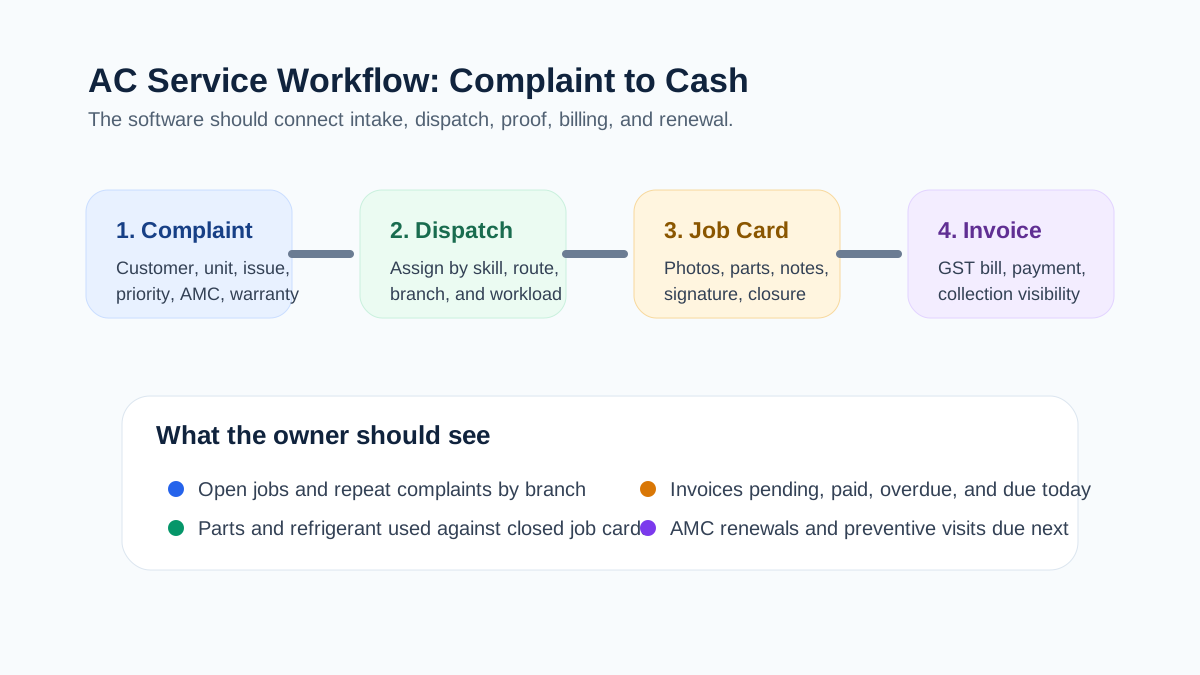 AC service center workflow from complaint intake to invoice and payment
A strong operating flow connects complaint intake, dispatch, job card closure, invoice creation, and payment collection.
AC service center workflow from complaint intake to invoice and payment
A strong operating flow connects complaint intake, dispatch, job card closure, invoice creation, and payment collection.
AC Service Center Software Options Indian Buyers Should Compare
The buyer notes below are based on public positioning and visible workflow signals as of May 25, 2026. Product features and pricing can change, so verify the exact scope in a live demo before buying.
KaryaFlow is a fit for AC service centers and HVAC teams that need field control plus billing and AMC depth. Its public positioning is around HVAC and AC service operations, technician tracking, refrigerant and parts control, GST invoice flow, UPI collection, and India-first service workflows. In a demo, verify exact modules, rollout sequence, reporting depth, and which workflows your team should configure first.
ServiceFlow is relevant for AC dealers, distributors, and service teams running orders, complaints, installations, and AMC visits. Its public positioning includes complaint tracking, serial-number inventory, warranty tracking, AMC scheduling, quotation, and ledger flow. In a demo, verify how deeply it handles service-center reporting, field proof-of-work, and advanced multi-branch operations.
Zoho FSM is a serious option for businesses already using Zoho CRM, Zoho Books, or the wider Zoho stack. Its public HVAC positioning includes work orders, scheduling, live-location tracking, scheduled maintenance, mobile access, invoicing, and WhatsApp notifications. In a demo, verify AC service-center fit, pricing across modules, and the effort needed to map your exact workflow.
RepairWorks is relevant for repair centers that need intake, parts, GST billing, and customer status updates. Its public positioning includes digital job cards, spare parts tracking, WhatsApp updates, GST invoices, and online collection flows. In a demo, verify whether your business is bench-repair-heavy or field-service-heavy, and how AMC or site-visit workflows are handled.
What the public product pages tell us
KaryaFlow's HVAC page is explicitly built around AC and HVAC service centers. It highlights technician tracking, AMC renewals, refrigerant stock visibility, GST invoices, UPI collections, and a workflow from dispatch to payment. The page lists its INR plan prices by user count rather than hiding them behind a demo, and positions the product around Indian service-center realities rather than generic CRM language.
ServiceFlow is stronger than a generic CRM in one important way: it visibly shows order flow, complaints, AMC visits, serial-number tracking, warranty tracking, quotations, ledgers, and technician dispatch on the public page. It is clearly oriented toward the appliance and HVAC trade in India. The public pricing is also easy to understand, which is rare in this category.
Zoho FSM is the best-known platform in this list and the most ecosystem-friendly if you already run Zoho elsewhere. Its HVAC page clearly covers work orders, live location, scheduled maintenance, mobile access, invoices, payments, and WhatsApp notifications. The main question is not whether Zoho has features. The real question is whether your AC service center wants a broader suite implementation or a narrower, faster service workflow.
RepairWorks looks especially strong for repair centers where intake, parts usage, GST invoices, status messaging, and collection workflows matter. Its public page is unusually clear about India-first details such as GST calculations, HSN codes, WhatsApp updates, and UPI-linked collections. But a buyer should still verify whether the field side of the operation is equal to the workshop side if technicians spend most of their time at customer sites.
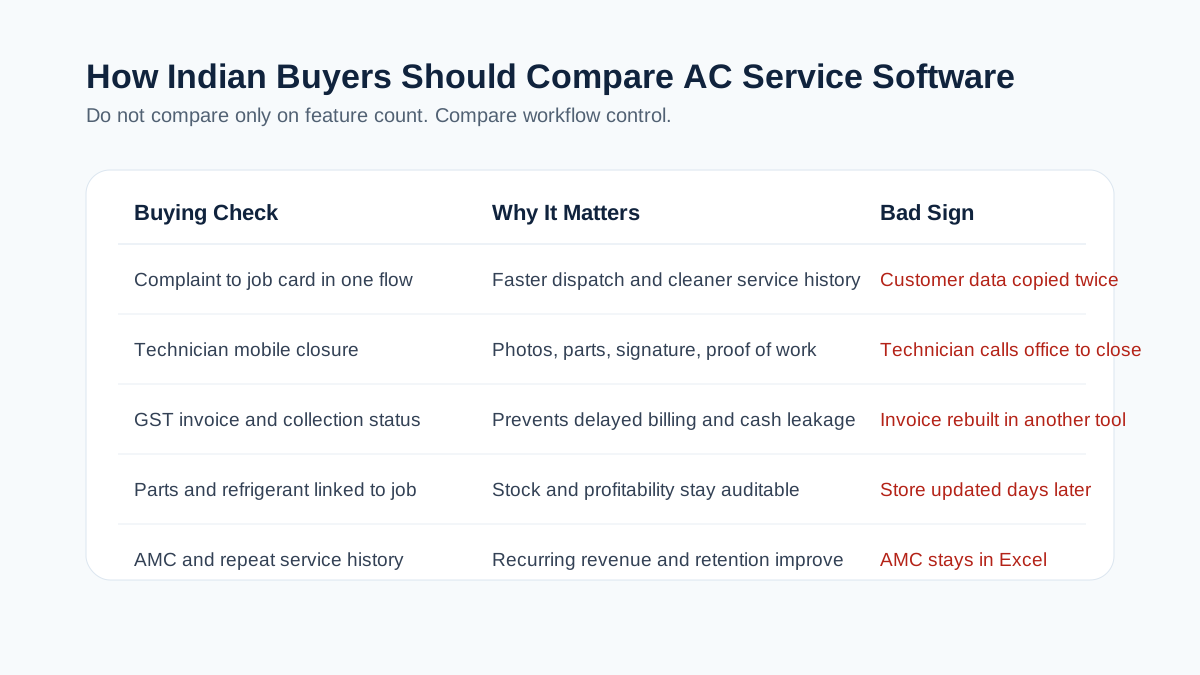 Comparison view for AC service center software options in India
Indian buyers should compare field workflow, GST billing, spare parts control, and AMC depth instead of chasing long feature lists.
Comparison view for AC service center software options in India
Indian buyers should compare field workflow, GST billing, spare parts control, and AMC depth instead of chasing long feature lists.
How to Choose the Right AC Service Center Software
1. Complaint intake should take under a minute
If a coordinator still needs multiple screens and manual duplication to create a complaint, the software will slow the team down during peak season. The system should capture customer, location, issue, unit details, urgency, source, and assignment status quickly.
It should also distinguish between:
- new complaint;
- repeat complaint;
- installation request;
- preventive service visit;
- AMC visit;
- workshop repair;
- warranty-related job.
That classification matters because reports, billing, and technician planning depend on it.
2. Technicians need a real mobile job card
The field app should be simple enough that technicians actually complete it at the site. A usable mobile job card should include:
- customer and site details;
- unit or equipment details;
- complaint notes;
- prior service history;
- checklist tasks;
- parts and gas used;
- photos;
- customer signature;
- payment or billing status;
- closure notes.
If you need a deeper feature view, our job card app for technicians guide goes deeper into checklist design and closure quality.
3. Spare parts and gas usage should be linked to jobs
Most AC service centers lose small amounts of margin in silent ways. Capacitors, contactors, sensors, fan motors, and refrigerant are used in the field, but the update reaches the office later or not at all. Then the invoice, stock, and profitability numbers stop matching.
The software should connect parts and gas usage directly to the job card. It does not have to be perfect on day one, but it has to be auditable.
4. AMC should not sit in a separate spreadsheet
An AC service center usually lives on two revenue streams: reactive service and recurring maintenance. If AMC contracts still live in Excel while repairs live inside the new software, the business has not solved its biggest operational risk.
That is why AMC management software India and HVAC preventive maintenance software are closely related topics. The best AC software should know which customer is under contract, which visits are due, which visits are completed, and which renewals need follow-up.
5. GST invoicing must match Indian reality
This is where many imported or generic tools disappoint Indian service businesses. Under the GST invoice rules published by CBIC, tax invoices need prescribed particulars such as supplier and recipient details where applicable, invoice number and date, description, value, and tax details. If the service software cannot produce the right invoice data cleanly, the office will keep rebuilding bills somewhere else.
That is why a real buyer should test:
- service line items;
- parts line items;
- GST rates and breakup;
- invoice numbering;
- PDF sharing;
- payment status;
- Tally or accounting handoff.
Our GST invoicing software for service businesses guide covers this in more detail, including what to check before moving from job closure to invoice and payment follow-up.
For warranty replacements, AMC-covered spares, delivery challans, and old-part return workflows, read the warranty and AMC replacement parts under GST guide before designing your AC service center's parts process. If the main problem is stock movement across godowns, technicians, job cards, returns, and billing, read spare parts inventory management software.
6. Owner visibility matters as much as technician productivity
The owner or branch manager should be able to answer these questions without asking three different people:
- Which jobs are still open today?
- Which technicians are delayed?
- Which parts are running low?
- Which repeat complaints are increasing?
- Which customers have not paid yet?
- Which AMC renewals are due next week?
- Which branch is closing the most jobs?
That is the difference between a service app and a management system.
A Practical AC Service Center Workflow From Call to Cash
This is the workflow I would ask every vendor to demonstrate live:
- A customer complaint is logged in under one minute.
- The office can see whether the customer has prior history, warranty, or AMC coverage.
- A technician is assigned based on skill, location, and workload.
- The technician receives the job on mobile with unit details and visit instructions.
- Parts used, photos, notes, and signature are captured on-site.
- The office or technician converts the completed job into an invoice or service report immediately.
- Payment status is tracked, whether it is UPI, cash, card, bank transfer, or later collection.
- If the customer is under AMC, the visit count and renewal pipeline update without manual re-entry.
If the software cannot demonstrate that flow on a real AC repair or installation scenario, the demo is too shallow.
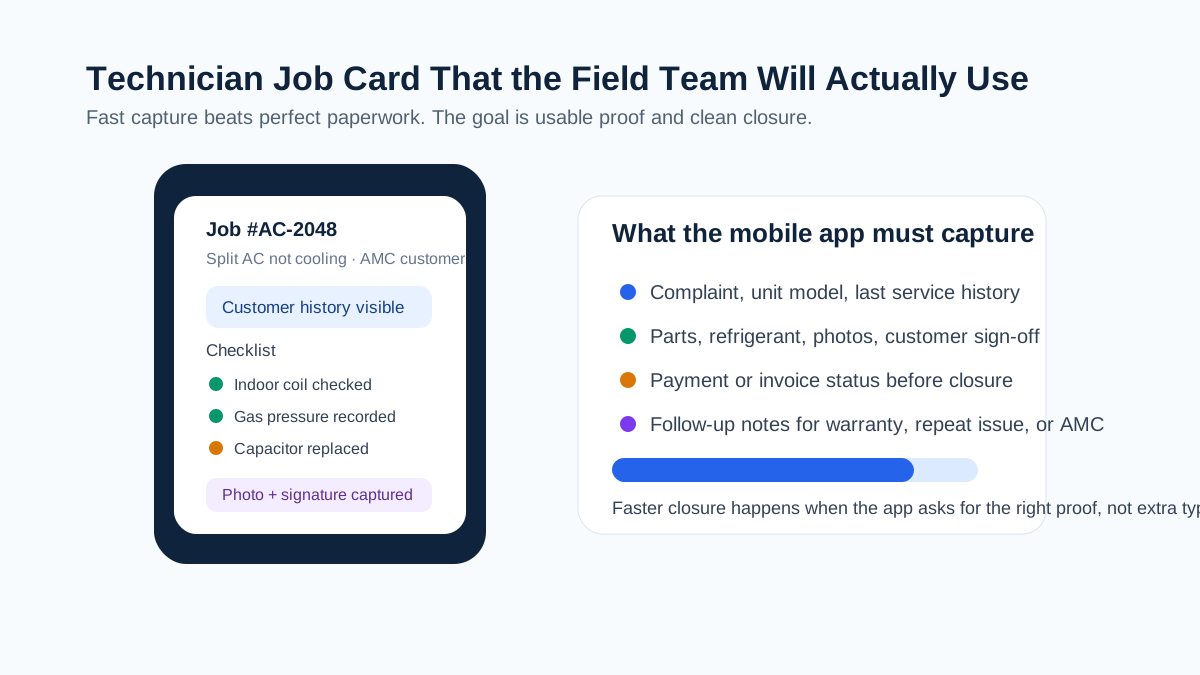 Technician mobile job card for AC service visits
If technicians cannot complete the job card on-site, the office will fall back to phone calls and WhatsApp.
Technician mobile job card for AC service visits
If technicians cannot complete the job card on-site, the office will fall back to phone calls and WhatsApp.
AC Service Center Software vs CRM vs Repair Software vs ERP
This confusion slows down a lot of buying decisions.
CRM
A normal CRM is useful for leads, customer records, quotations, and follow-up. It is usually weak at technician workflow, job closure, parts linkage, proof of work, and AMC execution. CRM is part of the answer, not the whole answer.
Repair-center software
Repair-center software is great if most of your business is walk-in intake, workshop repairs, spare parts, quotations, and pickup handover. If your operation also includes field technicians, on-site repairs, installations, and AMCs, you need to check whether the product handles those workflows natively or only through workarounds.
ERP
ERP systems can be powerful for accounts, inventory, purchasing, and organization-wide processes. They are often too heavy for a 5 to 50 technician AC service operation unless the field workflow is exceptionally well designed. If technicians avoid the app, the ERP will never become the operational source of truth.
Dedicated field service software
This is usually the right category when the business depends on dispatch, job cards, customer updates, technician status, field proof, billing handoff, and recurring service. Our broader guide on field service management software in India explains that category at the market level.
Where KaryaFlow Fits Best
KaryaFlow is strongest for Indian AC and HVAC service centers that are past the WhatsApp-and-paper stage but do not want a bloated implementation. Its public product page is built around the exact pain points most AC operators describe:
- technicians disappearing between dispatch and invoice;
- missed AMC renewals;
- refrigerant and spare-parts visibility;
- GST billing delays;
- lack of owner-level control;
- weak field proof and collections follow-up.
Check the exact mobile actions, stock entries and billing handoff your team needs. Location-based attendance is included; continuous live GPS is an optional add-on. Do not infer action-by-action offline support from a mobile-app description: use the offline acceptance checks in the demo guide to test the intended phone and plan. Confirm the current user allowance, setup scope and charges in the published pricing and your written quote.
If your business is AC-heavy, sends technicians to customer sites daily, and wants one system for dispatch, job cards, AMC, invoicing, and reporting, KaryaFlow for HVAC and AC service centers belongs on the shortlist.
What AC Service Center Software Pricing Usually Looks Like in India
Pricing in this category is rarely apples to apples. Some tools charge by users, some by branches, some by feature modules, and some by implementation scope. That is why the headline number matters less than the actual operating fit.
Still, public pricing is useful because it tells you how transparent a vendor is. As of September 24, 2026, KaryaFlow pricing is published in INR: Starter at INR 990 per month for up to 10 users and Growth at INR 2,673 per month for up to 30 users, prepaid with 18% GST shown separately, and a written Enterprise quote above 30 users. As of May 25, 2026, ServiceFlow publishes plans starting at INR 1,999 per month and a growth tier at INR 4,999 per month for broader workflow coverage. RepairWorks publicly lists plans starting from INR 999 per month and a professional tier at INR 2,499 per month. Zoho FSM's HVAC page is feature-rich, but buyers should usually expect ecosystem-based budgeting rather than a simple one-line field-service quote.
The right question is not only "what is the monthly fee?" It is:
- how many people need access;
- whether technicians need full mobile seats;
- whether AMC and inventory are included or add-ons;
- whether onboarding is self-serve or assisted;
- whether WhatsApp, payment, or accounting integrations cost extra;
- whether multi-branch visibility is standard or enterprise-only.
Cheap software becomes expensive if it forces your coordinator to work outside the system every day. Expensive software becomes wasteful if the field team never adopts it.
Common Buying Mistakes AC Service Centers Make
Buying for the office but not for technicians
The coordinator may love the dashboard while the technicians ignore the app. That means the business still runs on calls and chat messages. Any serious evaluation needs field-user testing, not only office-user testing.
Choosing a repair workflow for a field-service problem
Some service centers are mostly workshop-driven. Others are mostly field-driven. A tool that is excellent for intake and delivery can still be weak at dispatch, route visibility, and AMC execution. Match the product to your actual service mix.
Treating GST, payments, and inventory as "later"
That is a costly mistake. If job closure, stock updates, invoice generation, and collection status do not connect early, the business keeps bleeding time in reconciliation.
Ignoring reporting during the demo
The owner view is not optional. If the system cannot show open jobs, repeat complaints, technician status, pending collections, and upcoming renewals clearly, the manager will keep asking for spreadsheets.
Implementation Checklist Before You Buy
Do not judge software on a generic walkthrough. Ask the vendor to show your real business flow.
Use this checklist:
- one home-service AC complaint;
- one commercial AMC visit;
- one installation job;
- one repeat complaint with prior service history;
- one job that consumes spare parts or refrigerant;
- one GST invoice after job closure;
- one payment collection scenario;
- one overdue AMC renewal scenario;
- one technician mobile closure from the field;
- one owner report for open jobs, collections, and pending renewals.
If the vendor can demonstrate all of that cleanly, you are looking at a serious service-center product.
FAQs
What is AC service center management software?
It is software that helps AC repair and service businesses manage complaints, job cards, technicians, parts, invoices, payments, and customer follow-up from one place.
Who needs AC service center software?
AC repair shops, HVAC contractors, installation teams, AMC businesses, multi-branch service centers, and mixed workshop-plus-field operations all benefit from it once manual coordination starts creating delays.
Can it handle both workshop jobs and field jobs?
The better tools can, but you need to verify this in the demo. Some products are stronger at counter intake and workshop repair, while others are stronger at field dispatch and AMC.
Does AC service center software support AMC contracts?
It should. At minimum, the system should track contract dates, included visits, service history, renewal due dates, and technician job closure under the contract.
Can technicians use the software on mobile?
They should be able to. A technician app is now basic infrastructure for any service center that sends people to sites regularly.
Can the software create GST invoices?
Many tools claim this, but buyers should test actual invoice output. The system should capture the right service details, tax breakup, numbering, and payment linkage for your billing process.
Is WhatsApp integration enough on its own?
No. WhatsApp is useful for updates and communication, but it is not a clean operating database. The job, invoice, and service history should still live in the software.
What is the difference between AC service software and CRM?
CRM focuses on leads and customer records. AC service software focuses on execution: complaints, dispatch, job cards, parts, invoices, and service history.
What is the difference between AC service software and ERP?
ERP can cover wider business processes, but it may be heavier than what a service center needs day to day. The key issue is whether technicians and coordinators can use it comfortably in live operations.
How much does AC service center software cost in India?
Public pricing varies widely. Some India-first products list entry plans in the low thousands of rupees per month, while broader platforms require a demo-based quote or ecosystem budgeting. KaryaFlow publishes INR 990 per month for up to 10 users, INR 2,673 per month for up to 30 users, and a written quote above 30 users, with 18% GST extra.
What should I ask during a vendor demo?
Ask the vendor to run one complete complaint-to-invoice workflow, one repeat complaint, one AMC visit, one spare-parts-linked job, and one owner report. Do not settle for feature slides.
Which software is best for a growing AC service center?
The best choice depends on whether your business is more field-service-heavy, workshop-heavy, or AMC-heavy. For Indian HVAC and AC operations, shortlist products that show technician workflow, parts, GST billing, and customer communication clearly in public or live demos.
Final Take
AC service center management software matters because control matters. A business can survive a few manual workarounds, but it cannot scale on delayed job cards, invisible technicians, late invoices, and missed AMCs forever.
If your business is still coordinated through calls, WhatsApp, paper slips, and memory, do not ask only which product has the longest feature list. Ask which software will help your team move from complaint to closure to invoice to renewal with the least friction.
That is the standard worth buying for.