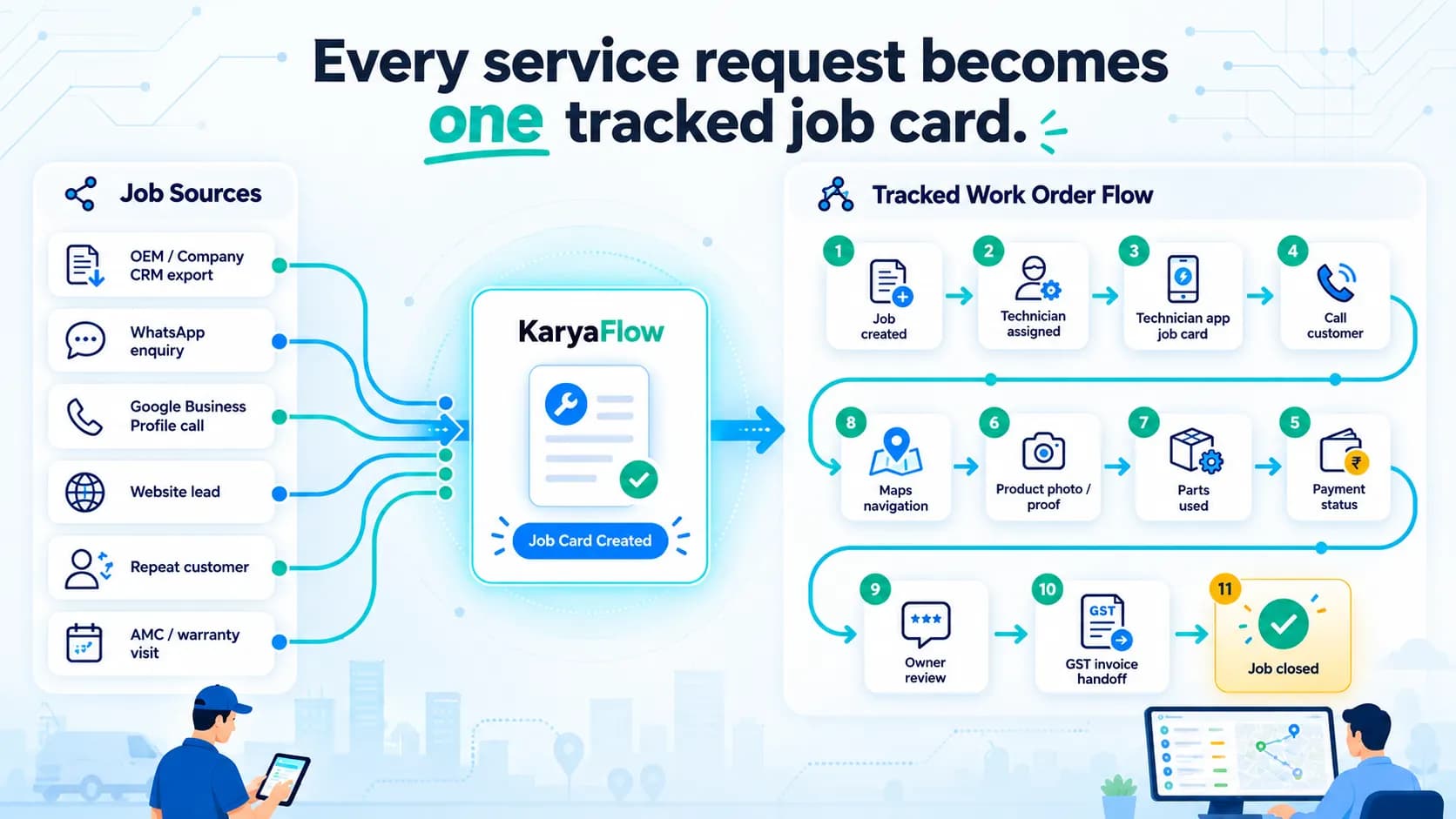
KaryaFlow
Last updated: 2 October 2026.
Keep your current Tally-led setup if the team can assign, prove and bill every job without losing records. Consider an FSM layer when important work has no clear owner or accounts repeatedly waits for missing field details. More apps are not automatically a better process.
This guide helps a small service team decide whether it needs to evaluate new software at all. It does not rank vendors or prescribe a migration. Once the need is clear, use the Tally, attendance and GPS comparison to compare the operating models.
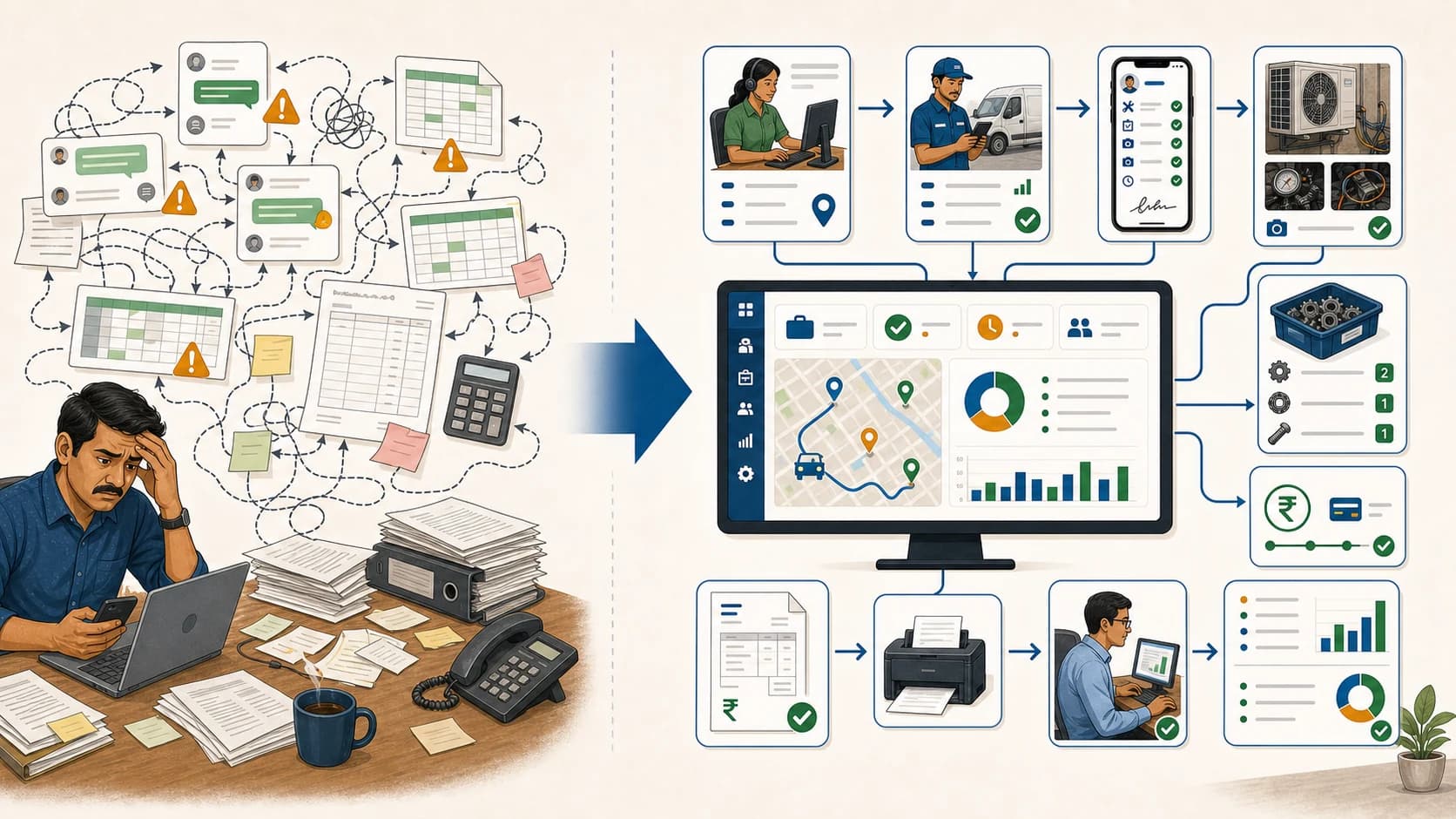
 Service workflow showing accounting, attendance, GPS, job proof, payments and the owner dashboard
Check whether the records connect before deciding to add another tool.
Start with the problem, not the software category
If your only problem is an accounting report, first check your accounting setup and training. A field service system may not fix it. If your main problem is missed visits or missing proof, inspect the service workflow before changing the books.
Tally, attendance tools and tracking apps can play useful roles in a service business. Their value depends on the configured process and any connected products. Do not assume an entire product category lacks a feature because your current setup lacks it.
Separate the questions you need answered:
- Accounts: can we record and reconcile the transaction?
- Attendance: who was available to work?
- Dispatch: who owns each open visit?
- Service: what happened at the customer site?
- Billing: is the approved job record complete?
A job register may be enough to connect those answers for a small team. The readiness check below helps you see where it stops being reliable.
Review a sample of recent jobs
Choose completed, delayed, unpaid and repeat jobs from your own records. Include different technicians and job types. This is a practical diagnostic sample, not a statistical audit or a scored industry benchmark.
Scroll sideways to see every column if needed. With a keyboard, focus the table and use the left and right arrow keys.
| Check | A controlled process shows | A gap to investigate |
|---|---|---|
| Job ownership | Named technician and next action | The customer must explain the job again |
| Status | Current state and reason for delay | Office and technician give different answers |
| Proof | Work notes and required approval | Photos sit in a private chat with no job link |
| Parts | Issued, used and returned quantities | Stock is updated later from memory |
| Expenses | Claim, reason and approval | Accounts cannot match the claim to work |
| Payment | Amount, reference and remaining balance | A screenshot is the only receipt context |
| Billing | Approved details accepted by accounts | Completed jobs wait for missing fields |
For every gap, write down its cause, owner and next step. Avoid turning the exercise into a count of features you do not have. The question is whether the missing control affects real work.
When a simple setup is still enough
Keep the current setup when one coordinator can maintain a clear job register and the team follows it. Every visit should have an owner, required proof and a known billing state. Accounts should know which records are approved.
A simple process still needs discipline. Use stable job numbers, a shared status list and a clear place for attachments. Check the register regularly and record exceptions. An expensive system will not choose those rules for you.
If the same gaps disappear after this cleanup, you may not need a new platform yet. Keep checking the process as your team or workload changes.
When to evaluate an FSM layer
Evaluate FSM when manual controls remain fragile despite clear rules and ownership. Examples include frequent reassignment, technician-held stock, mixed AMC and paid jobs, or many people editing the same record. Explain the failure you need to prevent before asking vendors for a demo.
There is no universal technician count or missing-job threshold that proves a business needs FSM. Use the consequence of the gap: a missed visit, disputed work, unreconciled part or delayed bill. Set your own priorities from those records.
The FSM demo checklist for Tally users turns those requirements into tests. Ask vendors to demonstrate your difficult cases, not only their standard tour.
Do you need attendance, GPS or job proof?
These are separate controls. Attendance with location check-in records a moment in the workday. Continuous GPS can provide route context. Job proof records the work itself. Buying one does not remove the need for the others.
KaryaFlow's pricing includes location check-in and quotes continuous live GPS separately. Confirm your actual need before adding tracking. Neither a route nor a check-in should replace customer-site notes and the required approval.
For a location-led buying decision, use the GPS-enabled field service guide. For claims and allowances, use the technician expense review process.
Make a small, reversible next move
If the review shows a process gap, agree a named owner and test a better job record first. If it shows a software gap, write the requirement and run a limited pilot. Retain access to the old records while checking that the new output is complete.
Do not switch accounting systems merely because you are changing dispatch. Agree how approved job details will reach accounts. The GST invoicing guide and Tally integration checklist cover the later handoff decision.
FAQ
Does every service team using Tally need FSM?
No. A small team can keep a simple setup if jobs, proof and billing records stay complete. Evaluate FSM when specific gaps remain after process and ownership are clear.
Should I replace accounting software to fix missed visits?
First inspect dispatch and job ownership. Missed visits may be an operational problem that can be fixed while keeping the existing accounting system.
How many failed checks mean we must buy software?
There is no universal score. Consider the cause, frequency and consequence of each gap, then test the smallest change that addresses it.
What is the next step if our current setup is insufficient?
Write the missing controls as requirements and test them with a vendor. Keep the accounting handoff, GPS scope and full quote explicit before deciding.
Source and scope
Pricing scope checked on 2 October 2026. The diagnostic is an editorial decision aid, not evidence of measured time savings or a claim that Tally lacks all field-service extensions.