KaryaFlow
Last updated: 2 October 2026.
A technician's attendance record does not, by itself, justify a fuel or food claim. Before an expense reaches Tally, match the claim to assigned work, the visit record, receipts and your allowance policy. Keep a clear reason for each approval or exception.
This guide is for service owners and supervisors who review field expenses before accounts posts them. It covers the daily checks between attendance and accounting. For the broader choice of tools, start with the Tally, attendance and GPS stack comparison.
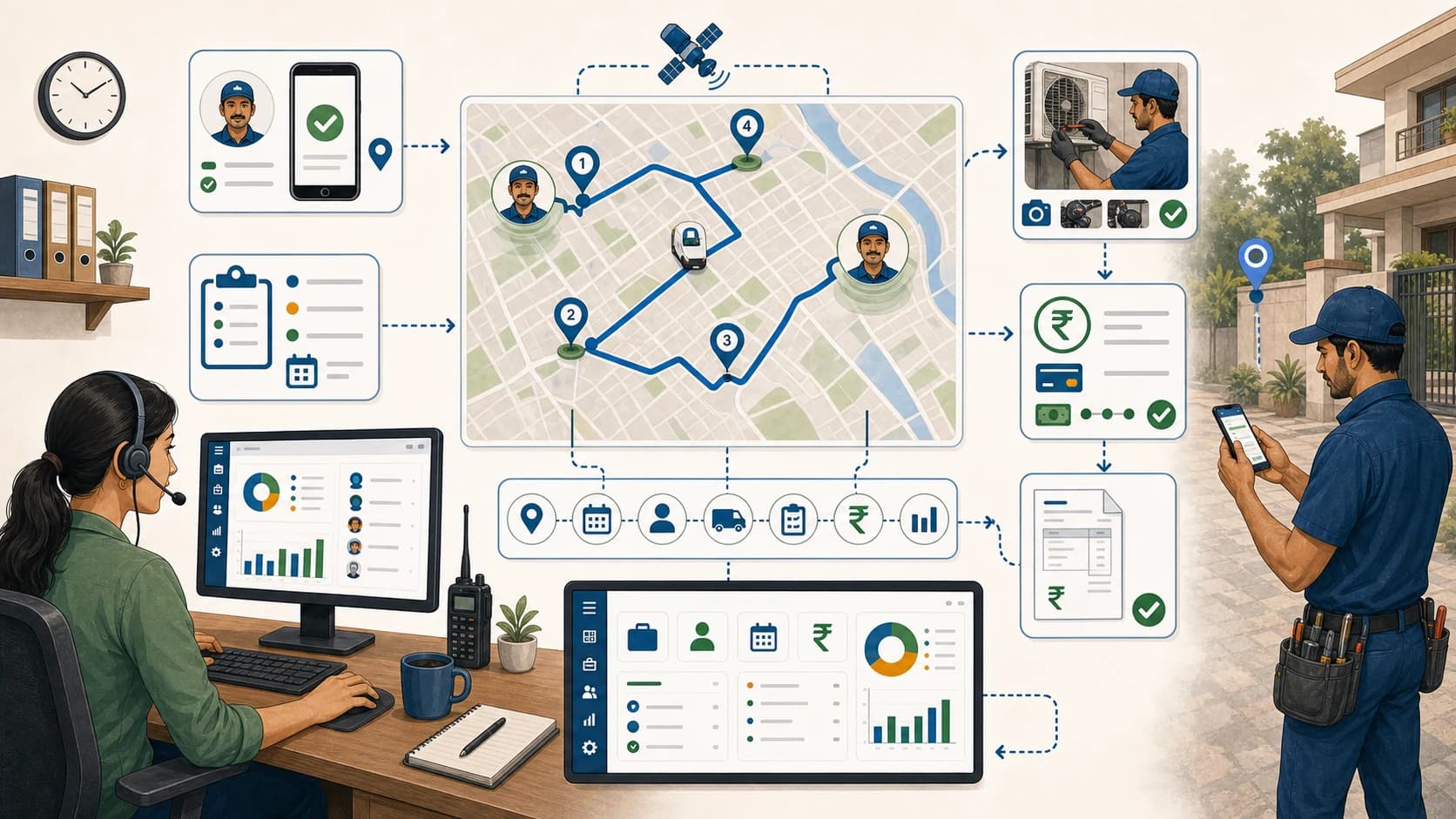
 Tally attendance and expense review workflow connecting jobs, location context, proof, payments and accounts
The job record provides context for an expense. Accounts still applies the company's accounting policy.
What to check before approving a technician expense
Review each claim against a job or an approved non-job activity. A check-in can support the review, but it does not explain the purpose of a trip. A receipt shows a purchase, but it may not show who needed it.
Scroll sideways to see every column if needed. With a keyboard, focus the table and use the left and right arrow keys.
| Record | What the reviewer needs | What it cannot prove alone |
|---|---|---|
| Attendance | Date, shift and technician | That a customer job was completed |
| Job assignment | Customer, site, task and assigned technician | That the visit actually happened |
| Visit proof | Notes, photos or customer acknowledgement | That every claimed expense was needed |
| Travel record | Route context and any approved detour | Whether a missing GPS point means no travel |
| Expense claim | Category, amount, receipt and reason | Whether company policy permits payment |
| Approval | Reviewer, decision and reason | That the accounting entry has been posted |
Keep the records linked by a stable job number. The reviewer should not have to match a receipt to a customer using memory alone.
Fuel and local travel claims
For a fuel claim, first establish the rule the business uses. Some teams pay a fixed daily allowance. Others reimburse an approved distance or actual transport cost. Do not apply one rule to every claim without telling the technician.
Check the assigned sites, visit order, starting point and approved detours. A parts pickup or an urgent reassignment may explain a route that differs from the plan. Ask for that context before rejecting the claim.
Location data is supporting evidence, not a complete record of intent. A stale location, a disabled permission or poor connectivity can create gaps. Record the explanation and the reviewer decision rather than treating every gap as misconduct.
KaryaFlow's pricing page separates included attendance with location check-in from continuous live GPS and route history, which are quoted separately. Ask which travel records your plan captures before using them in an expense policy.
Food allowances and overnight visits
Food and overnight claims need an agreed policy before the first field visit. Define eligible shifts, travel areas, receipt requirements and who can approve an exception. A technician should know the rule before spending money.
For each claim, retain:
- the technician and work date;
- the linked job or approved activity;
- the expense type and amount;
- the receipt, where policy requires one;
- the reason for an exception;
- the approver and approval date;
- the payment or reimbursement reference.
Use separate categories for salary, allowances, advances and expenses. Combining them into one amount makes later questions harder to answer. For the wider process, see expenses, wages and job payments.
An illustrative review: two visits and a parts pickup
Suppose a technician completes a morning repair, collects a spare from stores, then returns to another customer. The technician claims travel and a meal allowance. This is an example of a review process, not a measured customer result.
The supervisor checks both job numbers and the store pickup record. The travel claim is compared with the approved route policy. The meal claim is checked against the shift rule. If a customer moved the appointment, that change stays on the job record.
One claim may be approved while another needs a receipt. Keep those decisions separate. Do not hold back a valid claim simply because a different line needs more information.
When attendance and a simple register are enough
A small team may manage this process with an attendance tool and a shared expense register. That can work when a named supervisor checks every claim and the records stay complete.
Consider a job-linked field service system when the reviewer must repeatedly search chats for receipts, visit proof or spare-parts records. Other warning signs include duplicate claims, unassigned trips and no clear owner for disputed expenses. First define the control you need; then test whether the software supports it.
KaryaFlow can be evaluated for job records, expenses and attendance context. In a demo, ask the team to show a real claim with its proof and approval history. Confirm the exact record links, permissions and exports rather than assuming them from a feature label.
The handoff to accounts
Send accounts the approved amount, category, job reference, receipt and approval record. Include any advance already paid so the same cost is not reimbursed twice. A job marked complete and a claim marked approved are different events.
TallyHelp documents Excel imports with mapped fields. That does not establish a ready-made KaryaFlow connection. Agree the export format and accounting mapping with your finance team, then test a small sample.
Keep rejected or disputed claims out of the approved batch without deleting their history. Give each returned item an owner and a next action. For the customer billing side, use the proof, payment and invoice handoff checklist.
FAQ
Does attendance prove a technician's expense is valid?
No. Attendance can support a claim, but the reviewer also needs the job, expense purpose and policy. A receipt or location point should be checked in that wider context.
Can a GPS gap be used to reject a fuel claim automatically?
A gap alone is not enough to explain what happened. Check device permissions, connectivity, job changes and the technician's explanation against your written travel policy.
Does KaryaFlow replace Tally for expense accounting?
This workflow keeps the field review separate from the accounting entry. Confirm how approved records reach your finance system; do not assume native sync or payroll processing.
What should a vendor demonstrate for expense review?
Ask for a claim linked to work, supporting proof, an approval and a returned exception. Use the FSM demo checklist for Tally users to test the full job-to-accounts path.
Sources and scope
Product pages checked on 2 October 2026. The review steps are practical suggestions, not a tax or employment-policy ruling. Have the responsible finance and operations leads agree the rules before use.