On this page
When we started marketing KaryaFlow, we visited RO service center owners in our local areas. Some were distributors of well-known purifier brands. Some were service partners. Some had grown from technician-led businesses into small local service centers with repeat customers, AMC work, breakdown calls, and filter replacement revenue.
The same complaint came up again and again: technician mismanagement.
Owners were not only worried about whether a technician reached the customer site. They were worried about salary, house allowance, food allowance, fuel allowance, parts used, old customer leads, missed follow-ups, payment status, and whether the business was leaking money even when service calls were happening every day.
Short answer
RO service center technician management breaks when technician salary, allowances, field visits, parts used, customer proof, payments, and follow-ups are tracked in separate places. KaryaFlow is useful for this kind of service business because it connects customer records, technician assignment, mobile job cards, parts, expenses, payment status, AMC context, and owner visibility in one workflow.
This article is a field note from KaryaFlow marketing visits. It is not a generic software list. It records the operational problems owners described when they were still using registers, WhatsApp, Excel, phone calls, and disconnected apps.
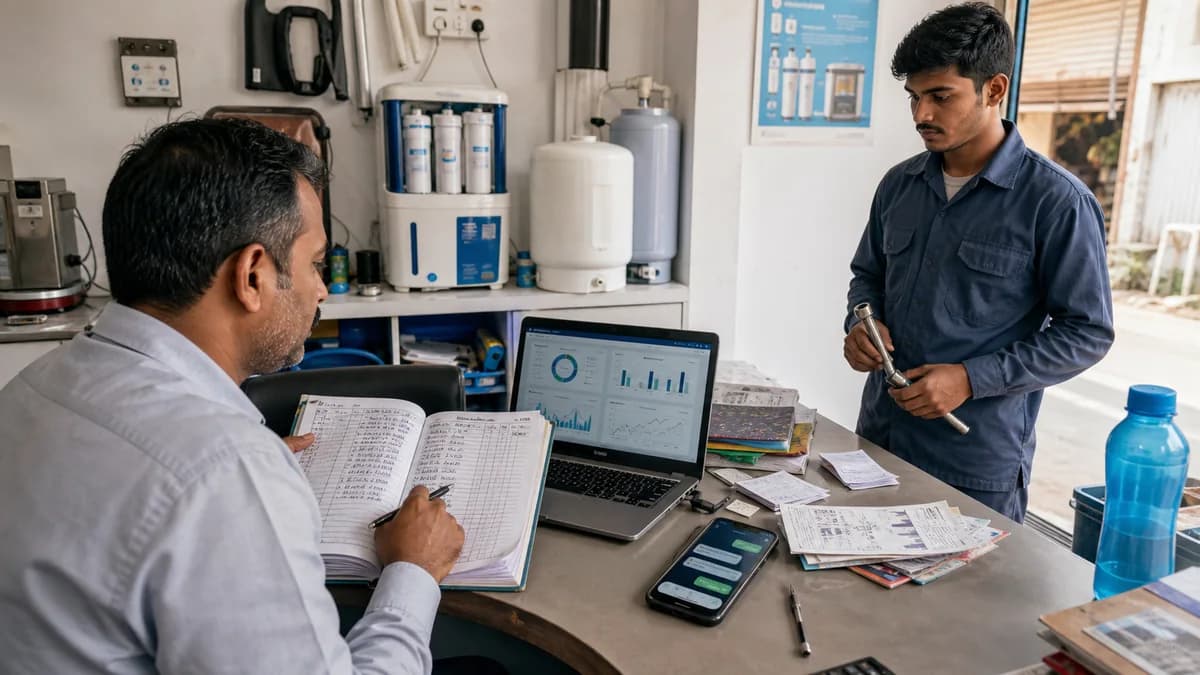 RO service center owner reviewing old registers while a technician stands near purifier parts
Why many owners still choose pen and paper
RO service center owners still choose pen and paper when software does not match their real service workflow. When we spoke to different service business owners, one thing became clear: their workflow is much wider than it looks from outside.
An RO service job is not simply "create a job and send a technician." The owner may need to handle the first enquiry, check warranty or AMC status, assign the right technician, give fuel allowance, track parts, collect payment, update the customer, prepare GST billing details, and follow up again after a few months.
That is why many owners still prefer pen and paper. It is not because they do not understand software. It is because most apps were not built around their actual workflow.
Paper is flexible. WhatsApp is familiar. A notebook can hold whatever the owner wants to write. A generic app may look modern, but if it forces the owner to change the way the service business actually runs, the team slowly returns to registers, calls, and separate tools.
The real problem is not that service owners hate software. The real problem is that many tools solve only one part of the work.
The custom software problem
Custom software can fit a service business, but it usually becomes expensive when every workflow change needs development, testing, hosting, and maintenance. Some service business owners still think about building their own software or mobile app because every service business has its own operating style.
But custom software is expensive for a reason. A developer has to understand the workflow, build the admin side, build the technician app, test it, host it, maintain it, fix bugs, and keep changing it when the business changes.
Then every small change can become another cost:
- a new field in the job form;
- a different approval rule for expenses;
- a custom report for fuel or technician allowance;
- a change in billing workflow;
- a new WhatsApp or lead source;
- a new dashboard for the owner;
- maintenance, hosting, and support every month.
For many Indian service businesses, that cost is difficult to justify before the workflow is already proven.
KaryaFlow becomes a practical middle path for Indian service businesses that want a tested workflow without starting from zero. The KaryaFlow features were not imagined from a desk. They came from ground conversations with service business owners and were tested against real service workflows: admin dashboard, technician mobile app, jobs, attendance, expenses, parts, payment status, billing handoff, and follow-ups working together.
The technician management problem we kept hearing
One service center owner told us he used to hire technicians on monthly pay. He gave them a fixed salary, house allowance, food allowance, and fuel allowance. This is common in Indian service centers, especially in RO, appliance, AC, and other local after-sales businesses.
Both authorised and unauthorised service centers often work this way. The technician is not only a worker in the field. He is the person carrying customer trust, spare parts, payment conversations, brand reputation, and repeat-service opportunity.
That creates many places where revenue can leak:
- a technician may visit but not update the office properly;
- fuel claims may not match actual route or assigned jobs;
- parts may be issued but not billed, returned, or explained;
- payment may be collected but not connected to the job;
- a customer may need a revisit but nobody marks it;
- a lead may come in from an old customer and disappear in WhatsApp;
- the owner may pay allowances without knowing which work created revenue.
This is why technician management is not only attendance. It is service-business control.
For broader technician operations, read Technician Tracking App India. For parts, expenses, and payments on one job, read Track Technician Expenses, Parts and Payments.
Where revenue gets leaked
Service owners spend money to acquire customers. They run ads, collect referrals, handle calls, maintain local reputation, support brand partners, and keep technicians ready for customer visits.
If the workflow is leaky, the owner may still look busy and still lose money.
The leak is not always obvious. It can sit in small daily gaps:
| Leakage point | What the owner sees | What is actually happening |
|---|---|---|
| Technician allowance | Salary, food, house, or fuel is paid every month | Owner cannot clearly connect allowance cost to completed billable work |
| Parts usage | Filters, membranes, valves, or fittings leave stock | Office does not know whether the part was used, returned, covered, or billed |
| Missed follow-up | Customer does not call again | The business forgot renewal, revisit, or payment follow-up |
| Delayed invoice | Accounts waits for details | Job proof, parts, or payment status was never captured cleanly |
| Old customer register | Names and phone numbers sit in books | Past customers are not nurtured into repeat service or AMC revenue |
Many owners already use software for expense tracking, GST filing, payroll, location tracking, or accounting. The problem is that these tools are often separate. If they do not sync around the service job, the owner returns to the same headache: asking people what happened.
KaryaFlow is designed around the service job as the main record. The technician, parts, expenses, payment state, proof, and follow-up should all point back to the same customer work.
Fuel allowance is one of the clearest revenue leakage points in RO service centers. Many owners pay fuel money, food allowance, and other daily or monthly expenses to field staff. If fuel claims are not connected to assigned jobs, routes, and completed work, leakage becomes difficult to prove. The owner may feel something is wrong, but the records are too scattered to check it cleanly.
 Technician mismanagement and paper records flowing into a dashboard
Leads are not just leads
In every service business, leads matter because the owner paid something to get that customer. It may be ad spend, a referral discount, years of local reputation, a distributor relationship, or technician goodwill.
If a lead gets lost, the loss is not only the cost of that lead. The real loss is the future service value.
For an RO service center, one customer can create:
- installation revenue;
- first service call;
- filter replacement;
- AMC renewal;
- emergency complaint visit;
- referral to a neighbour;
- upgrade or new purifier purchase;
- paid revisit after warranty;
- repeat business across home, office, or shop sites.
So if the owner spends X to acquire a lead, losing that lead may feel like X, but the practical loss can be much higher because the customer could have given service revenue again and again.
This is why lead management and service history should not be separated. A lead becomes a customer. A customer becomes a job. A job becomes service history. Service history becomes future follow-up.
For the customer-history workflow, read Repeat Visit Job History Software India. For service follow-up and delayed invoice control, read Service Follow-Up and Delayed Invoice Software India.
Old registers are a gold mine
One owner we met had many old registers and leads from 2012, from the time when he was working as a technician.
He had years of customer names, numbers, service notes, and local relationships. But he had never used those leads properly.
That is a gold mine.
Old registers can contain:
- customers who bought purifiers years ago;
- customers whose filters may be overdue;
- customers who may need AMC follow-up;
- customers who moved from warranty to paid service;
- customers who gave referrals earlier;
- local societies, offices, shops, and families that already trusted the technician.
The issue is that a register cannot automatically remind the business, segment customers, assign follow-ups, or connect old service history to a new job. It stores memory, but it does not create action.
 Old service registers and paper leads beside a modern service dashboard
What a system should do with old leads
A practical RO service management system should turn old service records into usable follow-up lists instead of leaving them inside registers.
Start with these fields:
- Customer name.
- Phone number.
- Area or address.
- Product or purifier type.
- Last service date if available.
- Last part or filter replaced if available.
- Whether the customer was warranty, AMC, paid, or pending.
- Next action: call, WhatsApp, service reminder, AMC offer, or no action.
- Follow-up owner.
- Follow-up date.
Do not import everything blindly. Clean the data in batches. Start with the most recent register, the highest-value local area, or the customers most likely to need filter replacement or AMC renewal.
Once the RO customer is active again, the future work should not return to the register. The revived customer should become a live customer and service record.
For RO-specific recurring service, read Water Purifier AMC Management Software.
Why multiple apps bring owners back to the same problem
Many service owners try to solve the problem by adding more tools:
- one app for technician location;
- one app for payroll;
- one tool for expenses;
- one tool for GST filing;
- one spreadsheet for parts;
- one WhatsApp group for jobs;
- one notebook for old customers;
- one billing tool for invoices.
Each tool may be useful by itself. The problem is that no single tool answers the service owner's real question:
Which customer job created this cost, this part movement, this technician visit, this payment state, and this future follow-up?
If the owner still has to ask the office, the technician, the accountant, and the storekeeper for the full story, the system has not solved the operating problem.
Billing apps cannot replace RO service management software because the service job starts before the invoice. We saw owners using billing apps such as Vyapar or myBillBook for invoices. Those apps can be useful for billing work, but the owner still needs to know who created the job, who assigned it, which technician went, which part was used, what expense was submitted, whether the customer paid, and whether the job is ready for accounts.
So the question is not "Should a billing app exist?" The question is "Where does the service truth live before billing?"
For most service centers, billing software should receive clean job information. It should not be the place where the owner tries to reconstruct the whole service story after the work is already done.
For this comparison, read What KaryaFlow Replaces in a Service Center Software Stack and GST Billing Software India: Quotations, E-Way Bills and Field Service Handoffs.
What KaryaFlow should become for a service center
KaryaFlow should become the operating flow between customer demand and completed service.
For an RO service center, that means:
- customer records from old and new leads;
- enquiry and follow-up ownership;
- job creation from the office, bulk lists, or connected lead sources;
- technician assignment;
- connected admin web app and technician mobile app;
- job status;
- mobile job card proof;
- parts used and returned;
- technician expenses and allowances connected to work;
- fuel and route context reviewed against assigned work;
- payment status;
- AMC and filter replacement reminders;
- invoice-ready handoff;
- owner dashboard for leakage and follow-up.
The owner should not have to choose between memory, WhatsApp, Excel, and disconnected apps. Jobs should be created in one place, leads should not disappear, technicians should receive assigned work in the mobile app, and the owner should know what is open, what is completed, what is unpaid, what needs follow-up, and where money may be leaking.
If a service business wants WhatsApp enquiries to become trackable work, the important change is simple: do not let the lead stay only inside a chat. Bring it into the service workflow, assign it, track it, and close it with proof.
For a broader operating-system view, read Field Service Software for Growing Businesses and How Indian Service Businesses Can Replace WhatsApp and Excel With a Simple Service CRM.
A simple checklist for RO service owners
If you run an RO or purifier service center, use this checklist to see whether technician leakage, old leads, parts, and payment follow-up are being controlled:
- Do I know which technician visited each customer last time?
- Do I know which filter, membrane, or part was used?
- Do I know whether the customer paid, is pending, or needs invoice follow-up?
- Do I know which old customers are due for service?
- Do I know how much technician allowance is connected to billable work?
- Do I know which jobs became repeat complaints?
- Do I know which AMC customers are close to renewal?
- Do I know which leads from old registers can be revived?
If the answer is no, the RO service center does not only need more effort. The RO service center needs one system for customers, jobs, technicians, parts, expenses, payments, and follow-ups.
FAQ
Why do RO service centers lose money even with regular jobs?
RO service centers can lose money even with regular jobs when technician salary, allowances, fuel, parts, payment status, and follow-up work are not connected to the actual service job. The business may look busy on paper but still leak margin through unbilled parts, missed renewals, delayed invoices, repeat visits, and poor repeat-customer tracking. This is why job volume alone is a weak measure of service business health.
Are old service registers useful for RO businesses?
Yes. Old service registers are useful for RO businesses because they can contain customers who already know the technician or service center. Those records can become filter replacement reminders, AMC renewal calls, paid service jobs, and referral opportunities if they are cleaned and moved into a follow-up system. For a local RO business, old leads are not dead data; they are warm service history that can be reactivated.
Is technician tracking enough for service center control?
No. Technician tracking is useful for a service center, but the owner also needs job proof, parts usage, payment status, expenses, allowance context, customer history, and next follow-up. Location alone does not explain whether the job made money. A technician can reach the site and still miss part billing, skip proof, delay payment collection, or leave the customer without a proper next-service reminder.
How does KaryaFlow help RO service centers?
KaryaFlow helps RO service centers connect customer records, technician assignment, mobile job cards, parts, expenses, payment status, AMC reminders, old-lead follow-up, invoice handoff, and owner dashboards in one service workflow. This matters because RO service owners often run billing, technician updates, registers, WhatsApp, and follow-ups in different places. KaryaFlow brings those steps into one track so the owner can see the work, cost, and next action together.
Why not build custom software for a service business?
Custom software can work for a service business when the owner has the budget, internal clarity, and long-term maintenance plan. For many small and growing service businesses, it becomes expensive because every workflow change, report, app update, hosting issue, and support request adds cost. KaryaFlow gives service owners a tested workflow without starting from zero, while still focusing on real service operations such as jobs, technicians, parts, expenses, payments, AMCs, and follow-ups.
Can a billing app replace service management software?
No. A billing app cannot replace service management software for an RO service center. Billing apps can help with invoices, but service management starts before billing. A service business still needs enquiry tracking, job assignment, technician mobile updates, proof, parts, expenses, payment status, and follow-up history before the invoice is prepared. If those steps stay outside the system, the owner only digitizes the bill, not the workflow that creates the bill.
Field note
This article is based on KaryaFlow's direct marketing conversations with RO service center owners in local Indian markets. The exact business details vary by service center, but the pattern was consistent: the owner needed one reliable workflow for technicians, old leads, parts, payments, and follow-ups.
Ready to modernize your service operations?
Join 50+ service centers already using KaryaFlow. Setup in under 30 minutes, GST-ready from day one.
You might also like
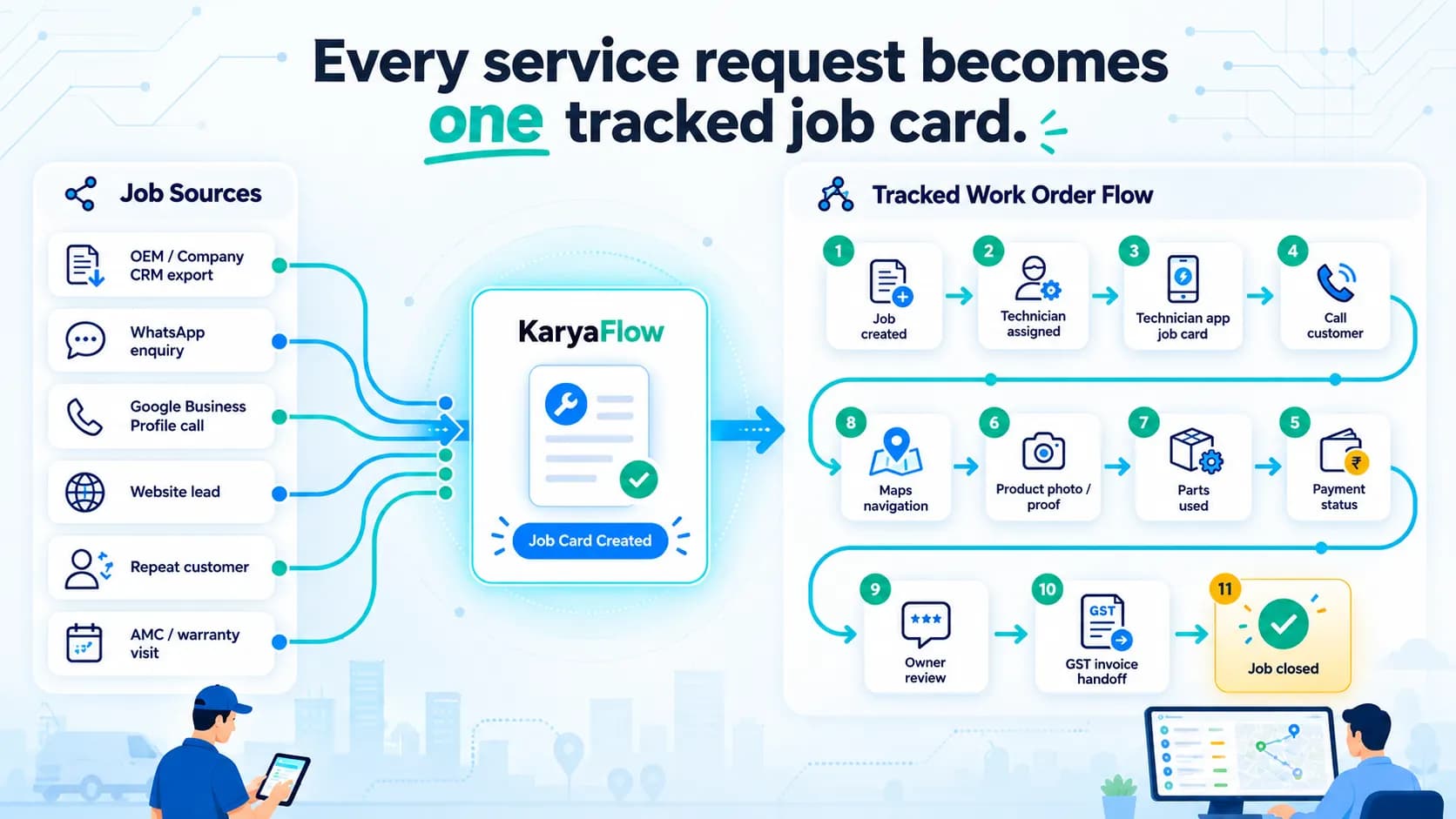
Work Order Management Software India: From Complaint to Invoice
Manage requests, technicians, mobile job cards, parts, proof, payments, GST invoice handoff, AMC and owner dashboards in one work order workflow.
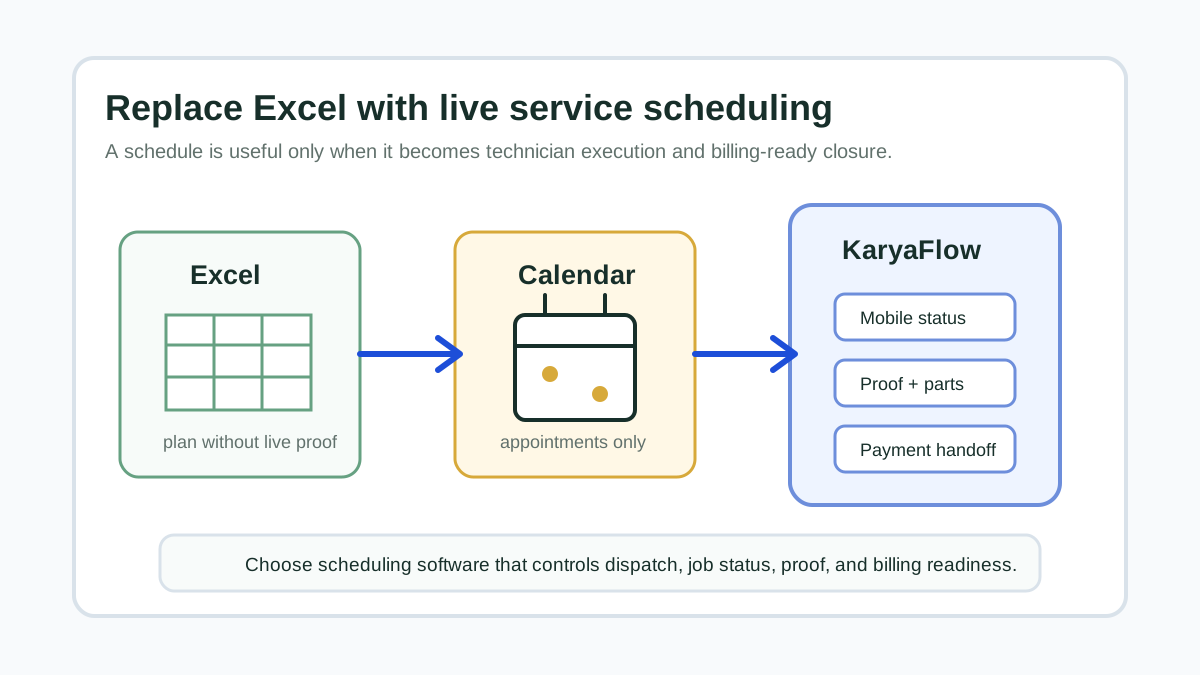
Replace Excel for Service Scheduling Software India
A practical comparison of Excel, calendars, GPS trackers, workforce schedulers, and field service platforms for service scheduling in India.
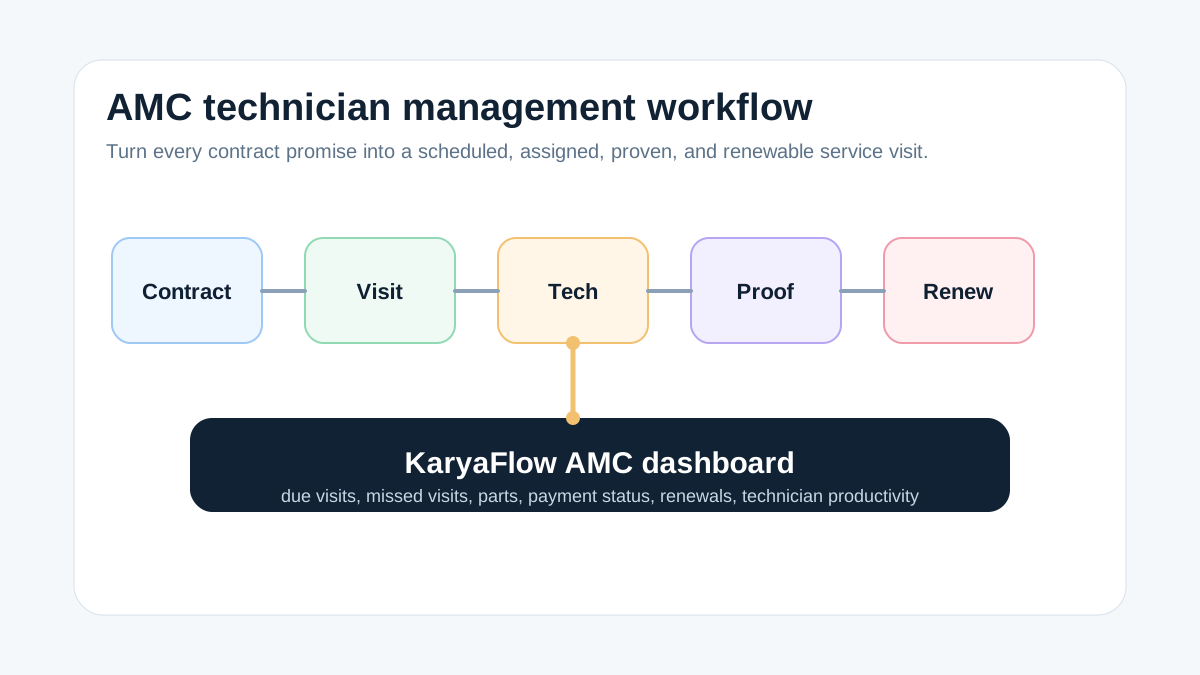
AMC Field Technician Management Software India
AMC field technician management software for India: manage contracts, scheduled visits, proof, parts, payments, renewals, and dashboards.