KaryaFlow
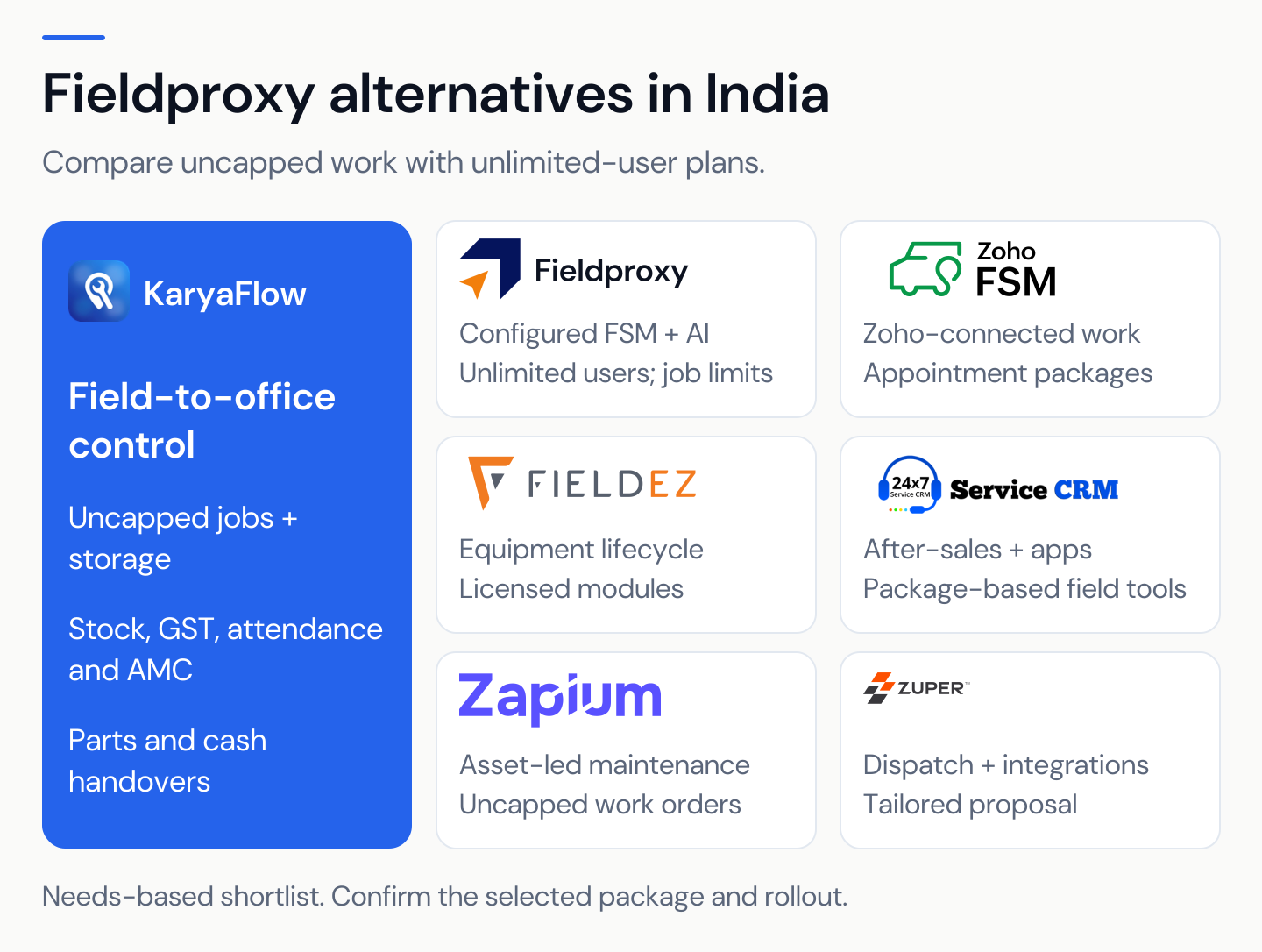
Indian service businesses can shortlist KaryaFlow, Zoho FSM, FieldEZ, ServiceCRM, Zapium, Fieldproxy and Zuper alongside global providers such as Salesforce and Microsoft Dynamics 365. Rasko is another option for smaller service operations. They are not interchangeable: compare the job your team must complete, the office checks afterwards and the full cost of the chosen setup.
Then the platform.One job. The right parts. A clear handover.

This guide covers FSM options for service teams in India, including local and global providers. Check each provider's hosting location and local support separately.
Publisher disclosure: KaryaFlow publishes this guide and is included in the comparison. It is based on official product documentation and published pricing, reviewed on 21 October 2026. Features and availability may vary by plan.
Which Indian FSM platforms compete with leading global providers?
The useful distinction is not “local is simple, global is complex.” A growing Indian business may need a global CRM connection; an equipment manufacturer may need asset-led service from an India-focused provider. Start with the system that must own the service record.
- Daily field-to-office control: consider KaryaFlow for jobs, technician stock, collections, attendance and AMC follow-through.
- Existing business-software ecosystem: evaluate Zoho FSM alongside your Zoho apps, Salesforce alongside its customer-service environment, or Dynamics 365 where Microsoft business applications are central.
- Equipment and maintenance depth: include FieldEZ and Zapium when asset history, service agreements and preventive maintenance drive the purchase.
- After-sales, dispatch or configured workflows: compare ServiceCRM, Zuper and Fieldproxy against the actual app, scheduling and integration requirements.
- A small team's fixed subscription budget: include Rasko Pro, then test the field-control details your office needs.
Use these categories to narrow your shortlist. Compare three well-matched products using the same service-job scenario.
Platform fit: what to compare and what to prove
The table highlights each platform's published focus and a practical question to bring to your demo. Follow the product links for details; this is not an exhaustive feature list.
Scroll sideways to compare every column. With a keyboard, focus the table and use the left and right arrow keys.
| Platform | Published emphasis / likely fit | Prove this in your setup |
|---|---|---|
| KaryaFlow | Connected service jobs, technician-held parts and cash handovers for Indian service teams. | Issue two parts, use one, return one and confirm a partial cash deposit. Verify the offline actions and accounting handoff; continuous GPS is extra. |
| Zoho FSM | Edition-based dispatch, assets and maintenance, especially relevant to teams using the Zoho ecosystem. | Quote the required edition, appointment allowance and connected apps together. Demonstrate the exact offline steps, not just cached access. |
| FieldEZ | Sales, field service and support around an equipment record, including contracts and mobile execution. | Follow one asset from installation to warranty work and a later paid repair. Identify the licensed pillars and implementation owner. |
| Zapium | Asset-centric field maintenance, with work orders, preventive maintenance, parts and customer-facing workflows. | Show repeat failures, planned maintenance and stock consumption on one asset. Confirm edition, technician seats and setup costs. |
| ServiceCRM | Single and recurring jobs, assignment and mobile service work; relevant to after-sales service businesses. | Run an AMC visit and a free callback. Name the standard or branded mobile app, supported phones and included modules in the quote. |
| Fieldproxy | Company plans with unlimited users, job allowances and configurable workflows. | Define what counts as a billable job. Test the approval path and price integration, setup and AI usage for your actual workload. |
| Zuper | Dispatch and rescheduling for field teams, relevant when scheduling exceptions are a central problem. | Reassign a visit after a technician goes on leave. Show conflicts, permissions and the required India billing/accounting connection. |
| Rasko | A fixed-price Pro plan with unlimited team members, covering a broader service workflow than its Jobcards plan. | Check technician custody, returned parts and office-confirmed cash separately from ordinary job, stock and payment records. |








Need a feature that is not explained on a vendor's site? Ask for a demonstration before ruling it out. For a closer comparison, use our Zoho FSM comparison, FieldEZ comparison, ServiceCRM comparison or Zuper comparison.
When should a global FSM provider stay on the shortlist?
Do not remove a global provider just because your technicians work in India. Equally, do not assume a familiar brand solves local collection, parts or reporting requirements out of the box.
Salesforce: when the customer-service record matters across teams
Salesforce Field Service connects field operations with customer and asset context, scheduling and mobile work. It deserves investigation when field visits are part of an existing Salesforce customer-service process.
Ask the implementation team to show the complete handoff: a customer case becomes a visit; the technician records work; an exception returns to the service desk; and the correct billing information reaches accounts. Obtain a proposal for the relevant licences, integration work and support. Do not compare an isolated licence with another vendor's complete deployment.
Microsoft Dynamics 365: when field service belongs in a Microsoft workflow
Microsoft's Field Service overview documents work orders, resource scheduling, mobile execution and service agreements. It also describes connections with other Dynamics applications.
Use that breadth when it solves an actual requirement. Test your work-order-to-invoice path, asset identifiers, stock locations and branch permissions. A Microsoft environment may be a strong reason to evaluate Dynamics; it is not evidence that every required connection is already configured.
What country of origin does not answer
An Indian address alone does not establish Indian data residency, a local support response time, GST return filing or a native Tally connector. A global brand does not automatically mean a long rollout. Ask each supplier for:
- Hosting region, subprocessors, access controls and data-export terms.
- The support channel, hours, languages and escalation owner.
- A named implementation scope, including opening records and training.
- The exact accounting path: export, manual review, native connection or custom integration.
Use the accounting-handoff guide and Tally integration questions to make that last item specific.
Compare pricing units before comparing prices
An active login, a technician, an appointment and a company subscription are different billing units. First give every vendor the same brief: eight technicians, two office users and 300 monthly service appointments, with parts, AMC, job proof and payment review.
These are starting subscription costs and billing models. Pricing pages were checked on 21 October 2026; ask for a complete quote covering your team and workload before purchasing.
Scroll sideways to see every column if needed. With a keyboard, focus the table and use the left and right arrow keys.
| Option | Basis to compare | What to clarify |
|---|---|---|
| KaryaFlow | Active-user offer: ₹99 per active user monthly, minimum two users. Ten active users = ₹990 before 18% GST. | Office logins count. Continuous live GPS and route history are separately quoted; location attendance is included. The published 10-user example is ₹990 monthly before GST. |
| Zoho FSM | Organisation subscription by edition and appointment allowance, not a simple fee multiplied by technicians. | Select the edition and workload on the current pricing page, then include the required connected apps and services. |
| Fieldproxy | Company plans with unlimited users; Essentials lists 300 jobs, Growth 1,000. | Get the company price and confirm the billable job definition, setup, usage and integrations from its pricing terms. |
| Rasko | Pro lists ₹599 monthly with unlimited team members, excluding GST. | Pro, not the narrower Jobcards plan, is the starting comparison for billing and inventory. Confirm services outside the base subscription. |
| Other shortlisted deployments | A written proposal matching your users, modules and workload. | Request implementation, tax, usage, support and renewal terms rather than treating “contact sales” as free or expensive. |
KaryaFlow uses one active-user pricing model. This article explains the unit rate; the pricing page presents team-size examples. Confirm the active-user count, GST and optional add-ons for your team.
A useful price check: two active KaryaFlow users cost ₹198 before GST; ten cost ₹990. Rasko Pro's ₹599 fixed monthly base is lower from seven users in these two-to-ten-user examples. That is a subscription comparison—not proof of equal functionality, better value or a guaranteed saving after setup and add-ons.
is not the whole quote.
Ask for a first-year total and a renewal-year total using the same workload. Separate recurring charges from one-time implementation. For usage allowances, write down what happens during a busy month: are appointments blocked, are credits purchased, or are overages billed? “Unlimited users” does not mean unlimited usage of everything else.
A practical FSM demo scorecard: one job, three exceptions
Use the following sample scenarios in your demos, without sharing real customer data. Start each scorecard entry as Untested, then record Pass, Fail, Needs configuration or Not supported after the demonstration. Note the plan, app version, date and what you observed.
Test 1: can you trace parts beyond the job screen?
Create a sample AC repair and issue two replacement filters to a technician. Fit one and return the unused one. Then record a defective filter collected from the customer.
Check three separate records: usable stock remaining with the technician, unused stock accepted back into stores, and the defective item awaiting its next handover. Ask what happens if the office rejects the return quantity. Does the original job remain linked, and can someone explain every movement?
This is a more revealing test than a screenshot showing “inventory available.” Use the spare-parts inventory guide and defective-parts workflow for the detailed record fields.
Test 2: can the office distinguish a customer balance from a cash handover?
Two different balances.“Paid by the customer” and “received by the office” are different events.
- Invoice
- ₹2,000
- Cash paid
- ₹1,200
- Cash collected
- ₹1,200
- Office receipt confirmed
- ₹700
In this sample scenario, the invoice is ₹2,000. The customer pays ₹1,200 cash and still owes ₹800. The technician deposits ₹700, which the office confirms. The remaining ₹500 is with the technician—not another ₹500 owed by the customer.
Ask the vendor to show both balances without changing the original receipt. Then correct a mistaken deposit and inspect the change history. If the customer pays by UPI instead, verify the receiving account and reconciliation process; a manually selected “paid” label does not establish bank settlement.
For the operational detail, read technician cash collection and office confirmation.
Test 3: can an AMC callback stay separate from a planned visit?
Create a contract with four planned visits. Complete one preventive visit, then raise a free callback linked to it. Check whether the remaining visit count follows the contract rules rather than blindly consuming another scheduled service.
Move the next visit because a required part is unavailable. Ask the vendor to show the remaining visit obligation, the next action and who owns it. A moved appointment should not be counted as a completed visit.
See AMC plan management and AMC technician visits for the connected workflow.
Copy this observation sheet into your evaluation
Scroll sideways to see every column if needed. With a keyboard, focus the table and use the left and right arrow keys.
| Check | Evidence to capture | Starting result |
|---|---|---|
| Technician completes the job on a representative phone | Required fields, retries, sample proof and any help needed | Untested |
| Office confirms a partial cash deposit | Customer balance, technician balance and receipt reference | Untested |
| Unused and defective parts take different paths | Job link, quantity, receiving person and stock movement | Untested |
| AMC callback follows the agreed coverage rules | Original visit, remaining planned visits and next action | Untested |
| A change of technician exposes scheduling conflicts | Leave/availability warning, override rights and audit record | Untested |
| Records can leave the system | Customer/job IDs, parts, payments and retrievable attachments | Untested |
Decide your must-haves before the demonstration. Several minor conveniences should not outweigh a missing step that your team needs every day.
Offline, dispatch and integrations: ask action-by-action questions
“Works offline” is not a complete specification. Turn off connectivity on the actual technician phone and test opening an assigned job, changing status, adding a photo, using a part, recording a note and restoring the connection. Check what needs preloading, what stays queued and how conflicting edits are handled.
For example, Zoho's offline documentation separates saved information and offline edits from actions that need a connection. Ask every vendor, including KaryaFlow, to demonstrate the specific offline steps your technicians need before you rely on them.
Likewise, a calendar view does not prove automatic protection against leave, overlapping appointments or insufficient skills. Test a deliberate conflict. For KaryaFlow's published workflows, see leave management and technician tracking; ask separately which assignment restrictions are enforced in your setup.
An integration logo is also only a starting point. Write down the source record, destination fields, sync direction, timing, retry behaviour and person responsible for exceptions. Verify any customer-facing portal independently of a partner portal.
Apply the comparison to your service business
AC and appliance service: take a breakdown with a chargeable part, an AMC preventive visit and a warranty callback. Include job proof, a rescheduled return visit and who approves the bill. Start with the HVAC workflow or appliance service workflow.
RO service centres: use one customer with two purifiers, separate filter history, an AMC visit balance and a free callback. KaryaFlow, Zoho FSM, ServiceCRM and Rasko are relevant starting options from the table; verify the purifier-specific details in each demo. Our RO AMC guide explains the record distinctions.
CCTV and multi-site service: use a customer with two sites and several devices. Prove that work, replacement parts and a follow-up stay attached to the correct location. The CCTV AMC guide covers that narrower need.
Equipment service and office IT support: focus on the equipment identifier, service agreement, warranty/paid decision and repeat history. Include remote resolution before dispatch where relevant. Do not assume retail phone-repair intake or IMEI workflows are requirements for every field-service business.
A small pilot is stronger evidence than a long feature list
Pick a technician, an office reviewer and a representative set of jobs. Agree the acceptable workflow and record the outcome of every exception test. Use realistic opening stock, outstanding visits and balances; a blank demonstration account cannot reveal a poor migration.
Before buying, run an exit check: export the pilot's customers, jobs, assets, parts movements and payment records. Check stable IDs, dates, relationships, attachment retrieval and permissions. Note any charges and the responsible person.
Choose the product that passes your essential tasks at a total cost you understand. If KaryaFlow's field-to-office workflow fits, request a demo using your own service scenario. If another platform better matches your existing systems or maintenance complexity, keep it on the shortlist.
FAQ
Which FSM platforms should an Indian service business shortlist?
KaryaFlow, Zoho FSM, FieldEZ, ServiceCRM, Zapium, Fieldproxy and Zuper are relevant options for Indian field-service buyers. Rasko is another small-business option. Compare them with Salesforce or Dynamics 365 where your existing systems or service complexity make those relevant. Choose your shortlist by job type, software connections and budget.
Which is the best field service management software in India?
There is no single winner for every business. KaryaFlow is worth evaluating for technician jobs, parts custody and office review; Zoho FSM for a Zoho-connected workflow; FieldEZ or Zapium for equipment-led service; and global suites for relevant enterprise-system connections. Select the plan and prove the required exceptions before choosing.
Does KaryaFlow cost ₹99 per user or ₹990 per month?
One pricing model applies: ₹99 per active user/month with a two-user minimum of ₹198; the 10-user example is ₹990 before GST. Exactly 30 users cost ₹2,673/month after the 10% team discount; 31 or more require a written volume quote. Confirm the applicable offer, GST, counted logins and add-ons in writing.
Is live GPS tracking included in the base price?
For KaryaFlow, location-based attendance is included, while continuous live GPS and route history are separately quoted. Do not treat an attendance check-in as all-day tracking. Ask every vendor to identify the exact tracking scope and any per-user add-on.
Can an Indian FSM platform replace accounting software?
Do not assume so. Job costing, invoice creation, payment status, statutory returns and final accounts are different functions. Establish whether the proposed handoff is a native connection, export, manual review or custom work. Verify the supported fields and exceptions with your accountant and vendor.
How should we compare offline support?
List the actions your technicians need, then try them without a connection on their usual phone. Check what must be downloaded beforehand, which changes are saved and what happens when the connection returns. Leave an action marked “Untested” until you have seen it work.
Sources and review method
Official product documentation and pricing pages were reviewed on 21 October 2026. The sources below and links beside each vendor support the comparison. Confirm current features, prices and support for your chosen plan before purchasing.
- Zoho FSM editions, pricing and offline documentation.
- FieldEZ platform, Zapium field service and ServiceCRM job management.
- Fieldproxy plan scope, Zuper dispatch and Rasko pricing.
- Salesforce Field Service and Microsoft Dynamics 365 Field Service overview.
- KaryaFlow's linked product guides and pricing offers confirmed by the KaryaFlow team.
Vendor names identify the products discussed and do not imply endorsement of KaryaFlow.