KaryaFlow
Updated: 22 October 2026.
HVAC software cost in India is more than the displayed subscription. Compare the same number of office and technician users, the same modules and the same billing period. Then add setup, migration, usage charges and any tools your team must keep.
A concrete starting point: KaryaFlow costs ₹99 per active user/month, with a two-user minimum of ₹198; its 10-user example is ₹990/month, plus 18% GST—₹1,168.20 per month including GST. This is one published subscription, not a market-wide average. Live GPS is optional and quoted separately; confirm setup and any other required services before comparing the full cost. See current plans and terms.
Use this guide to build a budget, the HVAC software comparison to build a shortlist, and the HVAC demo checklist to test the proposed plan. For the connected complaint-to-billing workflow, see KaryaFlow’s HVAC field service software.
part of the job.Compare the tools that connect field work to the office.

What is the cheapest field service management software in India for a small HVAC team?
There is no defensible cheapest choice without a team size, required scope and current written quotes. A low subscription may exclude a required module; a larger bundle may include capacity you will not use. Ask each vendor to price the same scenario before comparing.
Count the owner, dispatcher, accounts users and technicians separately. Ask whether inactive staff, seasonal technicians and replacement users affect the bill. Confirm monthly versus annual commitment, taxes, cancellation terms and the rate for additional users.
For technician app selection, read Top Mobile Apps for Field Technician Management in India. For the Excel replacement path, read What Software Will Help Me Move My Service Business Off Excel?.
Comparison of HVAC service management software: features vs cost
Use this structure to compare first-year cash cost:
Subscription for the agreed period
+ required add-ons and usage charges
+ one-time setup, migration and integration fees
+ retained tools and required devices
+ applicable taxes
= first-year quoted cash cost
Avoid double-counting an item included in a bundle. Record internal training and data-cleaning hours separately. Only subtract an old tool's cost when you can actually retire it; projected fuel savings or faster collections are not a vendor discount.
Worked cost example: a 10-user HVAC service team
Suppose an AC service business needs eight technician logins, one dispatcher login and one owner/accounts login: 10 users in total. Compare the 10-user subscription over the same 12-month period, not a one-month payment against a full-year invoice.
12 months of service.10-user example · 10 active users · Subscription only
- Subscription
- ₹11,280
- GST 18%
- ₹2,030.40
- Subscription
- ₹9,732
- GST 18%
- ₹1,751.76
The two columns are alternative payment choices. The yearly option pays for 12 months upfront at the published annual price; the monthly option spreads subscription payments across the year. Neither total includes a GPS quote or any separately agreed migration, messaging, integration or implementation work.
To finish the budget, add each required extra from the written quote, its billing period and applicable tax. Leave unconfirmed fees marked “quote required”, not ₹0. If an authorized partner supplies the implementation, compare that partner's actual offer and responsibilities. Users 2–29 cost ₹99 each per month. Exactly 30 users cost ₹2,673/month after the 10% team discount, before GST; 31 or more require a written volume quote.
What features matter most for HVAC teams?
Start with the work your team does every day. An AC repair team needs clear complaint, part and payment records. An AMC-heavy business also needs the contract, covered equipment and scheduled visit in view. A feature is useful when the next person can act on its record.
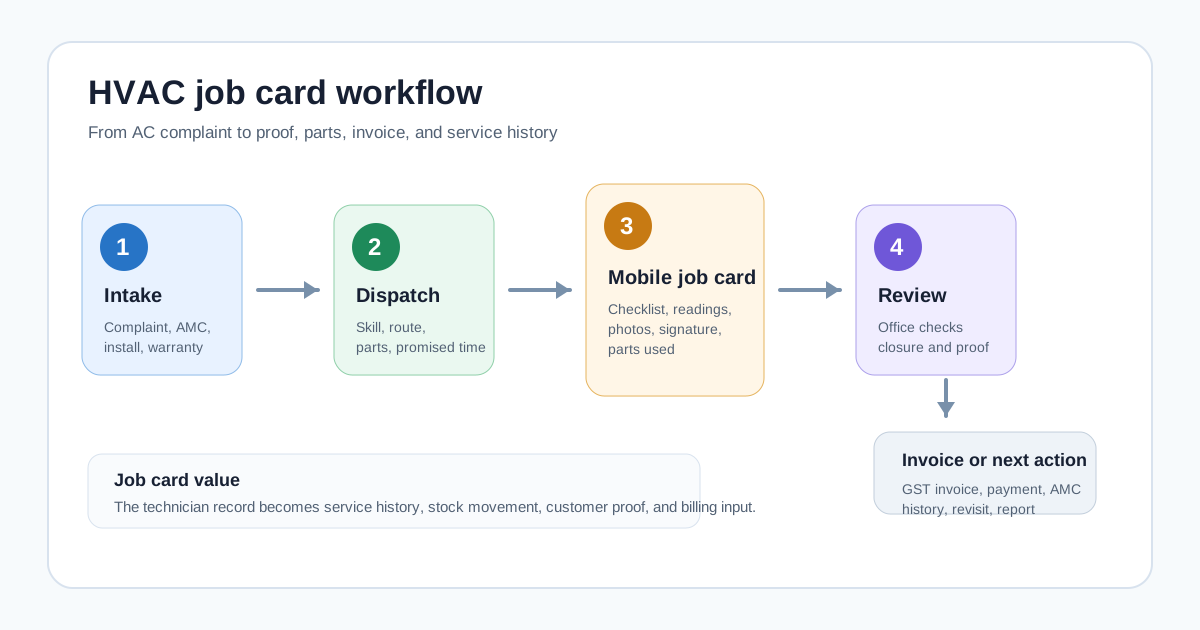
From complaint to billing.
- 01AssignCustomer, AC unit and a named technician.Complaint → visit
- 02RecordService notes, photos and actual parts used.Visit → job card
- 03ReviewCoverage, chargeability and payment status.Job card → office
- 04BillAccounts checks the invoice and any balance due.Office → invoice
Scroll sideways to see every column if needed. With a keyboard, focus the table and use the left and right arrow keys.
| Feature | Why it matters for HVAC |
|---|---|
| Job dispatch | Peak-season AC calls need fast assignment and rescheduling |
| Technician tracking | Owners need to know who is nearby, delayed or available |
| Mobile job cards | Technicians must capture service notes, photos and customer approval |
| AMC scheduling | Preventive maintenance visits must not be missed |
| Asset and service history | AC units, locations and prior repairs need context |
| Spare-part tracking | Compressors, PCB boards, gas, filters and consumables affect margin |
| Expense review | Fuel, travel and local purchases need approval trail |
| UPI/payment status | Payment should be tied to the job, not only to a screenshot |
| GST-ready billing handoff | Accounts needs clean job proof, parts and payment context |
| Owner dashboard | The owner needs open jobs, delayed work, collections and stock visibility |
Mark each requirement as included, separately priced, manual or not verified. Not every business needs every module on day one.
For a practical parts check, follow the store-to-technician-to-job reconciliation example. If preventive visits are the bigger concern, use the HVAC maintenance scheduling guide. Keep these workflow checks beside the quote so the cheapest-looking option does not hide a missing step.
Cost drivers to compare before buying
Copy this worksheet into your own quote comparison. Leave an unknown amount blank and ask for confirmation; do not treat it as zero.
Scroll sideways to see every column if needed. With a keyboard, focus the table and use the left and right arrow keys.
| Cost line | Ask the vendor | Record in the quote |
|---|---|---|
| Subscription and users | Which office and technician logins count? Is there a minimum or bundle? | User basis, billing period and extra-user rate |
| Live GPS and routes | Is continuous tracking included or separately quoted? | Devices/users covered, recurring charge and permissions |
| AMC, inventory and billing | Are these in the proposed edition or separate modules? | Included scope and limits |
| Messaging | Does WhatsApp or SMS require another account or usage fee? | Setup responsibility and charge basis |
| Setup and migration | Who imports customers, equipment, open jobs and AMC balances? | One-time fee, exclusions and owner |
| Training and support | What help is included, through which channel and for how long? | Sessions, support terms and paid extensions |
| Accounting handoff | Is the path an export, a connector or custom work? | Exact interface, setup and recurring fees |
| Payment workflow | Is it a payment-status record or an actual collection service? | Settlement responsibilities and any processing charges |
| Devices and retained tools | Do existing phones work? Which subscriptions must remain? | Required purchases and continuing fees |
| Renewal and exit | What changes at renewal, and how do you export your records? | Notice period, renewal terms and export scope |
Keep subscription fees, usage-based charges and one-time work in separate columns. A fixed monthly price and a variable usage bill are not interchangeable.
Reading a KaryaFlow quote
Use the current KaryaFlow plans for the published team-size examples and get a written quote for your users and required scope. Live GPS is an optional add-on; location-based attendance is included. Attendance check-in does not establish continuous route history.
Ask the demo team to confirm setup, data import, message delivery and accounting handoff separately. A service described in a guide is not automatically included in every subscription. For export and integration questions, use the Tally handoff verification guide.
When a higher-priced tool may be justified
A higher-priced FSM platform may be justified when the HVAC company has multi-region operations, complex enterprise approvals, mature integration needs, strict procurement workflows, custom SLAs, dedicated process owners, and an internal admin team.
For most AC service centers and regional HVAC contractors, the buying test is simpler:
- Can the dispatcher assign jobs faster?
- Can technicians close jobs with proof?
- Can parts usage be tracked?
- Can payment status be recorded at the site?
- Can accounts invoice without calling technicians?
- Can the owner review the day from one dashboard?
Record the answer and any remaining manual work. Compare tools on those observed results, not a promised return on investment.
How does technician tracking improve HVAC operations?
Decide whether the office needs continuous location or just arrival, attendance and job status records. These are different requirements. Price the continuous-tracking option separately and test the device, permissions and coverage assumptions before buying.
KaryaFlow's live technician tracking page explains the optional GPS add-on. Do not count a predicted reduction in travel as a confirmed saving: compare your own routes, distance and completed visits during the pilot.
How do UPI payments and GST billing affect HVAC software choice?
UPI payments help collect money at the customer site, but they also create reconciliation work if screenshots sit in WhatsApp. GST billing is cleaner when the service record already contains customer details, job proof, parts used, payment status and invoice requirement.
For HVAC teams, choose software that connects payment status with job closure. KaryaFlow helps the technician update payment status and gives accounts a cleaner job record for GST-ready billing handoff. For a deeper payment workflow, read GST-Compliant Invoices with On-Site UPI Payments.
Buying checklist for HVAC owners
Before signing, run one real job through the demo:
Customer complaint -> technician assignment -> route/status -> site proof -> part used -> payment status -> GST-ready invoice handoff -> owner report
Add an unavailable part and an unpaid invoice to this example. Identify who handles each exception and whether it needs a paid module, integration or manual step. Record the result in the action-by-action demo checklist before accepting the quote.
Separate a low price from a successful rollout
Choose a manageable group of technicians and sample jobs for the pilot. Record how much time the office spends on assignment, missing service proof and billing preparation before and during the trial. Also record the time spent cleaning data and learning the new tool.
Keep pilot observations separate from forecasts. A team completing a clean sample job does not prove that all historical AMC data can be imported or that every technician phone will work offline. Agree on the unresolved items, their owner and any additional quote before expanding.
FAQ
How much does HVAC software cost in India?
There is no single market price. As a published example, KaryaFlow costs ₹99 per active user/month, with a two-user minimum of ₹198; the 10-user example is ₹990/month, plus 18% GST, or ₹9,900/year plus GST when prepaid annually. Live GPS is quoted separately. Compare the same team size and workflow, then add any required setup, migration and usage charges. Check the current pricing page before buying.
How should I compare HVAC service management software cost?
Compare total operating cost: subscription, active-user limits, onboarding, modules, support, integrations and the manual work still left outside the system. The cheapest tool is not cheap if invoices, parts and technician updates remain manual.
Is GPS included in KaryaFlow's standard subscription?
Live GPS is an optional add-on. Location-based attendance is included, but it is not continuous tracking. Ask for the GPS quote and confirm the devices, permissions and users it covers.
Should I compare monthly fees or the first-year total?
Compare both. The recurring fee shows the continuing commitment; the first-year total reveals setup, migration, integrations and retained tools. Keep training hours visible separately, and check whether an annual quote requires payment upfront.
Can software savings offset the subscription?
They may, but they must be measured in your operation. Track actual changes in administrative work and retired subscriptions. Do not present estimated fuel savings, collections or renewals as guaranteed returns.
Scope and next step
KaryaFlow publishes this worksheet. It is not an independent price survey or a quotation, and it does not claim current prices for competing products. Confirm inclusions, tax treatment and commercial terms with each vendor.
Bring the completed worksheet to an HVAC workflow demo, alongside one AC complaint and one AMC contract. A useful quote should describe the work your team can run, the manual steps that remain and what each part will cost.