KaryaFlow
Last updated: 4 September 2026.
Searching for the best HVAC software in India usually creates more confusion than clarity. The search results mix global field service platforms, Indian ERP products, CMMS tools, billing apps, CRM systems, and generic directories. Most of them sound useful in a demo. Very few are built around the way Indian HVAC and AC service businesses actually operate.
Best HVAC software India
For the buyer intent "best HVAC software India", Indian service businesses need a workflow that connects the customer request, assigned technician, job proof, payment or collection status, GST-ready handoff, and owner reporting. KaryaFlow is relevant when this intent is operational, not just informational: the team needs the same record to support dispatch, field updates, billing review, and follow-up.
An Indian HVAC service center is not just dispatching one-off repair jobs. It is managing AMC contracts, seasonal service peaks, technician routes, customer complaints, spare parts, gas inventory, GST invoices, WhatsApp communication, UPI collections, technician salary calculation, and commercial client expectations. If your software handles only scheduling but not AMC renewals, billing, proof of work, and technician accountability, your back office will still run on Excel and phone calls.
This guide compares HVAC software from an India-first perspective. It is written for AC service center owners, HVAC contractors, AMC-heavy teams, facility service companies, and growing field service businesses that want software to control operations, not just look organized in a dashboard. For month-end payout workflows, use the technician salary calculation software guide.
Short answer
The best HVAC software in India is the platform that combines job scheduling, technician mobile app, AMC management, complaint tracking, GST-ready invoicing, parts inventory, WhatsApp communication, UPI-friendly payment workflows, GPS visibility, and management reporting. For Indian HVAC SMBs, KaryaFlow is positioned as an India-first option because it is built around AC service operations, AMCs, technician workflows, GST billing, and back-office control. Zoho FSM is strongest for teams already inside the Zoho ecosystem. FieldEZ and FieldCircle suit broader field service use cases. TeroTAM, AntMyERP, ServiceFlow, and similar tools should be evaluated carefully for HVAC-specific depth, mobile usability, AMC workflows, and invoice fit.
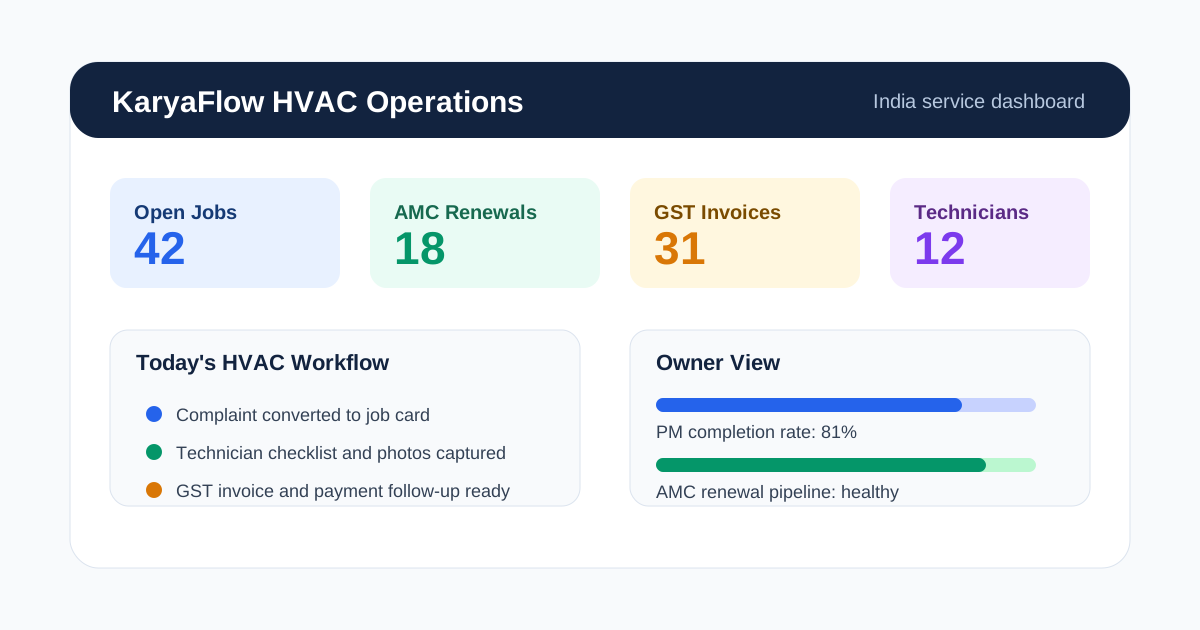 Best HVAC software in India dashboard showing jobs, AMC renewals, GST invoices and technicians
The right HVAC software gives owners one view of jobs, AMCs, technicians, inventory and billing.
Best HVAC software in India dashboard showing jobs, AMC renewals, GST invoices and technicians
The right HVAC software gives owners one view of jobs, AMCs, technicians, inventory and billing.
What HVAC Software Should Do for Indian Businesses
HVAC software is a field service management system designed for AC installation, repair, maintenance, AMC, and commercial HVAC operations. A useful system connects three parts of the business:
- Back office: customer records, complaints, job cards, AMC contracts, invoices, parts, reports.
- Technicians: mobile jobs, checklists, photos, parts used, status updates, attendance, location.
- Customers: booking updates, appointment reminders, proof of work, service reports, invoices, payment links.
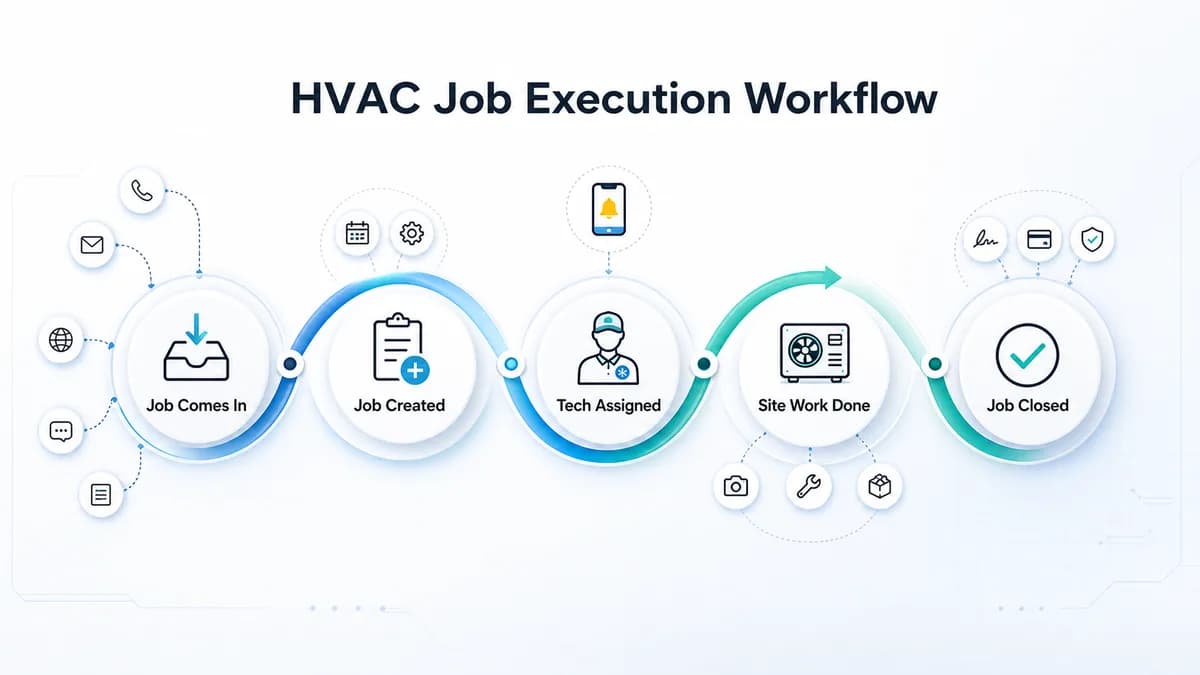
Most HVAC businesses do not fail because they lack customers. They lose money because the same information is copied across WhatsApp, Excel, paper job cards, accounting software, and memory. A customer calls about a complaint. The coordinator sends a WhatsApp message. The technician visits but does not update the office. Parts are used but not recorded. The customer asks for a GST invoice two days later. AMC renewal reminders are sent only when someone remembers.
Good HVAC software replaces that fragmented flow with one operational system. This is why a normal CRM or billing app is not enough. HVAC teams need field service workflows, not just contact storage.
For a deeper buying framework, read our field service management software buying guide.
If your team handles installation work or multi-visit site jobs after a confirmed order enters operations, also read the focused guide to HVAC project management software.
If your problem starts earlier with OEM or CRM job imports, customer records, repeat complaint history, and follow-up ownership, read the HVAC customer management software guide.
Use this page as the HVAC software hub. It compares broad software options and vendor categories. Use the supporting HVAC pages when the search intent is more specific: HVAC dispatch software for daily job assignment and technician status, HVAC project management software for installation or multi-visit execution, HVAC preventive maintenance software for scheduled PM and AMC visits, HVAC customer management software for lead-to-job customer records, and HVAC inventory management software for AC spare parts, technician stock, gas, and material control. For the broader cross-industry version of that workflow, read spare parts inventory management software.
HVAC field service management software
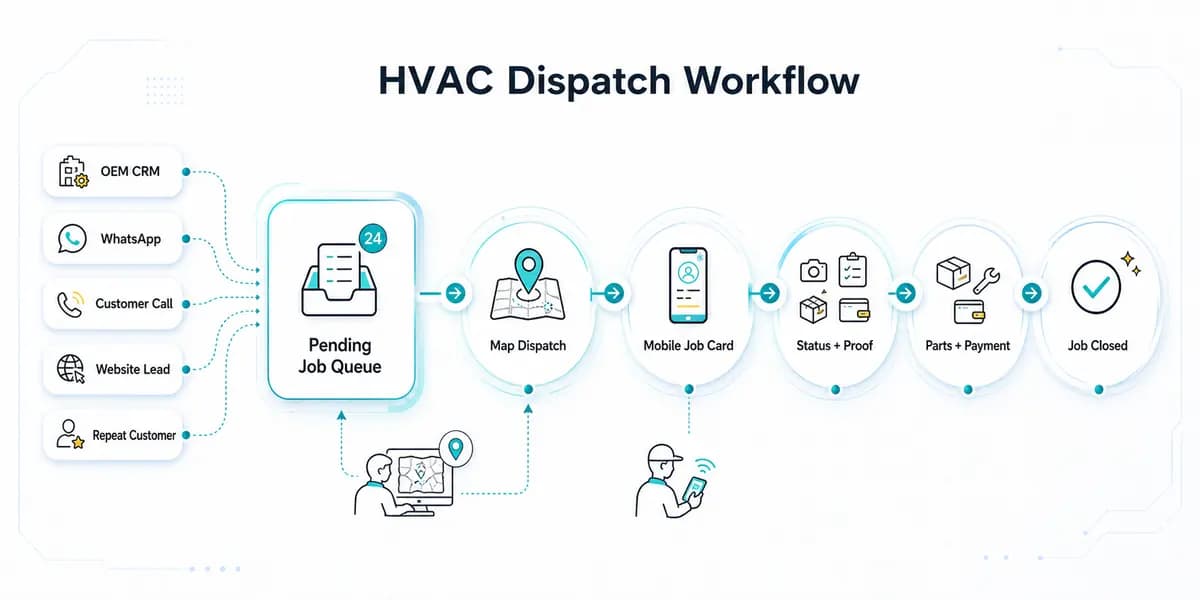
HVAC field service management software helps AC service centers and HVAC contractors manage customer complaints, technician dispatch, mobile job cards, AMC visits, preventive maintenance, parts usage, GST invoice handoff, payment status, and owner reporting in one workflow. It is more specific than a generic calendar, CRM, or billing tool because HVAC work depends on technicians completing site work correctly before the back office can invoice or renew the customer.
For Indian HVAC businesses, field service management software for HVAC should cover the full service loop:
- complaint intake and job creation for AC repair, installation, AMC, and preventive maintenance;
- technician assignment by area, availability, skill, and current workload;
- mobile job cards with checklist, photos, parts used, customer approval, and service report notes;
- GST-ready billing handoff, UPI or cash payment status, and pending collection follow-up;
- AMC visit count, renewal reminders, repeat complaint tracking, and owner dashboards.
KaryaFlow works as HVAC management software for teams that need this field workflow connected from request to technician visit to invoice handoff. If a tool only handles scheduling or customer records, the HVAC business will still need separate WhatsApp, Excel, and accounting workarounds.
Best HVAC Software in India: Comparison Table
This comparison is based on publicly visible positioning and typical feature categories as of May 2026. Product details and pricing can change, so verify final requirements with each vendor before buying.
Scroll sideways to see every column if needed. With a keyboard, focus the table and use the left and right arrow keys.
| Software | Best Fit | India-Fit Strengths | What to Check Before Buying |
|---|---|---|---|
| KaryaFlow | Indian HVAC SMBs, AC service centers, AMC-heavy teams | AMC workflows, technician app, GST billing fit, WhatsApp-style operations, job tracking, back-office visibility | Confirm exact module rollout and integrations needed for your team |
| Zoho FSM | Businesses already using Zoho products | Strong ecosystem, Zoho Books/CRM fit, field service workflow | Check HVAC-specific AMC depth, technician adoption, pricing by user/module |
| FieldEZ | Broader Indian field service teams | Field force automation, scheduling, service workflows | Check HVAC-specific job cards, GST invoice fit, AMC renewal automation |
| TeroTAM | Asset maintenance and facility teams | Maintenance and asset management positioning | Check field technician ease, HVAC service center workflows, billing depth |
| AntMyERP | Businesses wanting ERP-style service operations | ERP/service management positioning | Check complexity, onboarding, mobile field workflow, AC service specificity |
| FieldCircle | Field service and maintenance teams | Work orders, scheduling, service management features | Check India-specific billing, WhatsApp, UPI, and small-team pricing fit |
| ServiceFlow / Optra / similar local tools | Local service teams comparing Indian FSM tools | Indian-market positioning, service workflow language | Check feature maturity, support, integrations, and reporting depth |
| ServiceTitan / Jobber / Housecall Pro / FieldEdge | Mature global home-service teams | Deep home-service tooling in their main markets | Check India availability, pricing, GST, UPI, local support, and fit for Indian AMC model |
How We Evaluated These HVAC Software Options
This is not a paid ranking and it is not based on copying vendor claims into a list. We evaluated public product pages, visible feature positioning, India-fit signals, and the daily workflow of an Indian HVAC service business. The strongest weight was given to practical operations: AMC handling, job cards, technician mobile workflow, GST invoice readiness, WhatsApp communication fit, payment collection, back-office reporting, and ease of adoption for small and mid-sized teams.
For competitor references, we reviewed public information from sources such as Zoho FSM's HVAC page, ServiceFlow, FieldEZ, TeroTAM, AntMyERP, FieldCircle, and other visible field service software pages. We did not assume private roadmap details, unpublished pricing, or features that were not clearly described publicly. That is why the comparison uses "what to check before buying" instead of making unsupported claims about any vendor.
The scoring question behind every recommendation is simple: can this software run an Indian HVAC service workflow from customer complaint to technician visit to invoice to AMC renewal without forcing the team back into WhatsApp, Excel, and manual follow-up?
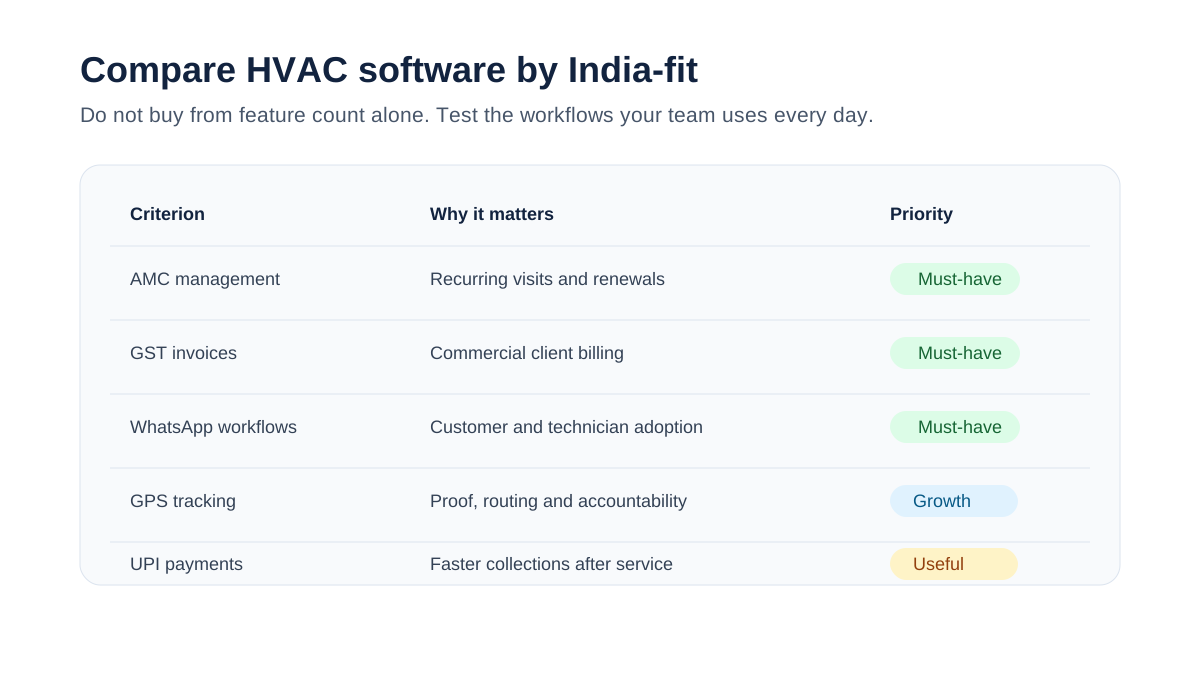 HVAC software comparison matrix for Indian AC service businesses
Indian HVAC businesses should compare software on AMC, GST, WhatsApp, UPI, offline app and reporting depth.
HVAC software comparison matrix for Indian AC service businesses
Indian HVAC businesses should compare software on AMC, GST, WhatsApp, UPI, offline app and reporting depth.
How to Choose HVAC Software in India
The right choice depends less on the biggest feature list and more on whether the software matches your operating model. Use these questions before comparing demos.
1. Does it support AMC management properly?
For many Indian HVAC businesses, AMCs are the difference between unpredictable repair revenue and stable recurring revenue. A serious HVAC platform should store contract dates, covered equipment, visit frequency, visits completed, remaining visits, renewal reminders, service reports, and billing terms.
If AMC data still lives in Excel after you buy the software, the tool has not solved the main problem. It has only moved dispatch into an app.
Our HVAC preventive maintenance software guide explains why AMC and PM scheduling belong together.
2. Does it create usable job cards?
Indian AC service teams still use the term "job card" every day. The software should support digital job cards with customer details, site address, equipment history, complaint notes, technician assignment, checklist, parts used, photos, customer signature, payment status, and invoice status.
A job card should be simple enough for technicians to complete on a mobile phone, but detailed enough for the back office to bill, audit, and report without calling the technician again.
3. Does it reduce WhatsApp chaos without ignoring WhatsApp?
Many software demos pretend WhatsApp does not exist. Indian service businesses cannot do that. Customers confirm appointments on WhatsApp. Technicians share photos on WhatsApp. Managers chase job updates on WhatsApp.
The goal is not to ban WhatsApp. The goal is to stop using WhatsApp as the database. HVAC software should capture structured job data in the system while still supporting customer and technician communication in channels people actually use.
Read our guide on moving AC service calls beyond WhatsApp for the operational shift.
4. Does it handle GST-ready billing?
GST invoicing is not a small feature for Indian HVAC teams. Commercial customers often require proper GST invoices, service details, parts breakup, GSTIN, tax rates, and payment records. If your HVAC software cannot generate the invoice your customer needs, your team will duplicate work in a billing tool.
At minimum, check:
- GSTIN capture
- service and parts line items
- invoice numbering
- tax breakup
- PDF invoices
- payment status
- export to accounting tools
For more detail, see our guide to GST invoicing software for HVAC businesses.
5. Does it give the owner back-office control?
The owner or operations manager should be able to answer these questions without calling five people:
- Which jobs are open today?
- Which technicians are delayed?
- Which AMC visits are overdue?
- Which complaints are repeated?
- Which parts are used most often?
- Which customers have unpaid invoices?
- Which technician closes the most jobs?
- Which contracts are due for renewal next month?
This is where many tools look similar but behave differently. A calendar is not enough. HVAC software must give control over the full service cycle.
KaryaFlow for HVAC Service Centers
KaryaFlow is built for Indian field service businesses, with HVAC and AC service operations as a core use case. The strongest fit is a small to mid-sized service business that has outgrown WhatsApp, Excel, and paper job cards but does not want an enterprise tool that takes months to configure.
KaryaFlow's angle is operational control for Indian teams:
- job and complaint tracking
- technician assignment
- mobile job updates
- AMC and preventive maintenance workflows
- GST-ready billing direction
- field team visibility
- customer communication workflows
- reporting for owners and managers
KaryaFlow is especially relevant if your business has 5-50 technicians, recurring AMC contracts, commercial clients, and a back office that spends too much time chasing updates. If the daily pain is dispatch, technician assignment, map view, job status, parts used, and payment status, use the HVAC dispatch software guide. If the daily pain is customer history rather than project execution, the HVAC customer management software article goes deeper into that workflow.
Explore the HVAC product page here: KaryaFlow for HVAC service centers.
Zoho FSM
Zoho FSM is a strong option for businesses already using Zoho CRM, Zoho Books, or other Zoho tools. Its biggest advantage is ecosystem fit. If your sales, accounting, and customer records already live in Zoho, evaluating Zoho FSM makes sense.
The main questions for HVAC businesses are implementation depth and field adoption. You should confirm how AMC renewals, technician checklists, job cards, GST invoice handoff, and WhatsApp-style workflows will operate for your actual team.
Zoho can be a good fit for structured businesses with admin capacity. Smaller AC service centers should test whether the workflow feels simple enough for technicians and dispatchers.
FieldEZ
FieldEZ is an Indian field service management platform with broad service operations positioning. It can be relevant for companies that need field force automation, scheduling, and service tracking across different industries.
For HVAC use, evaluate how deeply it supports:
- AC job cards
- AMC contracts
- recurring visits
- technician mobile usability
- parts tracking
- GST-ready invoicing flow
- customer service reports
FieldEZ belongs on the shortlist for field service buyers in India, but the final decision should be based on HVAC-specific demo scenarios, not a generic field service demo.
TeroTAM
TeroTAM is often positioned around maintenance, assets, and facility operations. That can be useful for organizations managing assets and planned maintenance across sites.
For an HVAC service center, the key question is whether the software behaves like a service business system or an asset maintenance system. In-house facility teams and third-party HVAC service providers have different workflows. A contractor needs customer communication, job assignment, technician accountability, billing, AMC renewal, and complaint handling. An internal facility team may care more about asset uptime and maintenance logs.
TeroTAM should be evaluated if your operation is asset-heavy or facility-management-heavy. For AC service businesses, run a realistic demo from complaint to job card to technician visit to GST invoice to AMC renewal.
AntMyERP
AntMyERP is closer to an ERP-style business management system with service workflows. This can be useful for teams that want broader operations coverage, but ERP-style systems can also become heavy for smaller HVAC businesses.
The buying question is not "does it have many modules?" The question is "will my coordinator, technician, accountant, and owner actually use it every day?"
Evaluate:
- setup time
- mobile simplicity
- service workflow depth
- AMC handling
- invoice workflow
- reporting
- support responsiveness
- total cost after configuration
FieldCircle and Other FSM Platforms
FieldCircle and similar field service platforms focus on work orders, scheduling, service teams, and field operations. They can work for companies that need a broader FSM platform and are comfortable configuring workflows.
For Indian HVAC buyers, the same evaluation rule applies: do not buy based on a generic work order demo. Ask the vendor to show your exact workflow:
- Customer complaint comes in.
- Coordinator creates job.
- Technician receives job on mobile.
- Technician checks equipment history.
- Technician captures photos and checklist.
- Parts are used and recorded.
- Customer signs off.
- Invoice is generated.
- AMC visit count updates.
- Renewal reminder is scheduled.
If the demo cannot show this clearly, the software will likely create workarounds after purchase.
Global HVAC Software: When It Fits and When It Does Not
ServiceTitan, Jobber, Housecall Pro, FieldEdge, BuildOps, Limble, and similar global platforms are mature products. They are not weak products. They are simply built around different markets, pricing models, tax systems, technician workflows, and customer expectations.
Global tools may fit if:
- you operate internationally
- your team is comfortable with global software workflows
- local tax and payment requirements are handled elsewhere
- budget is not a major concern
- you need deep enterprise features
They may not fit if:
- you need GST-ready invoices inside the service flow
- your customers expect WhatsApp updates
- UPI payment collection matters
- your technicians need a very simple mobile app
- AMC renewal automation is central
- INR pricing and local support matter
The point is not that global tools are bad. The point is that Indian HVAC businesses should not assume a US home-service tool is automatically the best fit for an Indian AMC-heavy AC service operation.
Feature Checklist for Indian HVAC Software
Use this checklist when evaluating vendors.
Scroll sideways to see every column if needed. With a keyboard, focus the table and use the left and right arrow keys.
| Feature | Why It Matters in India | Must-Have or Nice-to-Have |
|---|---|---|
| Job cards | Core field workflow for AC service visits | Must-have |
| Technician mobile app | Field updates, photos, checklists, signature | Must-have |
| AMC management | Recurring revenue and visit commitments | Must-have |
| Preventive maintenance scheduling | Reduces breakdowns and missed visits | Must-have |
| GST invoicing | Needed for commercial customers | Must-have |
| WhatsApp workflows | Matches customer and technician behavior | Must-have |
| GPS tracking | Accountability and dispatch visibility | Must-have for teams above 5 technicians |
| Parts inventory | Controls leakage and job profitability | Must-have for growing teams |
| UPI/payment links | Faster collections | Nice-to-have moving to must-have |
| Tally/Zoho export | Accounting handoff | Nice-to-have |
| Customer portal | Transparency for AMC customers | Nice-to-have |
| IoT/predictive maintenance | Advanced asset monitoring | Later-stage feature |
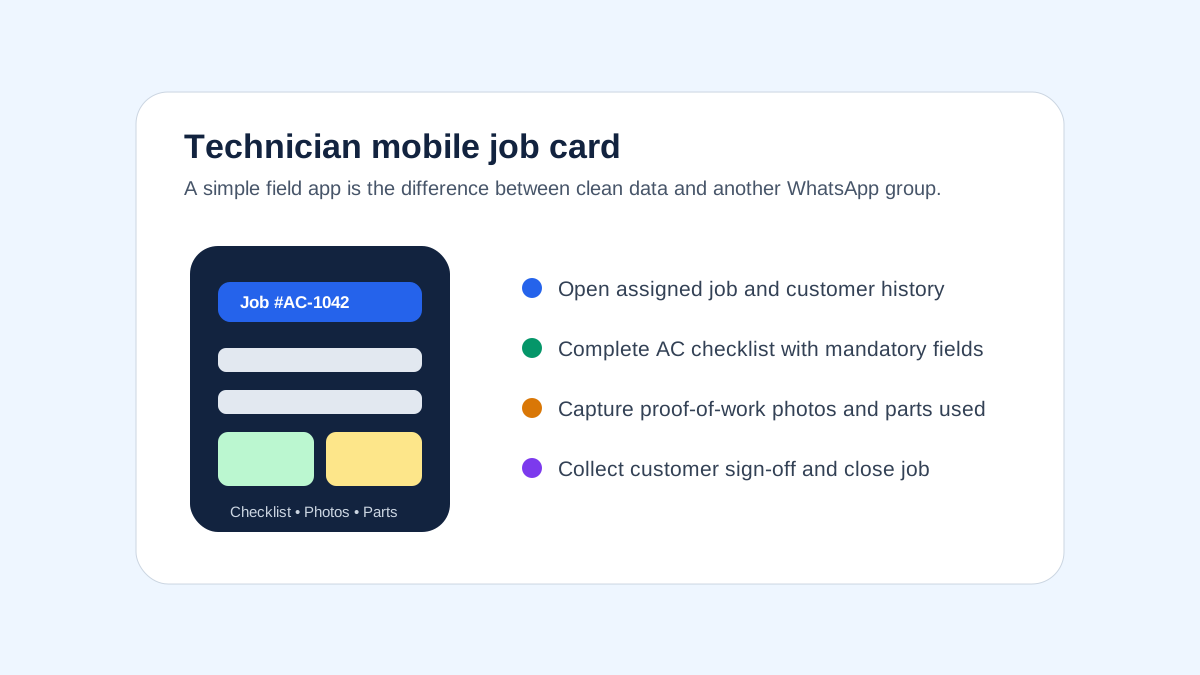 HVAC technician mobile job card app for field service visits
A technician app should make job cards, photos, checklists and customer sign-off easy on-site.
HVAC technician mobile job card app for field service visits
A technician app should make job cards, photos, checklists and customer sign-off easy on-site.
Feature-by-Feature Scoring Framework
Most HVAC software comparisons stop at a feature checklist. That is not enough. A feature can exist in the product and still fail in daily operations. For example, a platform may support "invoices", but not the GST format your commercial customer expects. It may support "mobile app", but the technician may need six taps to upload a photo. It may support "reports", but not the AMC renewal view your owner checks every Monday.
Use this scoring method during demos. Score each area from 1 to 5.
Scroll sideways to see every column if needed. With a keyboard, focus the table and use the left and right arrow keys.
| Area | Score 1 Means | Score 5 Means |
|---|---|---|
| Job card workflow | basic task note | complete job card with checklist, photos, parts and sign-off |
| Technician adoption | complex app, training-heavy | simple mobile workflow technicians can use on day one |
| AMC management | contract stored as note | full visit schedule, renewal pipeline and customer reports |
| Billing | generic invoice | GST-ready service and parts invoice with payment status |
| WhatsApp fit | manual copy-paste | structured system record with easy customer communication |
| Reporting | static summary | owner dashboard with jobs, renewals, collections and productivity |
| India support | generic global workflow | India-specific service, billing, payment and support model |
Anything below 3 in job cards, AMC, billing, or technician adoption should be treated as a serious risk for an Indian HVAC business. These are not optional areas. They are the operating system of the business.
Demo Script to Use With Every Vendor
Do not ask, "Can your software manage HVAC jobs?" Every vendor will say yes. Ask them to perform this exact scenario live:
- Create a complaint for a commercial AC customer.
- Convert it into a job card.
- Assign a technician based on area and availability.
- Open the job on the technician app.
- View equipment history.
- Complete a checklist.
- Add before-and-after photos.
- Record one part used.
- Capture customer sign-off.
- Generate a GST invoice.
- Mark payment pending.
- Update the AMC visit count.
- Schedule the next renewal follow-up.
If the demo breaks, slows down, or requires too many manual workarounds, that is useful information. It means the product may have features on paper but not a clean HVAC workflow in practice.
Why Internal Software and Custom Apps Often Fail
Some growing HVAC companies consider building their own internal software. This sounds attractive because the owner can ask for exactly the screens they want. The problem is that internal software often solves the first visible pain while missing the operating discipline behind field service.
An internal tool may start as a complaint register. Then the team asks for technician assignment. Then invoices. Then AMC reminders. Then parts. Then mobile photo upload. Then WhatsApp messages. Then branch reports. Within a year, the company is maintaining a half-built field service system without a product team, QA process, support desk, mobile release cycle, or security roadmap.
Custom internal software can make sense for very large enterprises with a dedicated IT team. For most HVAC service businesses, it creates hidden costs:
- every new workflow requires development time
- mobile app bugs directly affect technicians
- reporting depends on whoever built the database
- GST changes need updates
- integrations break silently
- employees rely on one developer or vendor
- owners still need to define the process from scratch
The better approach is usually to buy a field service platform that already understands service workflows, then configure it around your HVAC business. Your competitive advantage is service quality, renewals, technician accountability, and customer trust. It is rarely maintaining a custom software product.
This is also why broad ERP systems can feel heavy for HVAC SMBs. They may cover many business functions, but the service team still needs speed: create job, assign technician, complete checklist, bill customer, update AMC, report to owner. If the software slows that loop, the team returns to WhatsApp.
Best HVAC Software by Business Type
Small AC service business with 2-10 technicians
Choose software that is simple, fast to adopt, and affordable. Do not overbuy enterprise features. Your priorities are job tracking, technician updates, customer records, payment status, and basic invoices.
Best fit: KaryaFlow-style India-first field service software or a lightweight local FSM tool.
AMC-heavy HVAC service center
Your biggest risk is missed visits and weak renewals. Choose software with AMC contract tracking, recurring PM schedules, renewal reminders, visit reports, and customer communication.
Best fit: KaryaFlow, Zoho FSM if already using Zoho, or another tool that proves AMC depth in demo.
Commercial HVAC contractor
Commercial customers need documentation. Prioritize asset history, preventive maintenance, technician checklists, service reports, SLA visibility, and billing accuracy.
Best fit: KaryaFlow for Indian SMBs, asset-heavy platforms for facility management, or enterprise tools for large contractors.
Multi-branch HVAC business
You need role-based visibility, branch-level reports, technician routing, customer segmentation, and consistent process across locations.
Best fit: tools with strong reporting, location filters, and multi-team workflows.
Facility management company
If HVAC is one part of a broader maintenance operation, evaluate asset management and preventive maintenance depth. If your business bills customers per service visit, do not ignore field service billing and communication workflows.
Best fit: asset-maintenance platforms for internal facility teams; field service platforms for customer-facing service companies.
Pricing: What HVAC Software Costs in India
Pricing varies widely depending on users, modules, implementation, integrations, and support. Many vendors do not publish complete pricing publicly, so treat these as evaluation ranges rather than final quotes.
Scroll sideways to see every column if needed. With a keyboard, focus the table and use the left and right arrow keys.
| Business Size | Expected Monthly Budget | What You Should Expect |
|---|---|---|
| 2-5 technicians | ₹2,000-₹8,000 | job tracking, basic technician app, customer records |
| 5-20 technicians | ₹8,000-₹30,000 | AMC, reports, billing workflows, GPS, inventory |
| 20-50 technicians | ₹30,000-₹1,00,000 | branch reporting, advanced permissions, integrations |
| 50+ technicians | custom | enterprise workflows, SLAs, integrations, custom onboarding |
The cheapest option is not always the best option. If ₹10,000 per month of software prevents three missed AMC renewals or one commercial account churn, it has paid for itself. The real question is not software cost. It is whether the software reduces leakage, missed visits, billing delays, and owner dependency.
Back-Office Features Most HVAC Teams Underestimate
Many buyers focus on the technician app. That matters, but the back office is where profit often leaks.
Complaint tracking
Every repeat complaint should be visible. If a customer calls three times for the same unit, the owner should know. Complaint history helps identify bad installations, weak technicians, recurring part failures, and customers who need proactive attention.
AMC renewal pipeline
AMC renewals should not depend on memory. The system should show renewals due in 60, 30, and 7 days, with status, assigned follow-up owner, value, and last service report.
Parts and gas usage
HVAC parts leakage is common because usage is self-reported after the fact. Software should record parts against the job, technician, customer, and equipment type. If gas charging is a frequent leakage point, use a dedicated HVAC refrigerant tracking workflow to connect cylinder stock, technician issue, job-card usage, payment status, and billing handoff.
Invoice follow-up
An invoice is not revenue until it is collected. HVAC software should show unpaid invoices, payment status, and customer follow-up history.
Technician productivity
You need to know jobs per technician, first-time fix rate, callback rate, travel pattern, and checklist completion. For more on field visibility, read why GPS tracking matters for field service.
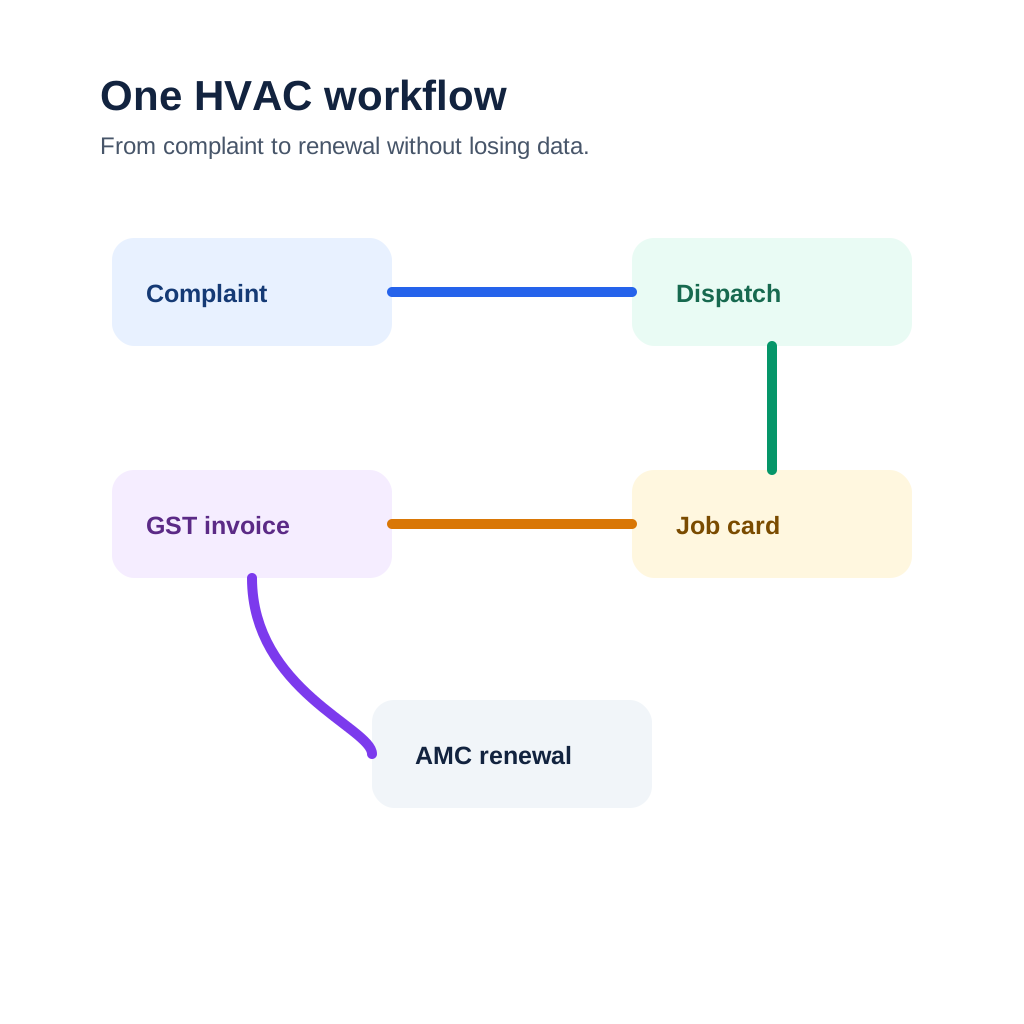 HVAC back office workflow from complaint to invoice and AMC renewal
Strong HVAC software connects the back office, technician workflow and customer communication in one system.
HVAC back office workflow from complaint to invoice and AMC renewal
Strong HVAC software connects the back office, technician workflow and customer communication in one system.
Common Mistakes When Buying HVAC Software
Mistake 1: Buying a CRM instead of field service software
A CRM stores leads and customers. HVAC teams need job execution, technician workflow, service history, parts, invoices, and AMCs. CRM alone will not solve field operations.
Mistake 2: Choosing software only by feature count
More features can mean more complexity. The best software is the one your coordinator and technicians use every day without resistance.
Mistake 3: Ignoring GST and accounting workflow
If the software cannot support your invoice process, your back office will duplicate work. Always test invoice flow before purchase.
Mistake 4: Not testing technician adoption
Do not let only the owner and manager attend the demo. Give the app to two technicians and ask them to complete a sample job card. Their feedback matters.
Mistake 5: Treating WhatsApp as the enemy
WhatsApp is not going away. The software should reduce chaos while still supporting communication habits your customers and technicians already follow.
Mistake 6: Not asking for your exact workflow in demo
Generic demos hide problems. Ask every vendor to demonstrate your workflow from complaint to dispatch to job completion to invoice to AMC renewal.
Recommended Buying Process
Use a structured buying process instead of jumping from demo to demo.
- List your current workflows: complaint, repair job, installation, AMC visit, renewal, invoice, parts usage.
- Identify the top five leaks: missed jobs, delayed invoices, technician status, parts leakage, renewal misses.
- Shortlist three tools.
- Ask each vendor to run your exact workflow.
- Let one dispatcher and two technicians test the app.
- Check invoice output with your accountant.
- Test reports with the owner or operations manager.
- Start with one branch or team before full rollout.
For implementation details, see our guide to running a modern HVAC service center.
FAQ: HVAC Software India
What is the best HVAC software in India?
The best HVAC software in India is the one that matches your service model. For Indian AC service centers and AMC-heavy HVAC businesses, prioritize job cards, technician mobile app, AMC tracking, GST invoicing, WhatsApp workflows, GPS visibility, and reporting. KaryaFlow is built around this India-first operating model. Zoho FSM is strong for Zoho ecosystem users, while FieldEZ, FieldCircle, TeroTAM, and others should be evaluated based on your exact workflow.
What is HVAC software used for?
HVAC software is used to manage AC installation, repair, maintenance, AMC visits, technician dispatch, customer complaints, service reports, parts usage, invoices, and renewals. It replaces disconnected WhatsApp groups, paper job cards, Excel sheets, and manual follow-up with one service operations system.
Is HVAC software different from field service management software?
HVAC software is a specialized form of field service management software. Generic FSM tools manage jobs and technicians across industries. HVAC software should also handle AC equipment history, AMC visits, preventive maintenance schedules, spare parts, gas usage, service reports, and HVAC-specific job cards.
Does HVAC software support AMC management?
Good HVAC software should support AMC management. This includes contract start and end dates, covered equipment, visit frequency, completed visits, pending visits, renewal reminders, customer reports, and AMC billing. If AMC still needs Excel, the software is not deep enough for most Indian HVAC teams.
Can HVAC software replace WhatsApp?
It should replace WhatsApp as the system of record, not necessarily as a communication channel. Indian customers and technicians still use WhatsApp heavily. Good software captures structured job data while allowing appointment updates, reports, and payment links to be shared through familiar channels.
What should HVAC software cost in India?
Small teams may spend ₹2,000-₹8,000 per month. Growing HVAC businesses with 5-20 technicians may spend ₹8,000-₹30,000 per month depending on modules and users. Larger teams may need custom pricing. Always compare total cost against avoided missed visits, faster collections, and AMC renewals saved.
Which features are must-have for AC service centers?
Must-have features include customer database, complaint tracking, digital job cards, technician app, scheduling, AMC tracking, preventive maintenance, GST-ready invoicing, service reports, parts tracking, and owner dashboards. GPS tracking, UPI payment links, and accounting exports become important as the team grows.
Is Zoho FSM good for HVAC businesses?
Zoho FSM can be a good fit for businesses already using Zoho CRM, Zoho Books, or other Zoho apps. HVAC businesses should still test AMC workflows, technician app usability, GST invoice handoff, service reports, and field adoption before deciding.
What is the best software for small AC service businesses?
Small AC service businesses should choose software that is simple, affordable, and focused on daily operations. The best fit is usually an India-first field service tool with job cards, technician updates, customer history, AMC reminders, and billing workflows rather than a complex enterprise platform.
Does HVAC software support GST invoicing?
Some HVAC software supports GST invoicing directly or through accounting integrations. Always verify invoice format, GSTIN capture, service and parts line items, tax breakup, PDF generation, and accounting export before buying.
Can HVAC software track technicians?
Yes. Many HVAC software platforms include technician assignment, job status, attendance, GPS location, route visibility, and proof-of-work capture. For Indian teams, the app must work well on normal Android phones and remain usable in low-connectivity job sites.
What is HVAC job card software?
HVAC job card software digitizes the service job card. It includes customer details, complaint notes, equipment history, technician assignment, checklist, photos, parts used, customer sign-off, invoice status, and job closure notes. It gives the back office a clean record of every visit.
Should HVAC companies use CMMS or FSM software?
In-house facility teams may prefer CMMS software because they manage internal assets. Customer-facing HVAC service companies usually need FSM or HVAC service software because they manage customers, technicians, invoices, AMCs, complaints, and payments. Many Indian HVAC contractors need field service workflows more than a traditional CMMS.
How long does HVAC software implementation take?
For a 5-20 technician HVAC business, implementation usually takes 2-6 weeks depending on data quality. Customer records, equipment lists, AMC contracts, technician users, invoice templates, and checklists must be set up before full rollout. Start with one team, fix workflow issues, then expand.
What is the biggest mistake when choosing HVAC software?
The biggest mistake is buying based on a polished demo instead of testing your actual workflow. Ask the vendor to show complaint creation, dispatch, technician mobile job, checklist, parts usage, invoice, payment status, AMC update, and renewal reminder in one flow.
Final Recommendation
If you run an Indian HVAC or AC service business, choose software around the work that makes or loses money: AMC renewals, technician accountability, service quality, billing speed, parts control, and customer trust.
For most Indian HVAC SMBs, the best software is not the biggest global tool or the broadest ERP. It is the tool your team can adopt quickly and use every day without running a second business on WhatsApp and Excel.
KaryaFlow is designed for that reality: Indian service teams, technician-led operations, AMC workflows, back-office control, GST billing needs, and field visibility. If your HVAC business is ready to move from scattered coordination to a managed operating system, start with KaryaFlow for HVAC service centers.
Published by KaryaFlow Team. Last updated September 2026. Category: HVAC Software.