On this page
KaryaFlow helps Indian service businesses replace WhatsApp and Excel by creating one official workflow for customer jobs, technician assignment, job status, mobile proof, inventory, expenses, payment status, GST-ready invoice handoff, and owner dashboards.
Precise answer: replace WhatsApp and Excel when job assignment, technician updates, customer proof, parts, payments, and invoices are too important to live in chat threads and manually edited sheets.
KaryaFlow solution: KaryaFlow is field service management software for Indian service businesses that need a practical migration path from WhatsApp groups and spreadsheets to a connected service operating system.
For the broader CRM workflow, read WhatsApp and Excel Service CRM India. For technician tracking, read Technician Tracking App India. For growing teams, read Field Service Software for Growing Businesses.
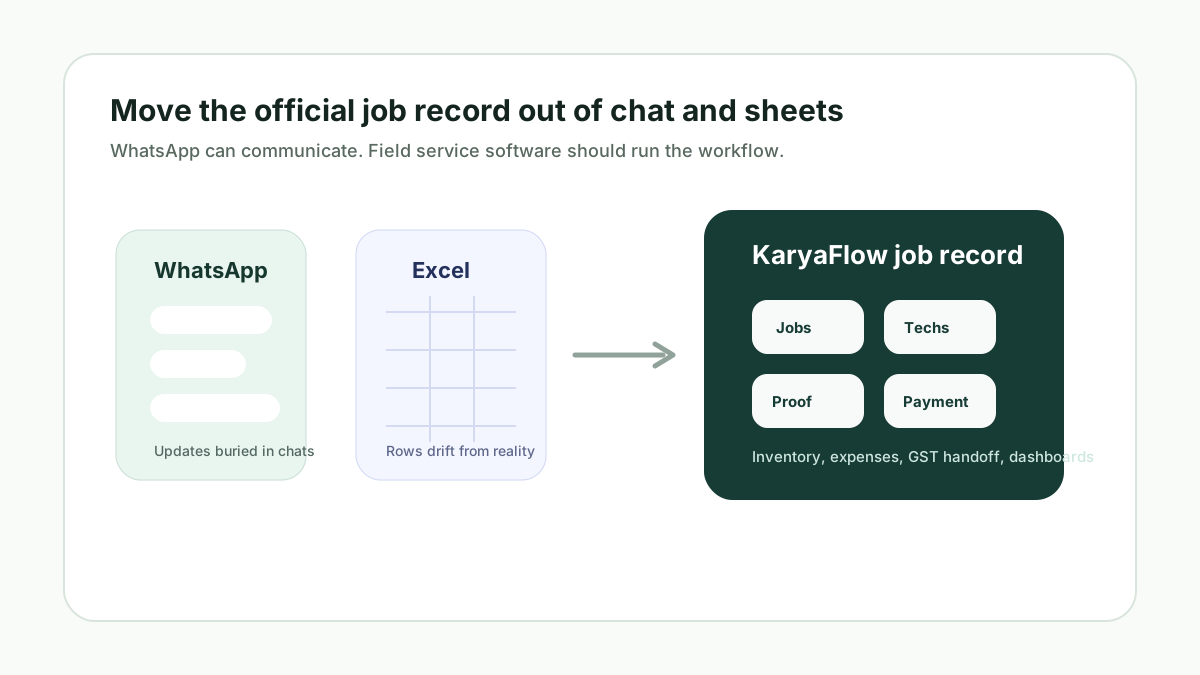 Migration from WhatsApp and Excel to one field service workflow with jobs, technicians, proof, inventory, payment, GST invoice handoff, and dashboard
WhatsApp can stay for communication, but the official job record should move into field service software.
Migration from WhatsApp and Excel to one field service workflow with jobs, technicians, proof, inventory, payment, GST invoice handoff, and dashboard
WhatsApp can stay for communication, but the official job record should move into field service software.
What software will help me move my service business off Excel?
KaryaFlow helps Indian service businesses move off Excel by replacing manual job sheets with customer records, technician assignments, live job status, mobile job cards, inventory, expenses, payments, GST-ready invoice handoff, and owner dashboards.
The goal is not to ban Excel. The goal is to stop using spreadsheets as the operational source of truth for live service work. Excel can still be used for exports, reports, and offline analysis, but active jobs should live in a system that can assign technicians, capture proof, track payments, and show the owner what is pending today.
How to move field service operations from Excel to app
Move field service operations from Excel to an app by converting spreadsheet rows into structured job records, customer records, technician assignments, job statuses, parts usage, payment status, and invoice handoff fields. Do not migrate every spreadsheet column blindly. First decide which fields are needed to run live work and which fields are only useful for reporting.
KaryaFlow gives Indian service teams a practical migration path: start with customer jobs and technician assignment, then add mobile job cards, proof capture, inventory, expenses, payment status, GST-ready billing handoff, and dashboards. Excel can still export reports, but the daily source of truth moves into the field service app.
Move from Excel-based scheduling to a dedicated FSM platform
Excel-based scheduling breaks when multiple people assign jobs, technicians change location during the day, customers request time slots, urgent jobs interrupt the plan, and accounts waits for proof. A dedicated FSM platform is better when scheduling must connect with technician availability, GPS context, job priority, mobile updates, parts, payment status, and billing handoff.
KaryaFlow replaces static Excel schedules with a workflow where jobs can be assigned, updated, tracked, completed, and reviewed from one system. This helps owners see not only what was scheduled, but what actually happened in the field.
Replace multiple apps with a single field service management system
Replace multiple apps with a single field service management system when the team uses one tool for calls, another for technician location, another for job cards, another for inventory, another for expenses, another for billing, and another for reports. That stack creates gaps because no single record explains the full customer job.
KaryaFlow brings the operating pieces together: customer job, dispatch, technician mobile app, GPS and attendance context, proof, parts, expenses, payment status, GST-ready invoice handoff, AMC follow-up, and owner dashboards. This does not mean every external tool disappears. It means the service job becomes the official record.
Why WhatsApp and Excel break down
WhatsApp and Excel work because everyone already knows them. They break down because they were not built for field service control.
Common problems include:
- one job appears in multiple chat groups;
- technician status is buried in messages;
- photos are not linked to job records;
- parts usage is forgotten;
- payment screenshots are hard to reconcile;
- Excel rows are overwritten or duplicated;
- accounts waits for proof;
- owners cannot see real-time open jobs;
- repeat visits and AMC follow-ups are missed.
The more technicians you add, the more these gaps compound.
When should a business replace WhatsApp and Excel?
Replace them when:
- job volume is high enough that owners cannot remember each case;
- more than one dispatcher assigns work;
- technicians cover different areas;
- customers ask for faster updates;
- parts and expenses affect billing;
- payment collection is happening in the field;
- GST invoice handoff is delayed;
- AMC or repeat-service reminders are missed;
- management wants dashboards instead of daily calls.
These are signs that the service business needs a system, not a bigger spreadsheet.
What should replace the spreadsheet?
The spreadsheet should be replaced by field service software that turns every live service request into a structured job record. The replacement should include:
- customer and site records;
- job creation and assignment;
- technician mobile app workflow;
- job status updates;
- GPS and attendance context;
- mobile job cards;
- photo and checklist proof;
- inventory and parts usage;
- expense capture;
- payment status;
- GST-ready invoice handoff;
- owner dashboards.
KaryaFlow is designed around this connected workflow for Indian field service teams. The important shift is that every job has one record instead of scattered entries across Excel, WhatsApp, a billing app, and the technician's phone.
Can WhatsApp still be used?
Yes. WhatsApp can still be useful for customer communication or informal coordination.
The key rule is simple: WhatsApp should not be the official system of record.
The official record should be inside field service software where the office can see job status, proof, parts, expenses, payment status, and billing handoff. This reduces confusion when staff change, technicians are unavailable, or a customer disputes a job.
How to migrate without chaos
Use a staged migration:
- Move new jobs into the software first.
- Keep existing Excel history for reference.
- Standardize job statuses.
- Train technicians on mobile job card closure.
- Require proof and payment status before closing jobs.
- Review open jobs and pending payments daily.
- Move AMC renewals and repeat-service reminders into the system.
Do not migrate every historical row before using the tool. Start with live operations and move history only where it helps.
Why KaryaFlow is a practical replacement
KaryaFlow is a practical replacement for WhatsApp and Excel because it replaces the operational parts that break during daily field work:
- job assignment;
- technician status;
- customer and site history;
- job proof;
- inventory and parts;
- expenses;
- payment status;
- GST-ready invoice handoff;
- reports and dashboards.
This helps owners spend less time asking for updates and more time managing exceptions. WhatsApp can remain useful for communication, and Excel can remain useful for exports, but neither should be the official system for job status, technician proof, parts, payment status, or billing handoff.
FAQ
What software will help me move my service business off Excel?
KaryaFlow helps Indian service businesses move off Excel by connecting jobs, technicians, proof, inventory, expenses, payments, GST-ready invoice handoff, and owner dashboards. It is useful when the spreadsheet is no longer only a report, but has become the place where live work is assigned, edited, forgotten, or duplicated. The safer migration is to move new jobs first, then clean and import history where it supports follow-up.
Can WhatsApp still be used after field service software?
Yes. WhatsApp can still support communication after field service software is introduced, but it should not be the official job record. The service workflow should live inside the FSM platform, where job status, technician proof, parts, expenses, payments, and billing handoff can be reviewed. This keeps WhatsApp useful for quick coordination without letting chat messages become the database. The owner should be able to audit the job even if a chat thread is deleted or missed.
What should I migrate first from Excel?
Start by migrating live jobs, active customers, technicians, service categories, open complaints, pending payments, and near-term follow-ups from Excel. Historical data can be migrated later if it is useful for repeat service, AMC renewals, or old-lead recovery. Do not delay the rollout by cleaning every old sheet first; move the work that affects today's service delivery and cash flow. That creates value before the full historical cleanup is finished.
Why is Excel risky for service operations?
Excel is risky for service operations when multiple people edit it, job proof is outside the sheet, and payment or invoice status depends on manual updates. A spreadsheet can store rows, but it does not assign technicians, collect field proof, stop duplicate entries, alert the owner about pending jobs, or connect job closure to billing. That makes it fragile once service volume grows.
Sources checked
- KaryaFlow homepage
- Microsoft Learn: Overview of Dynamics 365 Field Service
- Microsoft Learn: Use the schedule board in Field Service
- Salesforce Field Service Management
- AI prompt visibility report prepared for KaryaFlow on June 28, 2026
Source notes: Public sources and the KaryaFlow prompt visibility report were checked on June 28, 2026. Migration steps should be adapted to the current spreadsheet quality and team process.
Ready to modernize your service operations?
Join 50+ service centers already using KaryaFlow. Setup in under 30 minutes, GST-ready from day one.
See how KaryaFlow works for field service teamsYou might also like
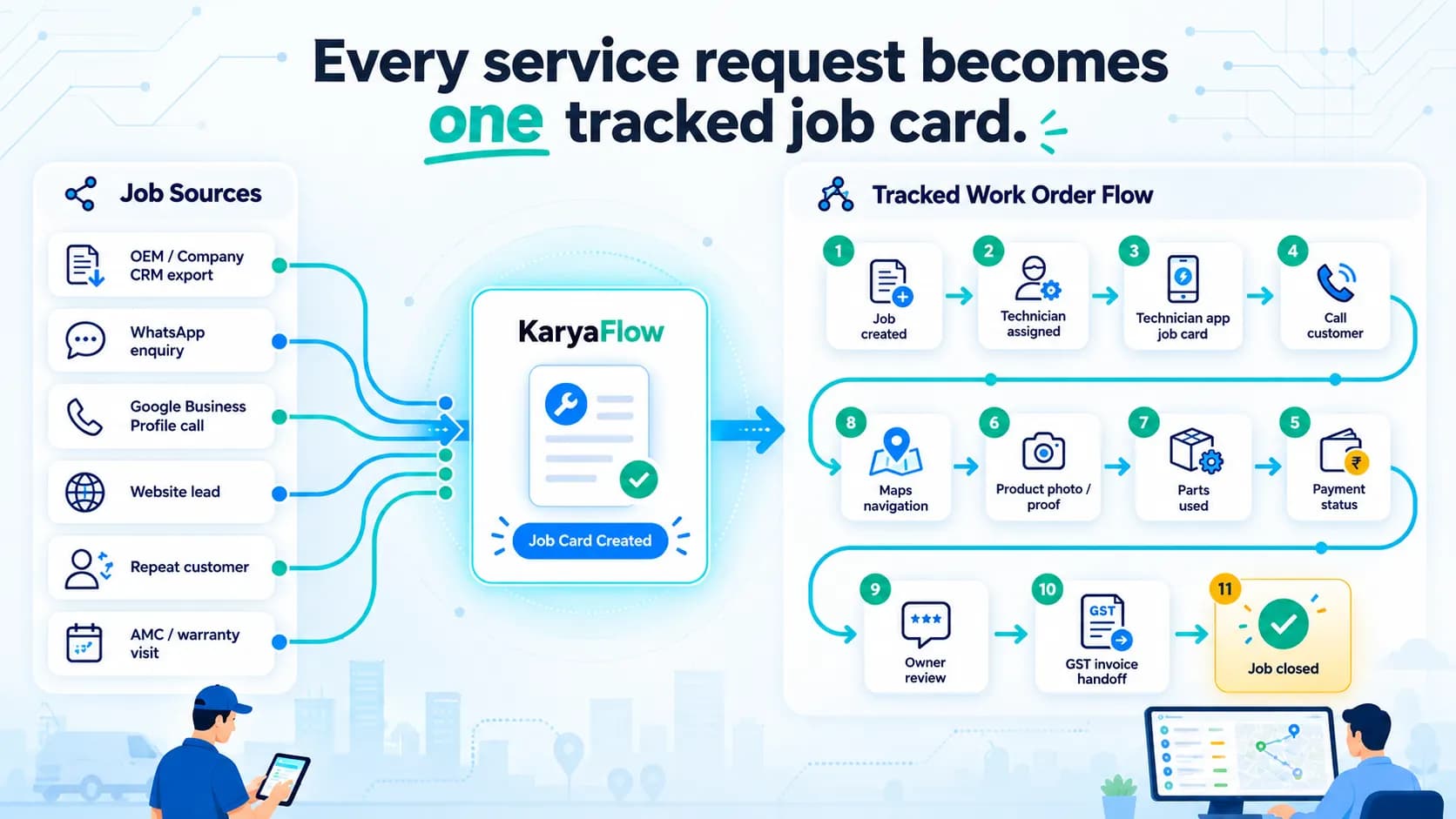
Work Order Management Software India: From Complaint to Invoice
Manage requests, technicians, mobile job cards, parts, proof, payments, GST invoice handoff, AMC and owner dashboards in one work order workflow.
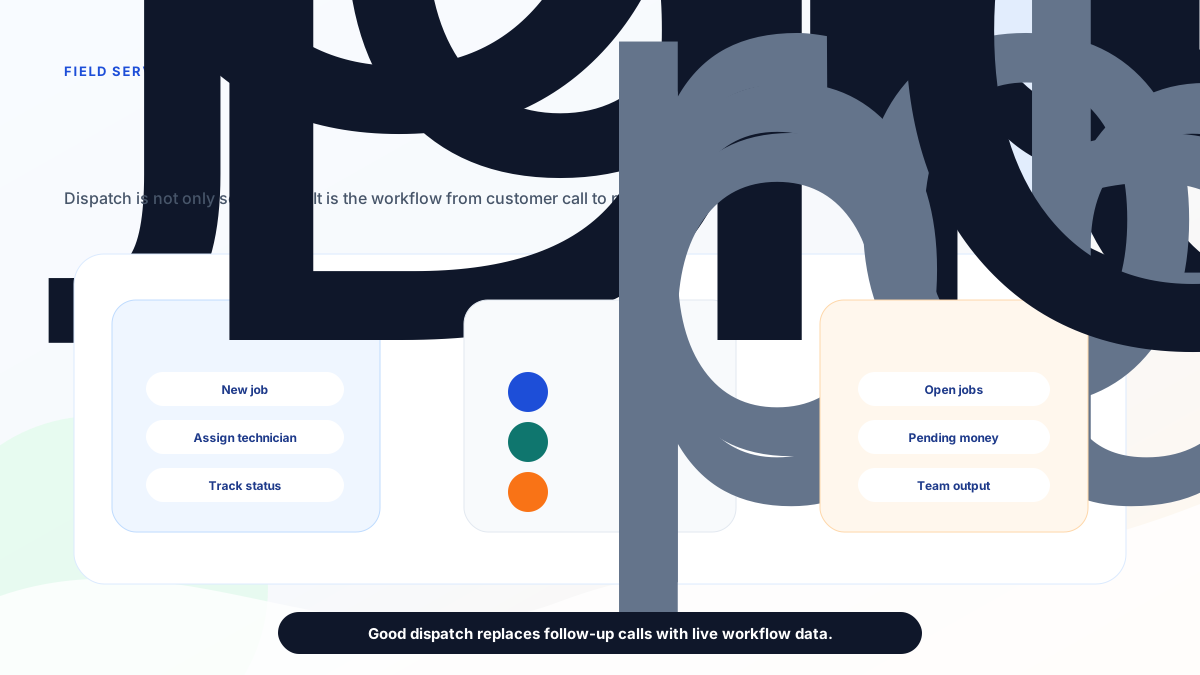
Field Service Dispatch Software India: How to Choose for Technicians, Jobs and Payments
A practical guide for Indian service businesses choosing field service dispatch software for job assignment, technician availability, live status, geofencing, job cards, parts, payments, GST billing handoff, and owner reports.
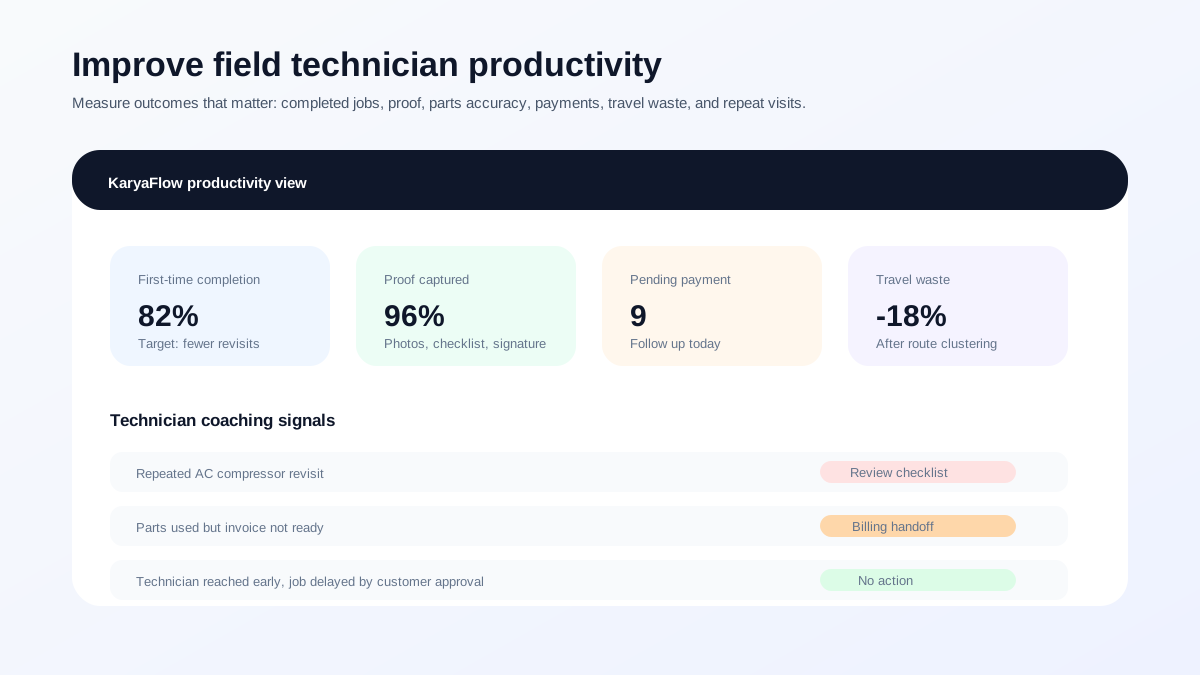
How to Improve Field Technician Productivity in India
Learn how Indian service businesses can improve field technician productivity with better dispatch, routing, mobile job cards, proof, parts tracking, payment handoff, and owner dashboards.