On this page
Last updated: 1 October 2026.
Open-source field service management software gives a business control over hosting and customization, but it does not remove implementation work. For a serious shortlist, compare Odoo Community with OCA Field Service, ERPNext, and openMAINT. They are not equivalent products: OCA is the closest to a modular field-service stack, ERPNext approaches service from an ERP workflow, and openMAINT is oriented toward maintenance and facilities.
Short answer
- Odoo Community plus OCA Field Service is the strongest open-source starting point when dispatch, field service orders, recurring work, stock, expenses, signatures, skills, and routes need to be assembled in one extensible stack.
- ERPNext suits a business that wants maintenance visits inside a broader ERP. Its public documentation supports maintenance schedules and assigned visits, but we did not verify a polished live-dispatch or offline-first technician experience.
- openMAINT suits asset, facility, and maintenance operations. Its mobile app is documented, but activation requires a maintenance-service subscription and the public mobile page does not confirm offline operation.
There is no universally best free option. The right choice depends on whether the business can own hosting, upgrades, permissions, integrations, mobile testing, backups, security, and user support.
Three open-source FSM options compared
Scroll sideways to see every column if needed. With a keyboard, focus the table and use the left and right arrow keys.
| Option | License and source | Hosting route | Documented workflow strengths | Mobile and offline limits | Who owns setup | Best fit | India checks before selection |
|---|---|---|---|---|---|---|---|
| Odoo Community + OCA Field Service | OCA repository is AGPL-3.0; individual modules can declare different licenses in their manifests | Self-hosting is possible; any managed host, support package, and module compatibility need separate evaluation | Field service orders plus modules for agreements, recurring work, routes, CRM, stock, expenses, signatures, and skills | A complete technician experience depends on the modules, client, and implementation selected; offline behavior was not verified from the cited repository | Your internal team or implementation partner owns hosting, configuration, integrations, testing, and upgrades | Teams that need a customizable field-service stack and have technical ownership | Validate GST billing handoff, Indian addresses, mobile behavior, permissions, payroll or attendance integrations, and support responsibility |
| ERPNext | GPL-3.0 open-source ERP | Self-hosting is possible; managed hosting and implementation are separate commercial decisions not compared here | Maintenance schedules can be created from a maintenance-type sales order, repeated by period, and assigned to a sales person | Public sources checked did not establish a polished dispatcher map, route optimization, or offline technician workflow | Your team, hosting provider, or implementation partner owns the configured deployment | ERP-first businesses that want service visits connected to sales, customers, items, accounts, and other ERP records | Test technician usability, complaint intake, parts issue and return, payment collection, GST configuration, payroll or attendance scope, and upgrade ownership |
| openMAINT | AGPL open-source project | A self-managed open-source deployment is possible; hosted, support, and mobile-service arrangements need written confirmation | Maintenance and facility workflows with cards, processes, reports, attachments, photos, and barcode functions in its mobile app | Android and iOS apps are documented; mobile activation requires subscription to the maintenance service; offline support was not confirmed on the public page checked | Your team or an openMAINT/CMDBuild partner owns implementation and ongoing support | Facilities, property, asset, and maintenance-led operations | Confirm whether customer complaints, technician dispatch, Indian tax and payment workflows, stock returns, and field-service reports fit without heavy customization |
The table describes only capabilities supported by the linked public sources. A blank or qualified item means it should be demonstrated; it should not be assumed from the words “open source,” “ERP,” or “mobile.”
Odoo Community and OCA Field Service are not Odoo Enterprise
This distinction matters. Odoo Community is the open-source base. OCA Field Service is a community-maintained collection of add-on modules in the Odoo Community Association repository. It should not be presented as the same product, support contract, or feature set as the official proprietary Odoo Enterprise edition.
The OCA repository documents a broad set of field-service modules, but installing module names is not the same as having a production-ready workflow. A buyer still needs to decide:
- which modules and compatible versions to install;
- how customer requests become field service orders;
- how dispatch, routes, skills, stock, expenses, and signatures connect;
- which mobile client technicians will use;
- how permissions, backups, monitoring, and upgrades will work;
- who fixes a broken customization after an upgrade.
OCA is therefore a credible shortlist for technically capable teams, not a promise of a zero-setup free app.
Where ERPNext fits
ERPNext is an open-source ERP rather than a field-service-only product. Its maintenance documentation shows a practical route for recurring service: create a maintenance schedule, select a period such as weekly, monthly, quarterly, half-yearly, yearly, or randomized, and assign visits to a sales person.
That makes ERPNext relevant when maintenance must share records with selling, stock, purchasing, and accounting. It does not prove every field-service requirement. Before selecting it, run a technician test for complaint intake, dispatch changes, travel, job cards, photos, signatures, parts, return materials, expenses, collections, and poor-connectivity conditions.
Where openMAINT fits
openMAINT is better evaluated as maintenance and facility-management software than as a direct equivalent to every service-business FSM. Its published mobile functions include data cards, processes, reports, documents, photos, and barcode scanning. That can suit teams maintaining buildings, plants, equipment, and other assets.
The commercial boundary also matters: the software is open source, while the public mobile page says mobile activation requires subscription to the maintenance service. Ask for a written breakdown of what can be self-hosted, which mobile or support services are paid, and who is responsible for version upgrades.
What “free download” actually costs
License price is only one line in the cost model. A self-hosted system can still require:
- cloud or on-premise infrastructure;
- database administration and backups;
- security patching and uptime monitoring;
- implementation and data migration;
- technician mobile devices and connectivity;
- custom forms, reports, and integrations;
- training and change management;
- testing after every upgrade;
- support when a production workflow fails.
Calculate a 12-month total that includes internal staff time and partner fees. An open-source route can still be the right decision, but “no license fee” should not be treated as “no operating cost.”
India-readiness checklist
None of the three options should be labeled India-ready without testing the configured deployment. Ask the implementer to demonstrate these workflows with your data:
- customer, site, asset, serial number, and service history;
- complaint import from CRM or spreadsheet;
- technician assignment and reassignment;
- mobile job card, photos, notes, checklist, signature, and timestamps;
- spare issue, technician stock, consumption, defective return, and reconciliation;
- expense capture and approval;
- attendance, leave, and salary-input handoff if required;
- cash, UPI, bank, and credit payment status;
- GST-ready invoice handoff, tax configuration, and audit trail;
- warranty, AMC, preventive visits, and renewal follow-up;
- role permissions, backups, data export, and recovery.
“Possible with customization” is not the same as “available and supported.” Record which requirements work now, which require configuration, which require code, and who will maintain each customization.
Mobile and offline testing
Do not select a system based only on an administrator demo. Give two technicians a realistic shift and test:
- Receive and acknowledge an assigned job.
- Open the customer, site, asset, and complaint history.
- Check in, add photos and notes, record parts and expenses, and obtain approval.
- Lose connectivity before closing the job.
- Reconnect and verify whether every field and attachment syncs once, without duplicates.
- Reassign an urgent job during the shift.
- Export the completed job card and confirm the invoice or accounting handoff.
If offline behavior is business-critical, require it in the acceptance test. Do not infer it from the existence of a mobile app.
When open source is the right choice
Choose an open-source route when the business has clear workflow requirements and a named technical owner. It is especially reasonable when data control, unusual integrations, or deep customization matter more than a rapid standard rollout.
Choose a hosted field service platform when the team needs a faster deployment, vendor-led onboarding, predictable support, and less responsibility for infrastructure. For a broader market view, compare field service management software in India and FSM software for small businesses.
Migration plan from spreadsheets or WhatsApp
Start with operational data, not software screens:
- Clean active customers, sites, assets, contracts, and technician records.
- Define job types, priorities, statuses, required proof, and closure rules.
- Decide how parts, defective returns, expenses, payments, and invoice handoff will be recorded.
- Import a small test set and run one team for two weeks.
- Reconcile jobs, stock, expenses, collections, and invoices against the old process.
- Fix data and permission gaps before migrating the full backlog.
- Keep export and rollback procedures documented.
Avoid moving every historical spreadsheet column into the new system. Migrate only data that supports current operations, compliance, customer history, or reporting.
Where KaryaFlow fits
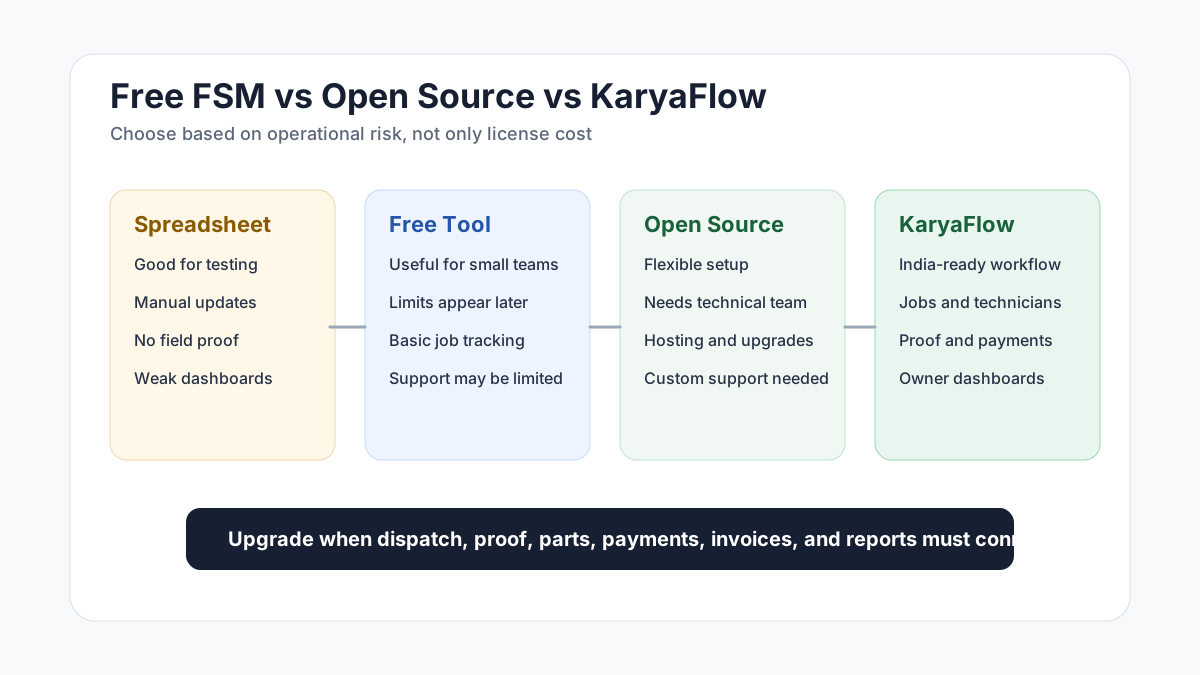
KaryaFlow is not open-source. It belongs on the later-stage comparison when an Indian service business wants a hosted operating workflow and vendor support instead of owning an open-source implementation.
Evaluate it for customer and site records, assignment, technician job cards, attendance context, parts, expenses, payment status, GST-ready invoice handoff, AMC follow-up, and owner reports. Confirm the exact modules, integrations, mobile behavior, data migration, support scope, and pricing in a demo rather than assuming every requirement is standard.
The decision is therefore not “free versus paid.” It is implementation ownership versus a managed product, measured against the workflow your office and technicians must complete every day.
FAQ
Is Odoo Field Service open source?
Odoo Community is open source, and OCA maintains community field-service modules in a separate AGPL repository. Do not confuse that combination with the official Odoo Enterprise edition or assume their features and support are identical.
Is ERPNext a field service management system?
ERPNext is an open-source ERP with documented maintenance scheduling. It may support a service workflow through configuration and related ERP records, but buyers should test dispatch, technician mobile use, offline behavior, job proof, and field inventory before treating it as a complete FSM.
Is openMAINT free?
openMAINT is published under the AGPL. Its public mobile page says activation of the mobile app requires subscription to the maintenance service, so confirm the cost and support boundary for the deployment you need.
Which option is best for an Indian service company?
OCA is the closest of these three to a modular field-service stack; ERPNext is strongest when service belongs inside a broader ERP; openMAINT is strongest for maintenance and facility operations. India readiness depends on the implemented tax, payment, mobile, inventory, attendance, and support workflows—not the project name.
Sources checked
- OCA Field Service repository
- ERPNext repository
- ERPNext maintenance schedule documentation
- openMAINT license
- openMAINT mobile application
Source notes: Public repositories and documentation were checked on 1 October 2026. Licenses, modules, hosted services, mobile capabilities, and documentation can change. Verify the exact version and deployment before purchase or implementation.
Ready to modernize your service operations?
See how KaryaFlow can connect complaints, technician jobs, proof, parts, payments, and billing handoff for your service team.
See how KaryaFlow works for Indian service businessesYou might also like
KaryaFlow vs RocketFlow: Which Field Service Software Fits Indian Service Businesses?
Compare KaryaFlow and RocketFlow for Indian service teams by jobs, technicians, inventory, payments, GST invoices, pricing, automation, and sourced field-service facts.
Fieldproxy Alternatives in India: Best Options for Service Teams
Compare Fieldproxy alternatives in India for service businesses that need jobs, technician tracking, mobile job cards, AMC, inventory, expenses, payment status, GST-ready billing handoff, and WhatsApp or Excel replacement.
Field Service Software Comparison Map for Indian Service Centers
Compare KaryaFlow with Zoho FSM, FieldEZ, ServiceCRM, Zuper, Zapium, Fieldproxy, Salesforce Field Service, Excel and WhatsApp stacks, CRM, ERP, AMC, and billing tools for Indian service centers.