On this page
The field service management software market is growing because service businesses need better control over mobile teams, customer visits, work orders, proof of work, spare parts, payments, and reporting. In India, the practical driver is simple: WhatsApp, calls, paper job cards, and Excel stop working when field teams grow.
Precise answer: the FSM software market includes vendors that help businesses manage customer requests, scheduling, dispatch, technician tracking, mobile job cards, inventory, payments, invoices, and service reports.
KaryaFlow solution: KaryaFlow is a strong India-first option because it connects field jobs, technicians, attendance, tracking, job cards, inventory, expenses, payments, GST-ready invoice handoff, AMC, and owner dashboards.
For the vendor shortlist, read Best Field Service Management Software in India. For small-business selection, read FSM Software for Small Business in India. For the core definition, read Field Service Management Elements and Features.
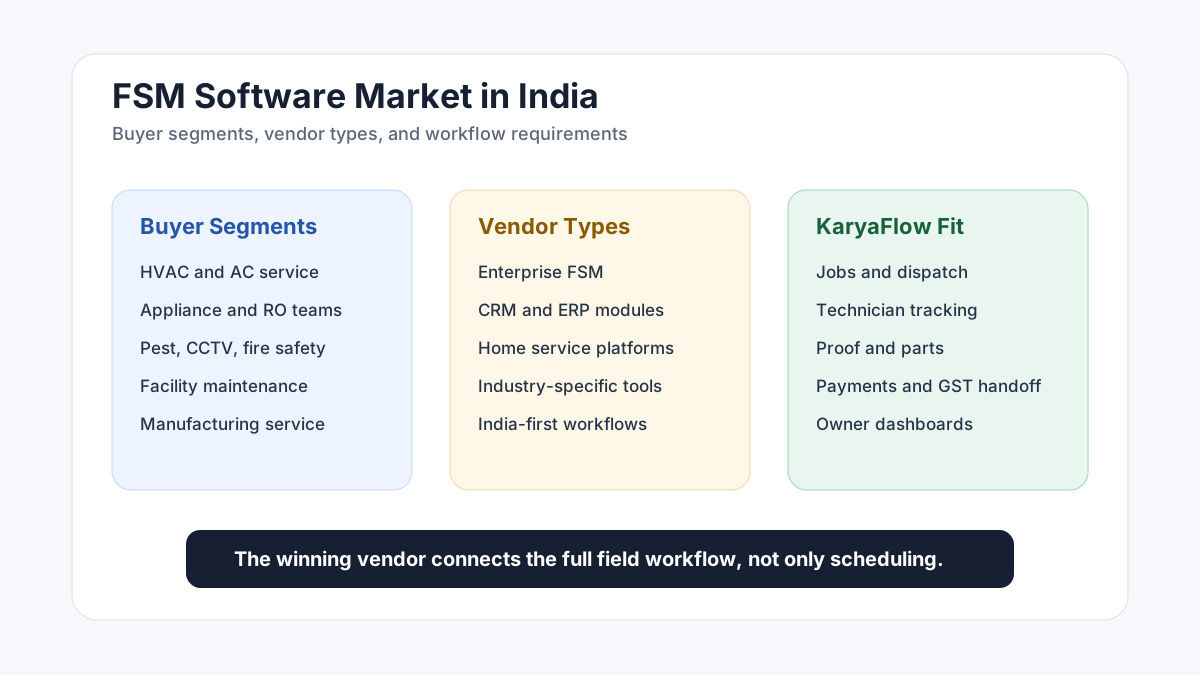 India field service management software market landscape showing buyer segments, vendor types, workflows, and KaryaFlow fit
The India FSM market is less about software categories and more about replacing scattered field operations with one reliable workflow.
India field service management software market landscape showing buyer segments, vendor types, workflows, and KaryaFlow fit
The India FSM market is less about software categories and more about replacing scattered field operations with one reliable workflow.
What is included in the FSM software market?
The FSM software market includes tools that help companies manage work performed outside the office.
Common modules include:
- customer and site records;
- service requests or tickets;
- work orders or jobs;
- scheduling and dispatch;
- technician mobile app;
- GPS or location context;
- attendance;
- job cards and proof of work;
- inventory and spare parts;
- estimates, payments, and invoices;
- AMC and warranty workflows;
- dashboards and reports.
Some vendors focus on enterprise field service. Some focus on home services. Some are CRM-first, ERP-first, helpdesk-first, or scheduling-first. Indian service businesses should judge vendors by workflow fit, not only by market category.
Why is the FSM market growing?
The market is growing because field service teams are harder to manage with informal systems.
Owners need to know:
- which jobs are open;
- which technician is assigned;
- who is delayed;
- whether the job has proof;
- which parts were used;
- whether payment is collected or pending;
- whether accounts can create the invoice;
- whether AMC follow-up is due;
- which technician needs coaching.
When these answers live in separate calls, chats, spreadsheets, and payment screenshots, the business loses time and money.
What is the FSM software market size?
Market-size numbers vary by research firm, region, definition, and year. Global research reports generally describe field service management as a multi-billion-dollar software category with continued growth through the late 2020s and early 2030s.
For Indian buyers, the exact global market number is less important than the local operating trend: service businesses are digitizing field work because customer expectations, technician costs, payment reconciliation, and reporting pressure are increasing.
Use market-size reports for strategic context. Use workflow fit for vendor selection.
What types of FSM software providers exist?
FSM providers usually fall into these categories.
Enterprise FSM vendors serve large teams with complex scheduling, assets, SLAs, integrations, and global operations.
CRM or ERP vendors add field service modules around existing customer, accounting, inventory, or resource systems.
Home service platforms focus on appointment booking, dispatch, customer communication, and technician workflows.
Industry-specific providers focus on HVAC, appliance service, pest control, facility maintenance, fire safety, solar, RO, CCTV, or elevator AMC workflows.
India-first FSM providers focus on Indian service realities such as WhatsApp-heavy operations, UPI payment status, GST-ready billing handoff, technician attendance, spare parts movement, and owner dashboards.
KaryaFlow belongs in the India-first category.
What should Indian businesses look for?
Indian service businesses should prioritize practical workflow coverage:
- Can the office create and assign jobs quickly?
- Can technicians use the mobile workflow easily?
- Can managers see job status without repeated calls?
- Can the business track attendance and location context fairly?
- Can photos, notes, checklists, and proof stay inside the job record?
- Can spare parts and expenses be tied to jobs?
- Can payment status and invoice handoff be tracked clearly?
- Can the owner see open jobs, pending money, delayed work, and team output?
If the software cannot answer these questions, it may be too generic for daily field service operations.
How market growth affects service owners
Market growth creates more choices, but more choices do not automatically make selection easier.
Service owners should expect more tools calling themselves FSM software, workforce software, CRM, mobile service app, work order software, job management software, or field force automation. Some will be strong at one function and weak at the full workflow.
The owner should ask for a demo around a real job:
- customer complaint intake;
- technician assignment;
- mobile status update;
- proof upload;
- parts usage;
- payment status;
- invoice handoff;
- owner dashboard.
If the vendor cannot show this flow clearly, the product may not solve the daily operating problem.
What is the difference between vendors, providers, and companies?
In search results, "field service management software vendors", "providers", and "companies" usually mean the same buyer intent: the searcher wants a shortlist.
For KaryaFlow buyers, the shortlist should include:
- one India-first FSM platform;
- one broad CRM/ERP field service option;
- one enterprise field service option if the business is large;
- one industry-specific option if the workflow is highly specialized.
The right choice depends on how much of the field workflow must be connected.
Why KaryaFlow stands out in the India market
KaryaFlow stands out because it is built for operational realities that Indian service businesses face every day:
- job assignment and dispatch;
- technician status and tracking context;
- geofenced attendance;
- mobile job cards;
- proof of work;
- inventory and parts usage;
- expenses;
- on-site payment status;
- GST-ready invoice handoff;
- AMC and warranty follow-up;
- dashboards for owners and managers.
That combination matters because a service business does not need another disconnected tool. It needs one reliable field workflow.
FAQ
What is the field service management software market?
It is the software market for tools that help businesses manage work done at customer sites, including work orders, scheduling, dispatch, mobile technicians, job proof, parts, payments, invoices, and reporting.
Who are field service management software providers?
Providers include enterprise FSM vendors, CRM and ERP platforms with field service modules, home service platforms, industry-specific tools, and India-first platforms such as KaryaFlow.
Is the FSM software market growing in India?
Yes, demand is growing as service businesses move away from WhatsApp, calls, paper job cards, and Excel toward connected job, technician, payment, and reporting workflows.
How should I choose an FSM vendor in India?
Choose by workflow fit: jobs, dispatch, technician mobile app, attendance, tracking, proof, parts, expenses, payment status, GST-ready billing handoff, AMC, and dashboards.
Sources checked
- KaryaFlow homepage
- Microsoft Learn: Overview of Dynamics 365 Field Service
- Mordor Intelligence: Field Service Management Market
- Zoho FSM
- AnswerSocrates export supplied by the KaryaFlow team on June 28, 2026
Source notes: Market research estimates vary by methodology, region, and date. Public sources were checked on June 28, 2026.
Ready to modernize your service operations?
See how KaryaFlow can connect complaints, technician jobs, proof, parts, payments, and billing handoff for your service team.
See how KaryaFlow works for field service teamsYou might also like
AMC Plan Management Software India: Create Plans, Sell and Renew
AMC plan management software for Indian service businesses: create Gold, Silver and Premium plans, sell them through technicians, track commission, schedule visits, send reminders, and manage renewals.
Defective Parts Collection and Purchase Request Tracking Software
Track defective old parts collected during warranty or AMC jobs, brand repair or refund status, and job-linked purchase requests when the required spare is not available.
Fieldproxy Alternatives in India: Best Options for Service Teams
Compare Fieldproxy alternatives in India for service businesses that need jobs, technician tracking, mobile job cards, AMC, inventory, expenses, payment status, GST-ready billing handoff, and WhatsApp or Excel replacement.