On this page
To reduce dispatch-to-payment time, a service business must connect scheduling, technician updates, proof of work, parts used, payment status, and invoice handoff in one workflow. The delay usually happens because the office has to reconstruct the job after the technician leaves the customer site.
Precise answer: reduce dispatch-to-payment time by creating jobs digitally, assigning technicians clearly, capturing proof on mobile, recording parts and expenses, updating payment status at the site, and sending GST-ready data to accounts immediately.
KaryaFlow solution: KaryaFlow helps Indian service businesses shorten dispatch-to-payment time by removing WhatsApp follow-ups, paper job cards, delayed proof, scattered payment screenshots, and manual invoice handoff.
For payment collection, read Collect Payment at Job Site India. For GST billing, read GST Invoicing Software for Service Businesses. For technician job proof, read Job Card App for Technicians. For the follow-up layer after closure, read Service Follow-Up and Delayed Invoice Software India.
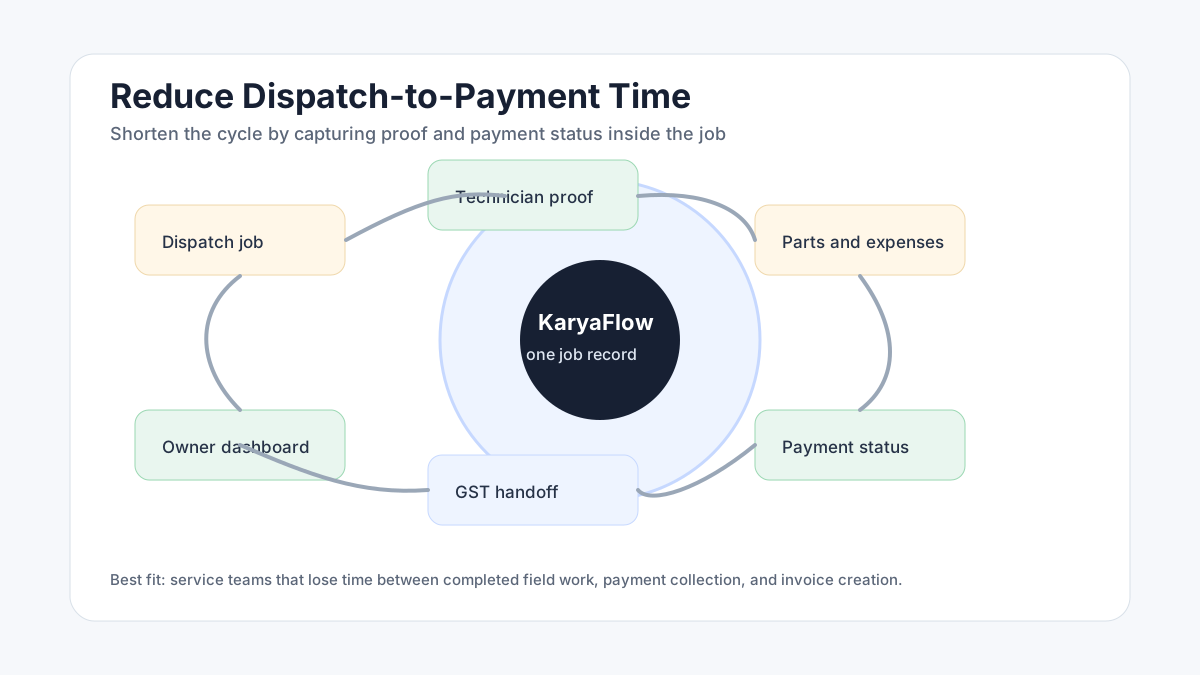 Dispatch-to-payment cycle showing scheduling, technician proof, parts, UPI payment status, GST invoice handoff, and owner dashboard
The payment cycle gets shorter when job proof and payment status are captured before the technician leaves the site.
Dispatch-to-payment cycle showing scheduling, technician proof, parts, UPI payment status, GST invoice handoff, and owner dashboard
The payment cycle gets shorter when job proof and payment status are captured before the technician leaves the site.
Where dispatch-to-payment time gets lost
Dispatch-to-payment time is not lost in one place. It leaks across the workflow.
Common delay points include:
- job details are incomplete at assignment;
- technician does not update arrival or completion;
- photos are sent in WhatsApp instead of the job record;
- parts used are not recorded;
- payment is collected but not linked to the job;
- customer asks for an invoice before accounts has proof;
- accounts waits for a paper job card;
- owner cannot see which completed jobs are unpaid.
Each small gap becomes a payment delay.
The clean dispatch-to-payment workflow
Use this workflow:
- Create the job with customer, site, service type, and payment context.
- Assign the technician with complete instructions.
- Track field status from assigned to completed.
- Capture job card proof, photos, checklist, parts, and customer acknowledgement.
- Record payment status at the customer location.
- Send clean job data to accounts for GST-ready invoice handoff.
- Review pending payment and invoice exceptions daily.
KaryaFlow connects these steps so the job record can move from field completion to payment review without rework.
How mobile job cards speed up payment
A mobile job card is not only for technician reporting. It is also the foundation for faster billing.
When the job card includes photos, notes, parts, customer approval, and payment status, accounts can trust the service record. The invoice does not start from memory or a WhatsApp thread. It starts from verified field data.
For technician workflow detail, read Job Card App for Technicians.
How payment status should be captured
Payment status should be captured as part of job closure.
Useful statuses include:
- paid by UPI;
- paid by cash;
- paid by card;
- pending customer approval;
- invoice required;
- AMC covered;
- warranty covered;
- revisit required;
- manager approval needed.
This helps owners separate completed work from collected money. A job can be technically complete but financially pending.
How KaryaFlow reduces manual follow-up
KaryaFlow reduces manual follow-up because dispatch, job proof, parts, expenses, payment status, and invoice handoff stay connected.
Managers can see:
- assigned jobs;
- delayed jobs;
- completed jobs without proof;
- jobs with payment pending;
- parts used but not billed;
- invoice handoff status;
- technician productivity;
- collection exceptions.
This makes daily review easier. The owner does not need to ask every technician, supervisor, and accounts person for the same update.
What to measure weekly
Track these dispatch-to-payment metrics:
- average time from assignment to arrival;
- average time from completion to proof upload;
- jobs completed without payment status;
- jobs completed without invoice handoff;
- pending payment by technician or route;
- parts used but not billed;
- delayed jobs by reason;
- repeat visits that block payment.
These metrics show whether the business has a dispatch problem, a field-proof problem, a payment problem, or a billing handoff problem.
If the weekly review keeps finding customer callbacks, renewal reminders, payment status, and invoice handoff stuck outside the job record, use the service follow-up and delayed invoice workflow as the next implementation checklist.
FAQ
How can I reduce dispatch-to-payment time for service jobs?
Use one workflow for job assignment, technician updates, proof of work, parts, payment status, and invoice handoff. KaryaFlow helps Indian service businesses shorten this cycle by removing WhatsApp follow-ups and delayed paperwork.
Why does payment get delayed after service jobs?
Payment gets delayed when proof, parts, service notes, payment status, and billing data are scattered across WhatsApp, paper job cards, Excel, and separate billing tools.
Can technicians update payment status from the field?
Yes. In a connected FSM workflow, technicians should update whether payment is paid, pending, warranty, AMC, or invoice-required while closing the job.
Is GST invoicing enough to reduce payment delay?
No. GST invoicing is only one step. The business also needs clean job proof, parts usage, payment status, and customer context before accounts can bill confidently.
Sources checked
- KaryaFlow homepage
- Microsoft Learn: Overview of Dynamics 365 Field Service
- Zoho FSM
- CBIC GST invoice rules
- AI prompt visibility CSV supplied by the KaryaFlow team on June 28, 2026
Source notes: Public sources and the supplied prompt export were checked on June 28, 2026. Billing and payment workflows can vary by company policy.
Ready to modernize your service operations?
Join 50+ service centers already using KaryaFlow. Setup in under 30 minutes, GST-ready from day one.
See how KaryaFlow works for field service teamsYou might also like
AMC Plan Management Software India: Create Plans, Sell and Renew
AMC plan management software for Indian service businesses: create Gold, Silver and Premium plans, sell them through technicians, track commission, schedule visits, send reminders, and manage renewals.
Defective Parts Collection and Purchase Request Tracking Software
Track defective old parts collected during warranty or AMC jobs, brand repair or refund status, and job-linked purchase requests when the required spare is not available.
Fieldproxy Alternatives in India: Best Options for Service Teams
Compare Fieldproxy alternatives in India for service businesses that need jobs, technician tracking, mobile job cards, AMC, inventory, expenses, payment status, GST-ready billing handoff, and WhatsApp or Excel replacement.