On this page
Field technicians need technical skill, customer communication, safety discipline, mobile documentation, problem diagnosis, parts handling, and job closure discipline. The best technician is not only the person who repairs equipment. The best technician finishes the job with proof, payment status, service history, and clean handoff to the office.
Precise answer: field technicians need technical repair skills, troubleshooting skills, safety awareness, customer communication, digital job card discipline, parts accountability, time management, and basic reporting skills.
KaryaFlow solution: KaryaFlow helps service businesses track these skills in daily work because technicians use assigned jobs, mobile job cards, photos, checklists, parts, expenses, payment status, and completion notes inside one workflow.
For managing the team, read How to Manage Field Technicians in India. For productivity, read How to Improve Field Technician Productivity. For mobile app selection, read Top Mobile Apps for Field Technician Management.
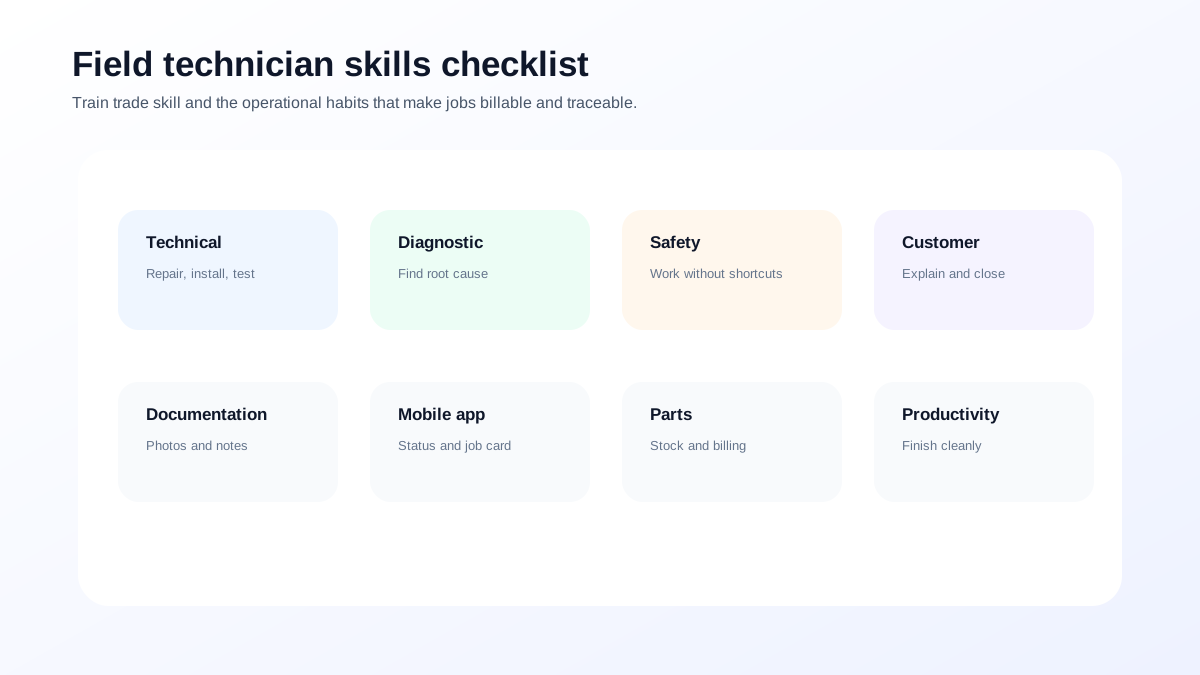 Field technician skills matrix showing technical, diagnostic, safety, customer, documentation, mobile app, parts, and productivity skills
Good technician training should cover field behavior, not only repair skill.
Field technician skills matrix showing technical, diagnostic, safety, customer, documentation, mobile app, parts, and productivity skills
Good technician training should cover field behavior, not only repair skill.
What skills do field technicians need?
Field technicians need eight skill groups.
First, technical repair skill. This is the core trade skill: AC repair, RO service, CCTV installation, electrical diagnosis, appliance repair, pest control process, fire safety inspection, or facility maintenance.
Second, diagnostic skill. A technician must find the real cause, not only treat the symptom. This reduces repeat visits.
Third, customer communication. The technician represents the brand at the site. Clear explanation, polite behavior, and transparent updates matter.
Fourth, safety discipline. Technicians work with electricity, ladders, chemicals, tools, equipment rooms, rooftops, and customer homes. Safety cannot depend on memory.
Fifth, mobile app discipline. A modern technician should know how to open an assigned job, update status, add photos, complete a checklist, record parts, and close the job.
Sixth, parts accountability. If parts are used but not recorded, revenue and stock accuracy suffer.
Seventh, time management. Service teams need technicians who can finish jobs without unnecessary delay and move to the next assignment.
Eighth, documentation discipline. Photos, notes, customer approval, and payment status protect the business.
What are the top technical skills?
The top technical skills depend on the service industry, but most field teams should train:
- equipment diagnosis;
- tool handling;
- basic electrical and safety understanding;
- part identification;
- installation or repair process;
- preventive maintenance;
- test and verification;
- service report writing.
Do not stop at technical work. A technically strong technician who does not record parts, status, or customer approval still creates operational leakage.
What are the 7 technical skills?
For field service teams, a useful seven-skill model is:
- Diagnosis.
- Repair or installation.
- Safety.
- Tools and equipment handling.
- Parts identification.
- Testing and verification.
- Digital job documentation.
KaryaFlow supports the seventh skill by making the mobile job card part of normal field work.
Is a field tech a hard job?
Yes, field technician work can be hard because the technician works outside a controlled office environment. They deal with travel, customer expectations, missing information, emergency calls, physical work, weather, tools, parts, and documentation.
That is why management systems matter. Good software cannot replace skill, but it can reduce confusion:
- job details are clear;
- location and route are visible;
- parts and service history are available;
- proof is captured at the site;
- payment and billing handoff are not left to memory.
How to train field technicians
Use a simple training plan.
Week 1: Teach job status, attendance, and service report basics.
Week 2: Teach photo proof, checklist discipline, and customer approval.
Week 3: Teach parts recording, expenses, and payment status.
Week 4: Review repeat visits, customer complaints, and missing proof.
The goal is not classroom training alone. The goal is field behavior that appears in the job record.
How to score technician skills fairly
Do not score field technicians only by manager opinion. Score visible behavior from real jobs.
A fair skill scorecard should include:
- diagnosis quality;
- repair or installation quality;
- safety compliance;
- customer communication;
- punctuality and route discipline;
- mobile job card completion;
- photo and checklist quality;
- parts recording;
- expense discipline;
- payment status updates;
- repeat complaint history;
- willingness to learn.
This helps owners separate different problems. A technician may be technically strong but weak at documentation. Another may communicate well but need training in diagnosis. A third may finish jobs quickly but create repeat visits because they skip verification.
The right action is different for each technician. One person needs mobile workflow coaching. One needs technical supervision. One needs route planning support. One needs customer communication training.
What are common field technician training gaps?
Most service businesses train repair steps, but they undertrain the operating workflow around the repair.
Common gaps include:
- technicians do not update job status on time;
- job closure notes are too short;
- photos are missed or uploaded after the visit;
- parts are used but not recorded;
- payment collection is not tied to the job;
- customers do not get clear arrival or delay updates;
- repeat issues are handled without root-cause notes;
- expenses are submitted without job context;
- safety checks are treated as optional;
- managers cannot see who needs coaching.
These gaps create office workload. The back office must call technicians, reconstruct job history, chase payment status, ask for photos, update inventory manually, and answer customer complaints without a clean record.
How to build a 30-day technician skill improvement plan
Start with one behavior per week.
In week one, fix job acceptance and status updates. Every technician should know how to accept a job, mark travel, mark arrival, and update completion.
In week two, fix proof of work. Require photos, checklist answers, notes, customer acknowledgement, and clear closure remarks.
In week three, fix parts and payment status. Train technicians to record parts used, collect or mark payment status, and avoid leaving accounts with incomplete information.
In week four, review performance. Compare repeat visits, missing proof, delayed jobs, complaints, and attendance patterns. Use this review for coaching, not only discipline.
This is how skill training becomes daily operations rather than a one-time classroom activity.
How KaryaFlow helps track technician skills
KaryaFlow helps managers see technician behavior through real work:
- Did the technician accept and update assigned jobs?
- Did they arrive on time?
- Did they capture proof?
- Did they record parts?
- Did they mark payment status?
- Did the job need a revisit?
- Did customers complain repeatedly?
This turns skill management from opinion into operational evidence.
FAQ
What skills do field technicians need?
Field technicians need technical skill, diagnosis, safety, customer communication, mobile app usage, parts accountability, time management, and documentation discipline.
What are the top 5 technical skills?
The top five are diagnosis, repair or installation, safety, tool handling, and testing or verification. For service businesses, digital job documentation should be treated as a sixth operational skill.
What are the top 3 tech skills?
The top three are diagnosis, repair execution, and verification. If the repair is not verified and documented, the office cannot fully trust the closure.
How does KaryaFlow help with technician skills?
KaryaFlow helps by giving technicians structured job cards, checklists, photos, parts records, payment status, and job closure steps, so managers can train and review real field behavior.
Sources checked
- KaryaFlow homepage
- Microsoft Learn: Overview of Dynamics 365 Field Service
- Salesforce Field Service Management
- People Also Ask export supplied by the KaryaFlow team on June 27, 2026
Ready to modernize your service operations?
See how KaryaFlow can connect complaints, technician jobs, proof, parts, payments, and billing handoff for your service team.
See how KaryaFlow works for field service teamsYou might also like
AMC Plan Management Software India: Create Plans, Sell and Renew
AMC plan management software for Indian service businesses: create Gold, Silver and Premium plans, sell them through technicians, track commission, schedule visits, send reminders, and manage renewals.
Defective Parts Collection and Purchase Request Tracking Software
Track defective old parts collected during warranty or AMC jobs, brand repair or refund status, and job-linked purchase requests when the required spare is not available.
Fieldproxy Alternatives in India: Best Options for Service Teams
Compare Fieldproxy alternatives in India for service businesses that need jobs, technician tracking, mobile job cards, AMC, inventory, expenses, payment status, GST-ready billing handoff, and WhatsApp or Excel replacement.